The problem
Selling on a pan-African marketplace means running your real business inside somebody else's seller portal. Orders appear there. Stock is managed there. Commission, fulfilment fees and returns are deducted there, and what finally lands in your bank is a net settlement that bears no obvious relationship to the gross value of the orders you shipped.
Sellers who have grown into NetSuite hit the same wall. The marketplace is a material share of revenue, but it is the one channel with no integration path, so it stays on exports and spreadsheets. Someone downloads the order report, someone else keys the orders in, and stock levels in the seller portal are updated by hand from a NetSuite saved search — usually late, sometimes wrong, and always after the item has already oversold.
Multi-country operations make it worse. A seller live in several African markets is running several seller accounts, several currencies and often several legal entities. Each one gets its own spreadsheet. Reconciling a payout against the orders it covers becomes a week of work that nobody has the appetite to do properly, so gross margin by channel becomes an estimate rather than a number.
What ECOSIRE builds
ECOSIRE builds a connector that lives inside your NetSuite account as an SDF project, delivered as an unmanaged bundle you own. It talks directly to the marketplace seller APIs your account is entitled to use, with your own credentials.
Order import
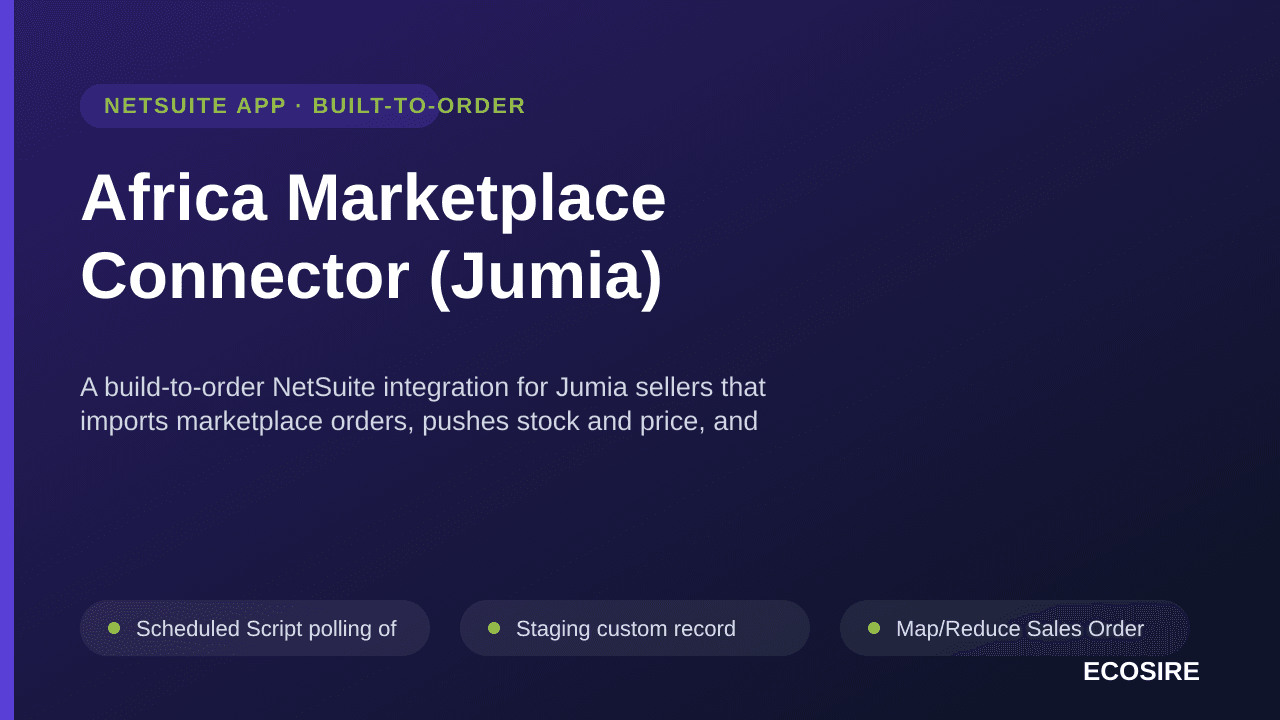
A Scheduled Script polls the marketplace seller order endpoint on the interval you choose, per seller account and per country. Each order is written to a staging custom record (customrecord_eco_jm_order_stage) with the raw payload, the marketplace order number, the country code, the seller account and a processing status. A Map/Reduce script then drains that queue and creates Sales Orders.
Marketplace order numbers are stored on a custom body field and checked with a saved search before creation, so re-polling the same page never produces a duplicate transaction. Order line items carry the marketplace item identifier so a later status change can be applied to the right line rather than the whole order.
Multi-country and multi-entity structure
Each seller account maps to a subsidiary, currency, location, department, class and customer form through a configuration custom record. In OneWorld accounts this means orders from different African markets land in the correct legal entity with the correct currency and the correct nexus, instead of being flattened into a single subsidiary and untangled later. A custom segment for marketplace and country can be applied to every line so channel reporting works without building parallel saved searches for each market.
Order status lifecycle
Marketplace orders move through states — pending, ready to ship, shipped, delivered, cancelled, returned — and those states matter for revenue. A Scheduled Script pulls status changes and drives the corresponding NetSuite action: creating Item Fulfilments when items ship, closing lines when the marketplace cancels them, creating Return Authorisations and Credit Memos when items come back. A SuiteFlow workflow governs which transitions are allowed so a late status update cannot reopen a closed period's transaction.
Stock and price push
A Scheduled Script pushes available quantity to each seller account from an Inventory Item saved search, netting out locations and quantity-committed as you configure. Sellers running shared stock across multiple markets can allocate a percentage or a fixed reserve per country rather than exposing the same pool everywhere and overselling. Price pushes run from a nominated price level or currency-specific price, so a price change made once in NetSuite reaches every market.
Fees, commission and settlement reconciliation
This is where marketplace selling usually breaks. The connector imports the marketplace fee and commission lines against each order and posts them to the expense accounts you nominate, so the Sales Order shows gross revenue and the fees appear as costs rather than being quietly netted out of the sale. Settlement or payout statements are imported into a custom record and matched to the underlying orders and fees, producing a reconciliation saved search that shows exactly which orders make up a given bank deposit. Unmatched amounts are flagged rather than forced.
Fulfilment models
Marketplaces run both seller-fulfilled and marketplace-fulfilled models, and they behave very differently in an ERP. Seller-fulfilled orders drive Item Fulfilment from your own location and push tracking back to the marketplace. Marketplace-fulfilled orders need stock recognised at a marketplace-controlled location, with transfers in and reconciliation against the marketplace's own stock report. Which of these we build is a scoping decision based on how you actually operate.
Who this is for
Formal-sector sellers with real volume across one or more African markets who have outgrown the seller portal as a system of record. Typically a distributor, importer or brand owner running NetSuite as the operational and financial backbone, with a finance team that needs channel-level margin and a clean settlement reconciliation, not an export.
How delivery works
Scoping call. We review your seller account structure, which countries and currencies you operate in, your API access and entitlements, your fulfilment model, your NetSuite subsidiary structure and how you want fees and settlements to post.
Fixed quote. You receive a written scope listing the record mappings, scripts, countries and acceptance tests. The price is fixed for that scope; anything added later is quoted separately.
Build. ECOSIRE develops the connector as an SDF project under version control. Typical lead time is two to four weeks from a signed scope, extending where multiple countries, entities or both fulfilment models are in play.
Install in sandbox. We deploy to your sandbox first, run real historical orders and a real settlement statement through it, and review the output with your finance team line by line before anything touches production.
Install in production. After sign-off the same bundle goes to production, configuration is completed, deployments are enabled and we monitor the first live polling cycles with you.
Support. A defect-fix support window runs from go-live against the agreed scope. Extended support and enhancements are quoted separately.
What you should know before you buy
This is build-to-order work. Nothing is pre-built and there is no instant download. The connector also depends on your own marketplace seller API access — the endpoints, rate limits and data fields available to your seller account determine what can be automated. We verify your entitlements during scoping and design to what your account can actually do, rather than promising behaviour the marketplace does not expose.