 Illustrative preview
A build-to-order Dynamics 365 Business Central AL extension that runs your loan book inside the ERP
— loan products and repayment schedules, disbursement workflows, collections and overdue ageing buckets, provisioning views and portfolio reporting.
ECOSIRE builds, installs and supports it after you request a quotation.
What is Microfinance & Lending Operations?
A build-to-order Dynamics 365 Business Central AL extension that runs your loan book inside the ERP — loan products and repayment schedules, disbursement workflows, collections and overdue ageing buckets, provisioning views and portfolio reporting. ECOSIRE builds, installs and supports it after you request a quotation. Built to order by ECOSIRE for Dynamics 365 BC (build-to-order) — indicative price from $999.00 USD; request a quote for a scoped proposal.
Key Features
Built to order, done for you
No DIY setup — a working app, built, installed and supported by ECOSIRE.
- 1
You order
Start with a one-time build price. We scope it with you at kickoff.
- 2
We build & install
ECOSIRE builds, configures and installs it on your Dynamics 365 Business Central.
- 3
Go live + support
You go live in about one working week, with two weeks of go-live support. Defects in the code we deliver are fixed free of charge.
About this Product
Microfinance institutions and small lenders almost always end up running the loan book somewhere other than the ERP. Business Central handles the general ledger, the bank accounts, the payment journals and the statutory reporting well — but it has no concept of a loan product, an amortisation schedule, a disbursement tranche, a PAR-30 bucket or a provisioning stage. Teams bridge the gap with spreadsheets: one workbook for schedules, another for arrears ageing, a third for the provision matrix that finance types into a manual journal at month end. The result is a loan portfolio the CFO cannot reconcile to the trial balance without a two-day exercise, and a collections team working from a file that was correct yesterday morning.
Business Central's native building blocks run out of road quickly here. Customer ledger entries and a Payment Terms code can express "due in 30 days" but not a 24-instalment declining-balance schedule with a grace period, a processing fee capitalised at disbursement and a penalty rate that starts on day 8 of delinquency. Dimensions can tag a branch or a loan officer but cannot carry the state machine a loan moves through — applied, approved, disbursed, current, in arrears, restructured, written off. And nothing in the standard product produces the reports a lender actually lives on: portfolio at risk by ageing band, disbursement and collection volumes by product and branch, expected credit loss staging.
What we build is a per-tenant AL extension (or an AppSource-shaped app where you prefer that packaging) that adds the lending domain to Business Central as first-class data rather than as a bolted-on interface. New tables carry Loan Product, Loan, Loan Schedule Line, Loan Transaction and Collection Entry; table and page extensions add borrower attributes and a Loans FactBox to the Customer card so a loan officer never leaves the record they are already on. Schedule generation, interest accrual, penalty calculation and provisioning live in codeunits, not in page code, so the same logic serves the UI, the job queue and the API. Posting is done through Business Central's own general journal posting routines with configurable posting groups per loan product, which is what makes the portfolio reconcile to the GL by construction instead of by reconciliation. Event subscribers hook the standard payment application and customer posting events, so a cash receipt applied against a borrower is allocated across penalty, interest and principal in your defined waterfall.
Operationally it runs on the platform's own plumbing. Nightly accrual, ageing reclassification and provisioning runs are Job Queue Entries with their own error handling and retry, so nothing depends on someone remembering to open a page. API pages exposed over REST API v2.0 / OData v4 let a mobile field-collection app, a payment-gateway callback or a credit bureau integration read and write loans without screen scraping — and the same endpoints feed Dataverse and the Power Platform if you want Power BI portfolio dashboards or a Power App for field officers. Dedicated permission sets separate the loan officer who originates from the credit committee that approves and the finance user who posts, and every state transition is written to an audit trail. The extension targets current Business Central release waves and works on both SaaS online and on-premises deployments.
Delivery is build-to-order. Nothing here is a download you buy today and install this afternoon: we start with a scoping call, confirm your loan products, interest methods, penalty and waterfall rules, ageing bands and provisioning matrix in a written scope, then build against your Business Central version. Typical delivery is one working week from confirmed scope, depending on how many products and integrations are in play. You get the compiled app plus the AL source, deployment into a sandbox for UAT before anything touches production, a documented and rehearsed rollback, and a git repository handover so the code is yours to maintain or extend with any AL developer.
What you get
- Full AL extension source code plus the compiled `.app` package, built and tested against your specific Business Central version (SaaS online or on-premises)
- Installation and configuration on your environment — loan products, posting groups, ageing bands, provisioning matrix and permission sets set up with your team, not left as blank tables
- Technical documentation: object ID ranges, table and codeunit reference, event subscriber list, API page endpoints with sample payloads, and documented extension points for future work
- End-user guide and a live training session for loan officers, collections staff and finance, recorded so new joiners can be onboarded without re-booking us
- UAT on a sandbox environment with your own data before any production deployment, plus a written and rehearsed rollback plan
- Post-go-live support window covering defect fixes, configuration adjustments and questions from your team
- Git repository handover — full commit history, branches and build pipeline transferred to your organisation so any AL developer can maintain or extend the code
- Data migration assistance for an existing loan book from spreadsheets or a legacy lending system, including opening-balance reconciliation to your GL control accounts
Who this is for
Head of Operations, microfinance institution
Runs a branch network where loan officers originate and collect, and today reconciles three spreadsheets against Business Central every month. Needs disbursements, repayments and arrears in one system with branch and officer visibility, so the daily collections list is the same number the CFO reports.
Finance Manager / CFO of a lending business
Owns the trial balance and the provision. Needs interest accrual, fee recognition and provisioning to post through Business Central's own G/L routines with auditable posting groups, so the loan portfolio ties to the ledger without a manual bridging journal and the auditor's sample traces end to end.
Credit / Risk Manager
Answers to a board or a funder on portfolio quality. Needs PAR by ageing bucket, product and branch computed the same way every month, drill-through to the individual loans behind any number, and provisioning stages that follow a documented matrix rather than an analyst's spreadsheet.
IT Manager or Business Central partner-side lead
Owns the tenant and worries about upgrade safety. Needs a properly structured AL extension — no base-object modification, clean object ID range, event subscribers rather than overrides, a documented API surface — that survives Microsoft's release waves, and wants the source code in their own repository.
How Microfinance & Lending Operations Compares
| Criterion | ECOSIRE | Custom Build | Competitor | Dynamics 365 Business Central Native |
|---|---|---|---|---|
| Time to a working loan book | one working week from confirmed scope, built and configured to your products | Months of internal analysis, build and rework — the lending domain is larger than it first looks | Installable in a day, then weeks bending your rules to fit its assumptions | Never — Business Central has no loan, schedule or arrears concept to configure |
| Fit to your interest methods and penalty rules | Built to the flat, declining-balance or fixed-instalment methods and waterfall you actually use | Exactly your rules, if the spec is right first time and the developer knows lending | Whatever the vendor's target market needed; anything else is a change request or impossible | Payment Terms and finance charge terms only — no amortisation schedule at all |
| GL reconciliation | Posts through standard journal routines with per-product posting groups; portfolio ties to the trial balance by construction | Depends entirely on whether the developer used posting routines or wrote G/L entries directly | Usually sound, but posting-group mapping is fixed to the vendor's chart-of-accounts assumptions | Customer ledger only — the loan book lives in spreadsheets, bridged by a manual journal |
| Portfolio at risk and provisioning | Configurable ageing bands, PAR by product/branch/officer with drill-through, provisioning matrix proposing a reviewable journal | Buildable, but usually the last thing built and the first to fall behind the board's questions | Fixed bucket definitions and provision logic; regulator-specific bands often need vendor work | Aged Accounts Receivable report only — no PAR, no buckets by loan product, no provision staging |
| Source code and ownership | Full AL source plus git repository handover — maintain in-house or with any AL developer | You own it, along with the knowledge risk when the developer who wrote it leaves | Compiled app only; dependent on the vendor's roadmap and continued existence | Microsoft's code — not extensible into lending without an extension anyway |
| Upgrade safety across release waves | Table/page extensions and event subscribers, no base-object modification; tested against current release waves | Varies — DIY builds are where base-object overrides and brittle patterns creep in | Generally upgrade-safe, though vendor lag after a release wave is common | Nothing to break, and nothing that solves the problem |
| Integration surface | API pages on REST API v2.0 / OData v4 for loans, schedules and repayments; Dataverse and Power Platform ready | Only what you find time to expose, usually after the UI work is finished | The vendor's chosen endpoints; anything unanticipated needs an escalation | Standard BC APIs cover customers and journals, but there is no loan entity to expose |
| Ongoing cost shape | One build cost, then an optional support retainer — no per-user licence on top of Business Central | Developer salary or agency day rate for as long as the code lives | Recurring per-user or per-loan subscription that scales with your growing book | No extra cost, and no capability |
Frequently Asked Questions about Microfinance & Lending Operations
How long does delivery take?
This is build-to-order, not an instant download. Typical delivery is one working week from confirmed scope. The clock starts once we have agreed in writing which loan products, interest methods, penalty rules, repayment waterfall, ageing bands and provisioning matrix you need — not from the day you request a quotation. Scope with several loan products, migration of an existing loan book, or an integration to a payment gateway or credit bureau sits at the longer end. We give you the estimate before you commit, and we tell you if a later request would push past it.
Is this available on Microsoft AppSource today?
No. We build it for you. The extension is written against your Business Central version and configured to your lending rules, and is normally deployed as a per-tenant extension. If you specifically want it packaged as an AppSource-shaped app for your own tenant governance, we can build it that way — but you are commissioning a build, not downloading an existing listing.
Does it work on Business Central online (SaaS) as well as on-premises?
Yes. It is a standard AL extension targeting current Business Central release waves and runs on both. On SaaS it deploys as a per-tenant extension through the admin centre; on-premises it is published to your service tier. There is no code modification of Microsoft base objects — we use table extensions, page extensions and event subscribers — so monthly service updates and the twice-yearly release waves do not break it.
How does it keep the loan portfolio reconciled to the general ledger?
All money movement — disbursements, fee recognition, interest accrual, repayments, penalties and provision proposals — posts through Business Central's own journal posting routines using posting groups configured per loan product. Nothing writes G/L entries by a side door. The sum of outstanding principal in the loan tables therefore agrees to the control accounts by construction, and an auditor can trace any loan transaction to its G/L entry and back.
What about support and updates after go-live?
Every build includes a post-go-live support window agreed at scoping, covering defect fixes, configuration adjustments and questions from your team. After that you can take a support and maintenance retainer with us, or maintain it yourself — you hold the full AL source and the git repository, so you are not locked in. When Microsoft ships a new release wave we test compatibility for retainer clients and advise on anything needing attention; clients without a retainer can commission a compatibility pass as a small piece of work.
Can it integrate with mobile collection apps, payment gateways or a credit bureau?
Yes. Loans, schedules, repayments and disbursements are exposed as API pages over REST API v2.0 / OData v4, so a field-collection app or a payment-gateway callback reads and writes real records with proper authentication and permission checks. The same endpoints connect to Dataverse and the Power Platform for Power BI portfolio dashboards or a Power App for officers. Named third-party integrations — a specific mobile money provider or bureau — are scoped and priced as part of the build, since each has its own API contract.
Can we migrate an existing loan book into it?
Yes, and it is a normal part of scope. We import loans with their current outstanding principal, remaining schedule, arrears position and ageing status, then reconcile the imported balances to your existing GL control accounts before you go live. Migrating from spreadsheets is usually straightforward; migrating from a legacy lending system depends on what export it offers, which we assess during scoping.
Related Modules
Memorial & Funeral Services Management
A Business Central extension that runs the whole funeral home operation — case file intake, arrangement conferences, service and merchandise selection, facility and staff scheduling, regulatory paperwork and family statements — on one record. Built to order by ECOSIRE for your Business Central tenant and your jurisdiction's rules.
Mercado Libre Connector for Business Central
A per-tenant AL extension that connects Mercado Libre (LATAM) listings, orders and Mercado Envíos fulfillment with Dynamics 365 Business Central — built, installed and supported by ECOSIRE on your tenant.
Multi-Country E-Invoicing Compliance Hub for Business Central
One configurable AL engine that generates and exchanges compliant e-invoices (UBL, CII, Peppol, FatturaPA, XRechnung, GCC) across 30+ countries from inside Business Central. Built, deployed as a per-tenant extension and supported by ECOSIRE.
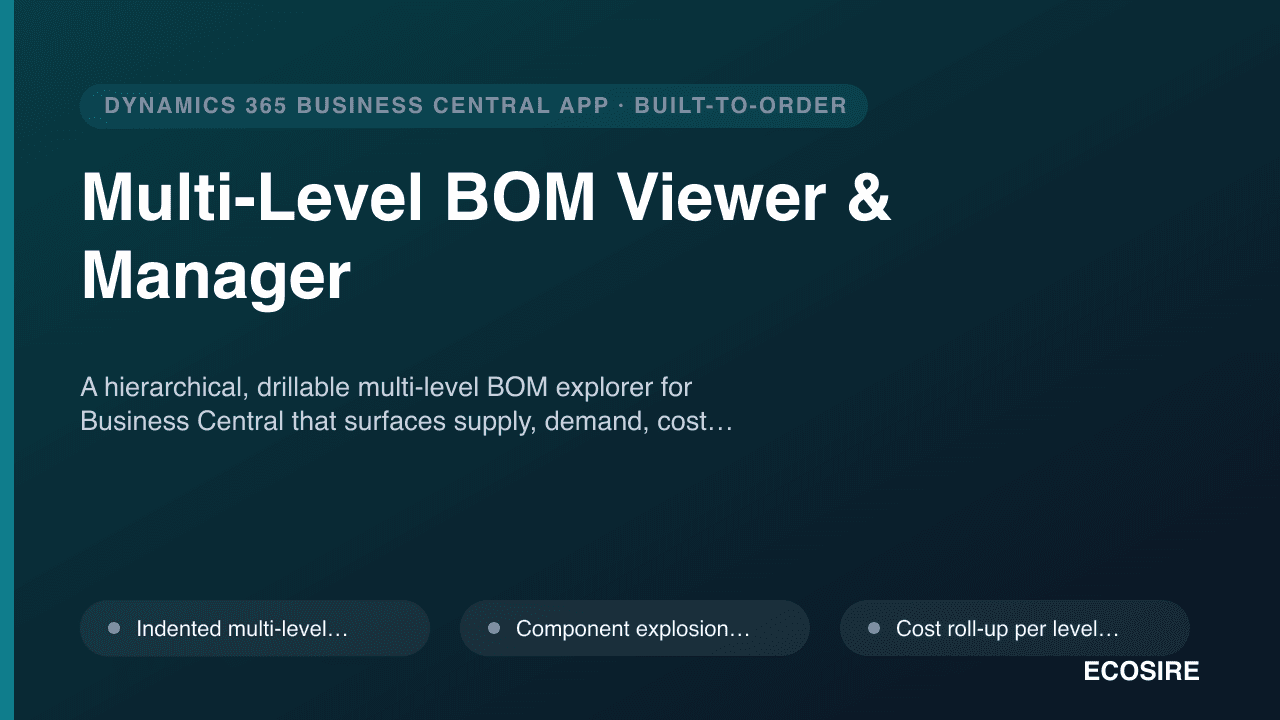
Multi-Level BOM Viewer & Manager
A hierarchical, drillable multi-level BOM explorer for Business Central that surfaces supply, demand, cost roll-ups, and can-build feasibility at every level of the product structure — built and installed by ECOSIRE as a per-tenant AL extension.
Microfinance & Lending Operations
A build-to-order Dynamics 365 Business Central AL extension that runs your loan book inside the ERP — loan products and repayment schedules, disbursement workflows, collections and overdue ageing buckets, provisioning views and portfolio reporting. ECOSIRE builds, installs and supports it after you request a quotation.
- Loan Product setup table defining interest method (flat, declining balance, or reducing with fixed instalment), term, grace period, fee schedule and posting groups per product
- Amortisation schedule generation in a codeunit, producing `Loan Schedule Line` records with principal/interest split, due dates and running balance, regenerable on restructure
- Disbursement workflow with configurable approval steps, single or tranche disbursement, and posting through Business Central payment journals to the borrower's bank or cash account
- Fee handling at origination — deducted from disbursement, capitalised into principal, or invoiced separately — each with its own G/L posting setup