NetSuiteSaaS Tools

NetSuite to ERPNext Migration Bridge

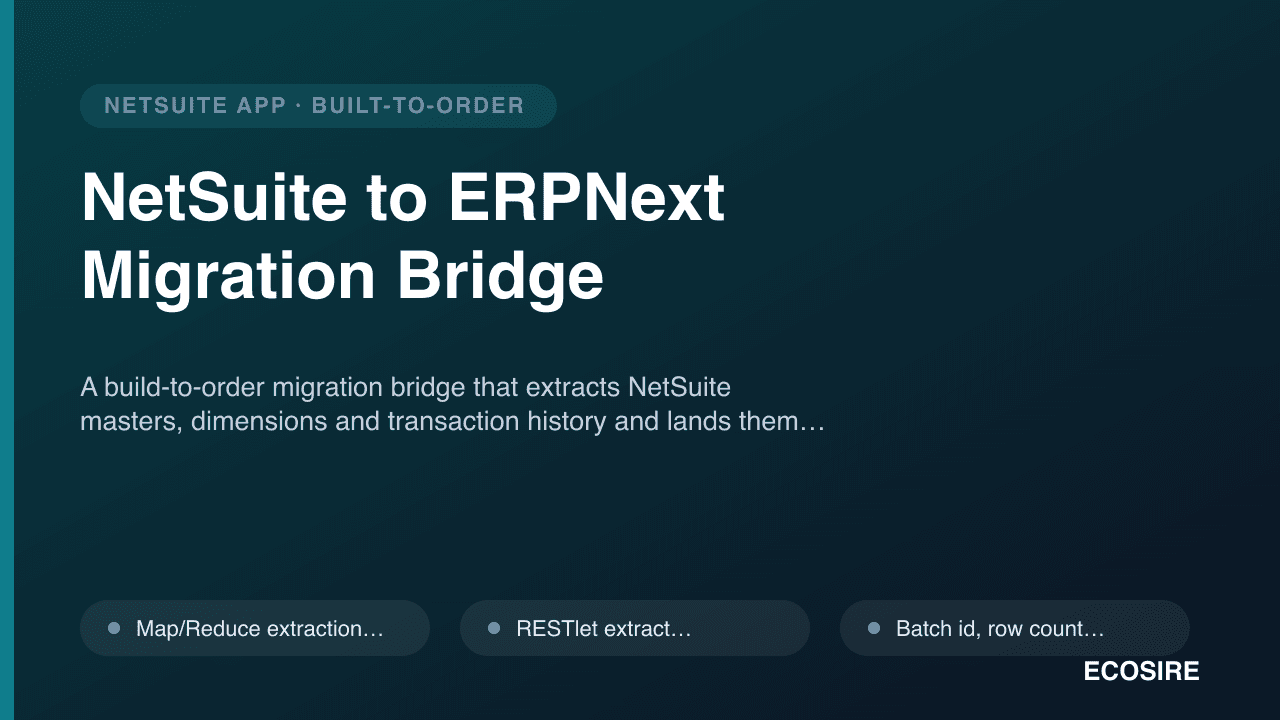
A build-to-order migration bridge that extracts NetSuite masters,

dimensions and transaction history and lands them in ERPNext with reconciliation on both sides.

ECOSIRE builds both ends after a fixed quote.

Built to order

What is NetSuite to ERPNext Migration Bridge?

A build-to-order migration bridge that extracts NetSuite masters, dimensions and transaction history and lands them in ERPNext with reconciliation on both sides. ECOSIRE builds both ends after a fixed quote. Built to order by ECOSIRE for Oracle NetSuite (build-to-order) — indicative price from $1499.00 USD; request a quote for a scoped proposal.

NetSuite to ERPNext Migration Bridge — A build-to-order migration bridge that extracts NetSuite masters, dimensions and transaction history and lands them in ERPNext with reconciliation on both sides

What we build

  • Map/Reduce extraction engine running saved searches across masters, dimensions and all transaction types with deterministic, versioned output
  • RESTlet extract endpoint secured by token-based authentication against a read-scoped integration role
  • Batch id, row count and control totals stamped on every extract so both sides can be proven equal
  • Subsidiary to ERPNext Company mapping, including multi-entity groups migrating into one ERPNext instance
  • Department, class, location and custom segment mapping to ERPNext Cost Center, Department, Warehouse or custom Accounting Dimensions
  • Chart of accounts extraction with account type, parent hierarchy and subsidiary restriction, mapped into the ERPNext Account tree
  • Item extraction across inventory, non-inventory sale, service, assembly and kit types, mapped to ERPNext Item stock, asset and BOM flags
  • Open AR and AP extracted with original dates, terms and payment applications, loaded as Sales Invoice and Purchase Invoice with matching aging
  • Historical GL extracted and loaded as period-batched Journal Entries, with intercompany handling for OneWorld accounts
  • Inventory quantity and valuation extracted by item and location, loaded to ERPNext warehouses with stock value preserved
  • Idempotent ERPNext insert keyed on NetSuite internal id, so a re-run updates instead of duplicating
  • Paired reconciliation reports — NetSuite saved searches against ERPNext queries — with a variance report citing the source internal id

About this Product

The problem

Leaving NetSuite is harder than arriving. The subscription is annual, so the exit window is fixed, and everything you need has to come out cleanly before it closes.

The data model does not translate one-to-one. NetSuite's subsidiary, department, class, location and custom segment structure has to collapse into ERPNext's Company, Cost Center, Department and Dimension model, and there is no automatic mapping — someone has to make a decision per value. Item types diverge: NetSuite inventory, non-inventory sale, service, assembly and kit items become ERPNext Items with is_stock_item, is_fixed_asset and BOM structures set accordingly. Tax handling is structurally different. Naming series, fiscal years and account trees have to exist in ERPNext before a single transaction can be inserted, and ERPNext validates aggressively on insert, so a bad row does not land quietly — it aborts.

Meanwhile the extraction side has its own trap. Pulling several years of transactions out of NetSuite through saved-search exports by hand produces files nobody can reconcile, misses applied payments and partial applications, and cannot be repeated identically for a rehearsal.

What ECOSIRE builds

ECOSIRE builds both halves of the bridge: a SuiteScript 2.1 extraction toolkit inside your NetSuite account, and the matching ERPNext-side import and reconciliation layer. We already build and sell on the ERPNext side, so the target is not guesswork. This is build-to-order — scoped, quoted, then built for your specific NetSuite configuration and your ERPNext instance.

NetSuite-side extraction

A Map/Reduce extraction engine runs saved searches over each object set and writes deterministic, versioned extract files: customers, vendors, contacts, employees, items, the chart of accounts, subsidiaries, departments, classes, locations and custom segment values, then transactions — invoices, credit memos, customer payments and applications, vendor bills, vendor credits, bill payments, journal entries, sales orders, purchase orders, item receipts and fulfilments, and inventory quantity and cost by item and location. Extracts are exposed through a RESTlet under token-based authentication so the ERPNext side pulls them on a schedule instead of a human emailing zip files. Every extract carries a batch id, row counts and control totals so the two sides can be proven equal.

Mapping layer

Mapping lives in editable records on both sides rather than in code. NetSuite subsidiary maps to ERPNext Company. NetSuite department, class, location and custom segments map to ERPNext Cost Center, Department, Warehouse or custom Accounting Dimensions — your choice per value. NetSuite account internal ids map to the ERPNext Account tree with the right root type and account type. Item types map to ERPNext Item with the correct stock, asset and BOM flags. Tax codes map to ERPNext Tax Templates. Because it is data, revising a decision on the third rehearsal is a re-run, not a rebuild.

ERPNext-side load

The ERPNext side inserts through the Frappe API with per-document validation and idempotency keyed on the NetSuite internal id, so a re-run updates rather than duplicates. Loads run in dependency order — Company, fiscal year, account tree, dimensions, naming series, then masters, then opening balances, then transactions. Open AR and AP land as real Sales Invoice and Purchase Invoice documents with original posting dates and their payment applications, so ERPNext aging matches what NetSuite showed. Historical GL loads as period-batched Journal Entries. Stock lands with quantity and valuation by warehouse. Failed documents are captured with the ERPNext validation message and the originating NetSuite internal id rather than being skipped silently.

Reconciliation on both sides

We produce a matched pair of reports: NetSuite saved searches for trial balance by account and period, AR aging, AP aging and inventory value, and equivalent ERPNext queries. A variance report lists each difference with the NetSuite internal id so you trace it back to the exact source record. You sign off on numbers, not impressions.

Exit discipline

The extraction toolkit is yours and runs while your NetSuite subscription is live, so you can take a final complete extract before the account is decommissioned — including years you do not intend to load into ERPNext but must retain for audit. We deliver that archive alongside the migration.

Who this is for

Companies that have decided to move off NetSuite for cost or fit reasons and need the history to come with them: typically mid-market distribution, manufacturing, services and multi-entity groups where NetSuite's licensing has outgrown the value delivered. It also fits partial moves, where some entities go to ERPNext while others stay on NetSuite during a transition — the extraction side supports repeated incremental runs.

How delivery works

1. Scoping call. We review your NetSuite account structure — subsidiaries, segments, item types, transaction volumes and years of history — and your target ERPNext version, hosting and any existing configuration or apps in place. 2. Fixed quote. You receive a fixed-price quote covering the object set, the number of rehearsals, and the cutover window. 3. Build. ECOSIRE develops the SuiteScript 2.1 extraction toolkit — Map/Reduce scripts, saved searches, RESTlets, custom records and an integration role — and the matching ERPNext import and reconciliation layer. 4. Install in test. The NetSuite side deploys to your sandbox as an SDF project or unmanaged bundle; the ERPNext side deploys to a staging site. We run a full rehearsal at production volume and produce the paired reconciliation pack. 5. Production. After sign-off on the rehearsal reconciliation, we run the production extract and load in your agreed cutover window, with a documented rollback position. 6. Support. A post-cutover support window covers reconciliation questions, remedial batches and adjustments found during your first close in ERPNext.

Lead time is typically one working week from signed quote to the first rehearsal, depending on how many entities and years are in scope.
How delivery works

  1. 1

    Scoping call

    A short call to confirm the workflow, your platform version and where the integration boundaries sit.

  2. 2

    Fixed quote

    You receive a written scope and a fixed price. Nothing is built until you approve it.

  3. 3

    Build and test

    We develop against a copy of your configuration and test it there. Typically two to four weeks.

  4. 4

    Install and support

    We install on your instance, hand over the source, and include two weeks of go-live support. Defects in the code we deliver are fixed free of charge.

What you get

  • Complete SuiteScript 2.1 extraction toolkit — Map/Reduce scripts, saved searches, RESTlets, custom records and integration role — as an SDF project you own
  • The matching ERPNext-side import and reconciliation layer, installed on your staging site and then production
  • Unmanaged bundle installation in your NetSuite sandbox, followed by production after sign-off
  • At least one full rehearsal at production volume with the paired reconciliation pack: trial balance, AR aging, AP aging, inventory value and variance report
  • A complete final archive extract of your NetSuite data, including years not loaded into ERPNext, taken before the account is decommissioned
  • Migration runbook covering extract sequencing, ERPNext load dependency order, validation error resolution and batch re-run
  • Training for your finance and administrator team on both sides, plus a post-cutover support window through your first close in ERPNext

Who this is for

Chief Financial Officer

Is driving the move for cost reasons and needs certainty that the opening position in the new system matches the closing position in the old one before approving the switch. The paired reconciliation pack gives a signed-off trial balance, aging and inventory comparison rather than an assurance.

IT Director

Faces a hard subscription renewal date and knows that once NetSuite is decommissioned, anything left behind is gone. The extraction toolkit runs while the subscription is live and produces a complete final archive, including history not loaded into ERPNext but required for audit.

ERPNext Implementation Lead

Has to stand up Company, fiscal years, account tree, dimensions and naming series before any transaction can be inserted, and gets aborted imports when a dependency is missing. The load runs in enforced dependency order with per-document validation messages tied back to the NetSuite internal id.

How NetSuite to ERPNext Migration Bridge Compares

CriterionECOSIRECustom BuildCompetitorNetSuite Native
Automated NetSuite-side extraction of masters and transactionsIncludedPartial supportPartial supportPartial support
Segment to ERPNext dimension mapping decided per valueIncludedPartial supportNot includedNot included
Open AR and AP loaded with payment applications and correct agingIncludedPartial supportNot includedNot included
Idempotent ERPNext load keyed on NetSuite internal idIncludedPartial supportNot includedNot included
Paired reconciliation reports on both systemsIncludedNot includedNot includedNot included
Inventory quantity and valuation by warehouse preservedIncludedPartial supportPartial supportNot included
Complete archive extract of non-migrated history before decommissionIncludedPartial supportNot includedPartial support
Phased, per-subsidiary incremental migration supportedIncludedPartial supportNot includedNot included

Frequently asked questions

Can we buy this and start migrating this week?
No — it is build-to-order. The mapping between your NetSuite segment structure and your ERPNext dimension model is the substance of the work, and it does not exist until we have looked at your account. After a scoping call we issue a fixed quote and build both sides. Typical lead time is one working week from signed quote to the first rehearsal, with the cutover date set around your close calendar and your NetSuite renewal.
Which NetSuite and ERPNext versions are supported?
NetSuite: current releases running SuiteScript 2.1, standard or OneWorld, with SuiteCloud Development Framework, token-based authentication and the SuiteScript and REST Web Services features enabled. The extraction role needs read access to the records in scope. ERPNext: current supported versions on the Frappe framework, self-hosted or on your chosen hosting. We confirm the exact target version during scoping because Frappe validation behaviour differs between major versions, and we build the loader against the version you will actually run.
How do NetSuite subsidiaries, departments, classes and custom segments map to ERPNext?
Subsidiary normally maps to ERPNext Company, so a OneWorld group becomes a multi-company ERPNext instance. Department, class, location and custom segments map to Cost Center, Department, Warehouse or custom Accounting Dimensions — the decision is made per value, not per type, because in most accounts these fields have been used for more than one purpose over the years. Every mapping lives in an editable record, so revising a decision after a rehearsal is a re-run rather than a rebuild.
What happens to data we do not load into ERPNext?
It is extracted and archived anyway. The toolkit runs while your NetSuite subscription is live, and delivery includes a complete final extract covering the objects and years you choose not to migrate but must retain for audit or statutory reasons. That archive is handed to you in structured files with the control totals from the extract, so it is verifiable later.
Will the aging and trial balance in ERPNext match what NetSuite shows on cutover day?
That is the acceptance criterion, and it is what the rehearsal exists to prove. Open AR and AP load as real invoices with original posting dates and payment applications rather than as lump-sum opening balances, so aging buckets reconstruct correctly. We produce the same four reports on both sides — trial balance by account and period, AR aging, AP aging and inventory value — plus a variance report citing the NetSuite internal id for each difference. We do not go to production until you have signed off the rehearsal reconciliation.
Can some entities stay on NetSuite while others move to ERPNext?
Yes. The extraction side supports repeated incremental runs scoped by subsidiary, so a phased migration is a supported pattern rather than a workaround. We scope the phasing explicitly during the scoping call, because a partial move changes how intercompany transactions and consolidated reporting are handled during the transition period, and that has to be decided before the first load rather than discovered at the first close.

Request a Quotation

Tell us about your NetSuite to ERPNext Migration Bridge requirements and we'll send pricing, licensing options and a tailored proposal — usually within one business day.

No payment now. This sends a quote request to our team — we'll follow up by email with pricing and next steps.

Pairs well with

Multi-Entity Consolidation & Close Manager — A NetSuite SuiteScript 2
Built to order

Multi-Entity Consolidation & Close Manager

A NetSuite SuiteScript 2.1 application for intercompany elimination, currency translation review and a controlled month-end close checklist. Built to order for your subsidiary hierarchy after a scoping call and fixed quote.

From $1499.00Starting point — quoted to your scope
View specification
NetSuite Project Management & PSA Extension
Built to order

NetSuite Project Management & PSA Extension

A built-to-order extension that adds the project, resource, timesheet and billing controls a professional-services firm needs on top of the NetSuite you already run. ECOSIRE scopes it to the NetSuite edition and project modules you are licensed for.

Quoted per project
View specification
Pakistan FBR Digital Invoicing Compliance
Built to order

Pakistan FBR Digital Invoicing Compliance

A build-to-order NetSuite integration that submits sales invoices and debit/credit notes to FBR's digital invoicing service, stores the returned invoice number and QR code, and prints them on your document. Built for your account after a scoped quote.

From $999.00Starting point — quoted to your scope
View specification
Pakistan Wallet Payment Gateway Connector
Built to order

Pakistan Wallet Payment Gateway Connector

A NetSuite connector for Pakistan's mobile wallet payment rails — payment initiation, callback handling, PKR customer payment posting and settlement reconciliation. Built to order after a scoping call and fixed quote.

From $999.00Starting point — quoted to your scope
View specification