 Illustrative preview
A build-to-order AL extension that connects ManoMano orders,
offers, stock and settlements to Dynamics 365 Business Central.
ECOSIRE scopes, builds, installs and supports it for your tenant — it is not an off-the-shelf AppSource download.
What is ManoMano Marketplace Connector for Business Central?
A build-to-order AL extension that connects ManoMano orders, offers, stock and settlements to Dynamics 365 Business Central. ECOSIRE scopes, builds, installs and supports it for your tenant — it is not an off-the-shelf AppSource download. Built to order by ECOSIRE for Dynamics 365 BC (build-to-order) — indicative price from $999.00 USD; request a quote for a scoped proposal.
Key Features
Built to order, done for you
No DIY setup — a working app, built, installed and supported by ECOSIRE.
- 1
You order
Start with a one-time build price. We scope it with you at kickoff.
- 2
We build & install
ECOSIRE builds, configures and installs it on your Dynamics 365 Business Central.
- 3
Go live + support
You go live in about one working week, with two weeks of go-live support. Defects in the code we deliver are fixed free of charge.
About this Product
Selling DIY, garden and home-improvement goods on ManoMano means running a second order book. Orders arrive in the ManoMano seller back office, stock is decremented in a spreadsheet or by hand, and someone re-keys each line into Dynamics 365 Business Central so that inventory, VAT and the general ledger eventually agree. Business Central is excellent at what happens after an order exists — reservations, warehouse shipments, posted sales invoices, item ledger entries — but it has no native concept of a marketplace offer, a marketplace order status, or a marketplace commission deducted before payout. Out of the box there is no ManoMano authentication, no offer feed, no shipment push-back, and no way to reconcile a settlement statement against posted documents. Oversell, late dispatch confirmations and unexplained payout gaps follow.
ECOSIRE builds a dedicated AL extension for your Business Central tenant that closes that gap. The extension ships as a per-tenant extension for SaaS (or a compiled .app deployed to your on-premises service tier) and follows standard Business Central patterns: a ManoMano Setup page holding endpoint, seller account and credential references, setup credentials stored in Isolated Storage rather than plain table fields, table extensions on Sales Header, Sales Line and Item for marketplace identifiers, new tables for offers, mapping and a transaction log, and codeunits invoked by Job Queue Entries so no operator has to remember to press a button. Outbound calls use HttpClient with retry and throttling handling; every request and response is written to a log table you can filter, so a support question is answered from data rather than guesswork.
Functionally, order import polls ManoMano on the schedule you choose, creates Sales Orders (or Sales Invoices, if that suits your flow) against a marketplace customer template, and maps marketplace order states onto a status field you can filter and act on — waiting for acceptance, accepted, shipped, cancelled, refunded. Stock and price synchronisation runs the other way: an event subscriber on item ledger and reservation changes marks affected items dirty, and a queued codeunit pushes available quantity and price for the offers you have flagged, so availability reflects Business Central reality instead of a nightly guess. Product listing export maps Business Central items — with item category, item attributes and unit of measure — onto ManoMano's category and attribute expectations through a mapping table you maintain in the client, not in code. When a Warehouse Shipment or Sales Shipment is posted, the carrier and tracking number are pushed back to ManoMano automatically. Settlement files are imported into a reconciliation worksheet that matches gross sales, commission and other fees to the posted documents and produces balanced General Journal lines for the fee and payout accounts your accountant nominates.
Everything is exposed the way the rest of your platform expects. Dedicated permission sets separate operators from administrators; API pages (REST API v2.0 / OData v4) surface marketplace orders and offer status so Power BI, Power Automate or a Dataverse-connected app can read them without direct SQL; and telemetry events are emitted to your Application Insights resource so failures are visible in the same place as the rest of your Business Central signals. The extension targets current Business Central release waves and is built and tested against the platform and application version your tenant is actually on, with AL test codeunits covering the mapping and reconciliation logic.
This is a build-to-order product, not an AppSource download. We start with a scoping call — your ManoMano seller account setup, catalogue size, which of your Business Central companies are in play, how you want marketplace orders to hit the ledger, and which fee accounts settlements should post to. We come back with a fixed scope, then build against your Business Central version, deliver into a sandbox for UAT, and go live only once you have signed off. Typical delivery is one working week from confirmed scope, depending on catalogue complexity and how much of the settlement reconciliation you want automated. You receive the full AL source for your version, a git repository handover, install and configuration documentation, a user guide, a training session, and a post-go-live support window.
What you get
- Full AL source code of the extension, built and tested against your exact Business Central platform and application version (SaaS per-tenant extension or on-premises `.app`)
- Private git repository handover with commit history, branch model and build instructions
- Installation and configuration on your sandbox and production environments, including Job Queue Entry setup, permission set assignment and credential loading
- Technical documentation: object ranges, table and page extensions, integration endpoints, event subscribers, retry and telemetry behaviour, upgrade notes
- End-user guide covering order acceptance, offer publishing, shipment confirmation and settlement reconciliation, plus a live training session for your operations and finance users
- UAT on your sandbox against real ManoMano data with a signed-off acceptance script and a documented rollback plan (extension uninstall and data disposition)
- Category and attribute mapping loaded for your live catalogue, agreed with you during UAT
- Post-go-live support window for defect fixes and configuration assistance, with agreed response expectations
Who this is for
E-commerce Operations Manager
Runs ManoMano alongside a webshop and other marketplaces, and is tired of re-keying orders and chasing dispatch confirmations. Needs marketplace orders to land as real Sales Orders with the right customer, VAT posting group and shipping agent, and needs tracking to reach the buyer without anyone logging into a second portal.
Head of Finance / Financial Controller
Cannot reconcile the ManoMano payout to revenue because commission and fees are netted off before the money arrives. Needs a settlement worksheet that ties gross sales to posted invoices, splits fees to nominated G/L accounts, and produces journal lines that balance — so the marketplace stops being a reconciling item at month end.
Business Central Partner or Internal AL Developer
Owns the tenant and its extension estate. Wants source code, a sane object range, event subscribers instead of base-app modifications, permission sets, telemetry and AL tests — so the connector survives release waves and can be maintained without calling the original author.
Supply Chain / Inventory Lead
Carries the cost of overselling on a marketplace where late or cancelled dispatch damages seller standing. Needs offer availability driven by real Business Central quantities net of reservations, with configurable buffers per item or location.
How ManoMano Marketplace Connector for Business Central Compares
| Criterion | ECOSIRE | Custom Build | Competitor | Dynamics 365 Business Central Native |
|---|---|---|---|---|
| Fit to your setup | Built against your Business Central version, companies, VAT posting groups and catalogue after a scoping call | Fits perfectly if specified well — the specification work lands on your team | Generic configuration; non-standard posting setups usually need workarounds | No ManoMano concept exists to fit |
| Order import and status mapping | Job Queue driven import with a client-editable status mapping table and accept/reject actions on the Sales Order | Whatever you build; status mapping is often hardcoded first time round | Usually present, but status vocabulary is fixed by the vendor | Manual re-keying from the ManoMano back office |
| Stock accuracy | Event-driven, net of reservations, with per-item safety buffers and backoff on rate limits | Achievable, but event subscriber and throttling work is easy to underestimate | Often a scheduled batch push; oversell risk between runs | Quantities maintained by hand or spreadsheet |
| Settlement and fee reconciliation | Reconciliation worksheet matching fees to posted documents, generating balanced journal lines a human reviews | Rarely built in v1 — usually deferred and done in Excel | Commonly a fee summary import without document-level matching | Manual spreadsheet reconciliation at month end |
| Source code and lock-in | Full AL source plus git repository handover; your partner can maintain it | You own it outright | Compiled app; you depend on the vendor roadmap | Not applicable |
| Release-wave upgrades | Tested against your preview sandbox before each major wave; compatible build supplied | Your team owns every wave regression | Vendor updates on their schedule, not yours | Microsoft handles the platform; your manual process is unchanged |
| Extensibility and reporting | API pages (REST v2.0 / OData v4), permission sets and Application Insights telemetry for Power BI, Power Automate and Dataverse | Depends entirely on how it was scoped | Varies widely; telemetry is often absent | Standard Business Central APIs, but no marketplace data to expose |
| Cost and time to value | Fixed quote after scoping; typically one working week to go live | Highest cost and longest timeline; carries all the discovery risk | Fastest to install, slowest to fit — subscription plus adaptation effort | No licence cost, paid for in ongoing manual labour and oversell |
Frequently Asked Questions about ManoMano Marketplace Connector for Business Central
How long does delivery take?
This is a build-to-order extension, so nothing ships until we agree scope. Typical delivery is one working week from confirmed scope. Straightforward order import, stock sync and shipment push-back sit at the shorter end; a large catalogue with complex attribute mapping, multiple Business Central companies, or fully automated settlement posting sits at the longer end. We give you the estimate in writing after the scoping call, before any money changes hands.
Is this an existing app I can download from Microsoft AppSource?
No. There is no instant download. We build the extension for your tenant, against your Business Central version and your ManoMano seller account configuration, and we install it for you. That is deliberate: marketplace connectors that assume a generic setup tend to break on the first non-standard VAT posting group, unit of measure or company structure. If you later want it published to AppSource under your own publisher account, we can discuss that separately.
What happens with support and Business Central updates?
You get a post-go-live support window for defect fixes and configuration help, agreed at scoping. Business Central ships two major release waves a year plus monthly service updates; we test the extension against your preview sandbox ahead of a major wave and provide a compatible build. Because you receive the full AL source and the git repository, you are never locked in — your own partner or in-house developer can maintain it if you prefer.
Does it work on Business Central on-premises as well as SaaS?
Yes. On SaaS it is deployed as a per-tenant extension through the admin centre; on-premises we deliver a compiled `.app` for your service tier and document the publish and install steps. The AL code is the same. On-premises deployments need outbound HTTPS from the service tier to the ManoMano API, which we confirm during scoping.
How does stock synchronisation avoid overselling?
Offer availability is derived from Business Central inventory net of reservations, not from a raw quantity-on-hand figure, and you can set a per-item or per-location safety buffer. Updates are triggered by event subscribers when inventory actually moves, then pushed by a queued codeunit, so the marketplace reflects a change within the sync interval you configure rather than waiting for a nightly batch. Marketplace rate limits are handled with backoff, so a busy period slows the queue instead of dropping updates.
What exactly does settlement reconciliation do to my general ledger?
It never posts silently. Settlement files are imported into a reconciliation worksheet that matches gross sales, commission and other fees against posted documents and shows you the variances. From there it generates General Journal lines against the fee and payout G/L accounts you nominate. A human reviews and posts. Unmatched lines stay visible in the worksheet rather than being forced into a suspense account.
What do you need from us to start?
A scoping call, ManoMano seller API access for a test account, your Business Central version and environment details, a sandbox we can deploy into, and a decision from finance on which G/L accounts marketplace fees and payouts should hit. We do not need production access until UAT is signed off.
Related Modules
Lazada Marketplace Connector
A build-to-order AL extension that connects your Lazada seller account to Dynamics 365 Business Central — importing orders, pushing stock and prices, exporting listings, confirming shipments and reconciling settlement payouts. ECOSIRE scopes, builds, installs and supports it for your tenant.
Leroy Merlin Marketplace Connector
A build-to-order AL extension that connects the Leroy Merlin Mirakl marketplace to Dynamics 365 Business Central for offer publishing, order import, stock and price sync, shipment push-back and settlement reconciliation. ECOSIRE scopes, builds, installs and supports it — it is not an AppSource download.
Marketplace Returns & RMA Manager for Business Central
A per-tenant Business Central AL extension that centralizes marketplace returns, RMA workflows, reason-code mapping and refund posting across all your selling channels — built, installed and supported by ECOSIRE.
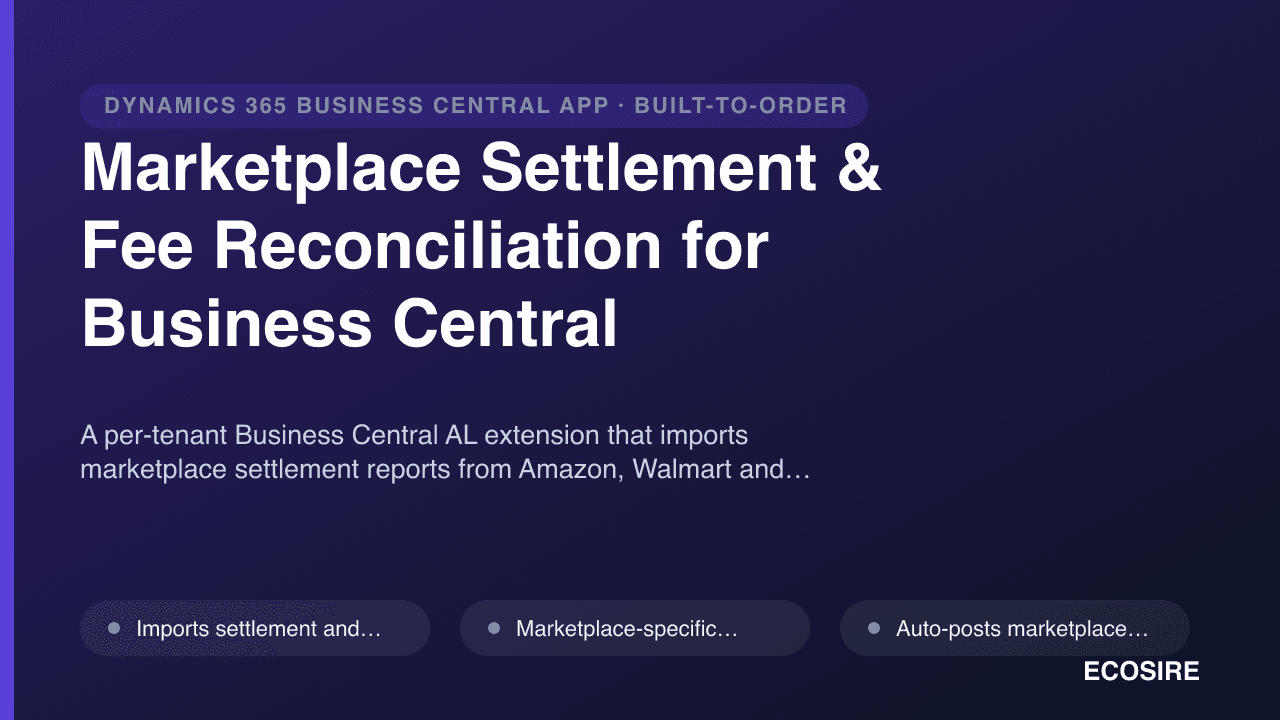
Marketplace Settlement & Fee Reconciliation for Business Central
A per-tenant Business Central AL extension that imports marketplace settlement reports from Amazon, Walmart and eBay, auto-posts fees, ads and refunds as ledger entries, matches net payouts to bank receipts, and flags discrepancies — built and supported by ECOSIRE for your tenant.
ManoMano Marketplace Connector for Business Central
A build-to-order AL extension that connects ManoMano orders, offers, stock and settlements to Dynamics 365 Business Central. ECOSIRE scopes, builds, installs and supports it for your tenant — it is not an off-the-shelf AppSource download.
- Order import codeunit that polls ManoMano on a Job Queue Entry schedule and creates Sales Orders or Sales Invoices against a configurable marketplace customer template, with the ManoMano order reference stored on a `Sales Header` table extension
- Marketplace status mapping table translating ManoMano order states (waiting for acceptance, accepted, shipped, cancelled, refunded) onto a filterable status field, with acceptance and rejection actions from the Sales Order page
- Real-time stock synchronisation driven by event subscribers on item ledger and reservation changes: affected items are flagged and a queued codeunit pushes available quantity for the offers you have enabled, so availability follows Business Central rather than a nightly snapshot
- Price synchronisation from a nominated Business Central price list or Sales Price entry, with per-offer overrides and a minimum-price guard so a bad mapping cannot publish a loss-making offer