Recurring invoices are not subscription billing
Zoho Books can raise the same invoice every month. That is where the similarity with subscription billing ends. The moment a customer upgrades on the 14th, adds five seats mid-quarter, downgrades at renewal, pauses for two months, or has a card decline on the third attempt, the finance team goes back to spreadsheets.
The accounting side is worse than the operational side. An annual contract invoiced in January is not January revenue — it is twelve months of revenue that must be released month by month. Without a deferred revenue schedule, your monthly P&L shows a spike in January and a hole from February onward, your gross margin is meaningless, and every investor or auditor conversation starts with an apology and a spreadsheet.
Meanwhile failed payments quietly leak revenue. A card expires, one email goes out, nobody follows up, and the customer keeps using the service for four months before anyone notices. There is no retry ladder, no escalation, no automatic suspension, and no record of what was attempted.
What ECOSIRE builds for you
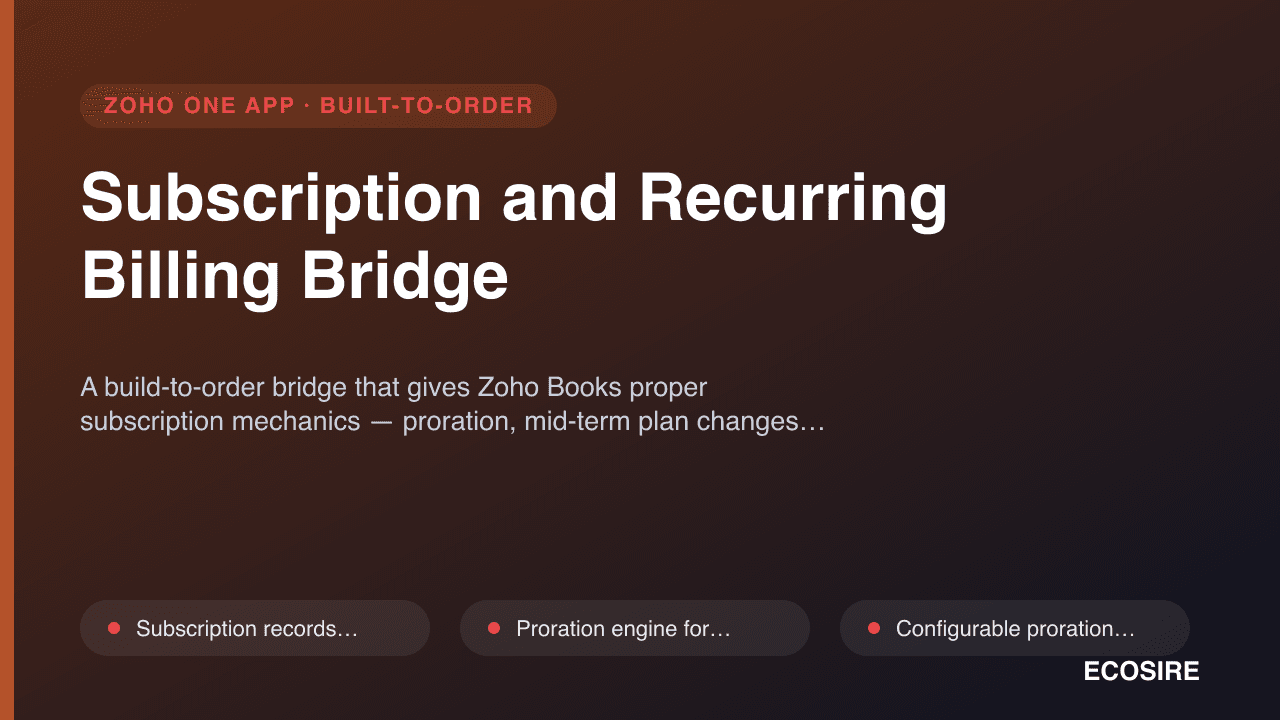
ECOSIRE builds a subscription and billing layer that sits on top of your existing Zoho Books organisation and, where relevant, Zoho CRM and Zoho Inventory. It is implemented with Deluge custom functions, Zoho Books and Zoho Subscriptions REST APIs, Zoho Flow orchestration, and a Zoho Creator control panel for the finance team. Your ledger stays in Books; we add the mechanics Books does not have on its own.
A real subscription record
Every customer subscription becomes a record with a plan, a quantity, a billing frequency, a term, a start date, a next-bill date and a status: trial, active, paused, past due, cancelled or churned. Add-ons and usage components hang off it. Status transitions are event-driven, timestamped and reversible with an audit entry, so "why is this account still active?" always has an answer.
Proration that finance agrees with
When a customer upgrades, downgrades, adds seats or changes frequency mid-term, the bridge calculates the prorated credit for the unused portion and the prorated charge for the new plan, then raises a Credit Note and an Invoice in Zoho Books against the correct customer and the correct accounts. You choose the convention — daily, monthly, or bill-on-next-cycle — and it is applied consistently rather than differently by whoever happened to process it.
Deferred revenue that closes the month
Every invoice line with a service period generates a deferred revenue schedule: the full amount posted to a deferred revenue liability account on invoice, then released to the revenue account in periods across the contract term. A month-end routine posts the recognition Journal Entries in Zoho Books, and a deferred revenue waterfall report reconciles the liability balance to the sum of unreleased schedules. Mid-term changes, cancellations and refunds adjust the remaining schedule rather than leaving orphaned balances.
Dunning that behaves like a process
Failed payments enter a configurable retry ladder — retry after 1, 3, 7 and 14 days, each with its own email template, each escalating. The ladder can raise a task for the account owner in Zoho CRM, notify the finance channel in Zoho Cliq, and after a final failure move the subscription to past-due, restrict access through your product's own hook, or cancel. Every attempt, response code and message sent is logged against the subscription.
Renewals, trials and the calendar around them
Trial-to-paid conversion, renewal reminders, auto-renew versus manual renewal, notice periods and cancellation-effective dates are all handled by scheduled functions with the notification templates you approve. Nothing renews silently that you did not configure to renew silently.
Tax handled where you actually trade
Billing respects your Zoho Books tax configuration — GST for Indian organisations including place-of-supply logic, VAT for GCC and other VAT jurisdictions, and tax treatment per customer for zero-rated or out-of-scope supply. Prorated credits and charges carry the correct tax treatment rather than being posted net and fixed later.
Who this is for
SaaS and software companies, managed-service providers, subscription equipment and maintenance businesses, membership organisations, and any company on Zoho Books whose revenue arrives on a contract term rather than at a point of sale. It is particularly relevant when an auditor, an acquirer or a lender has started asking for revenue recognition that ties to the contract.
How delivery works
1. Scoping call. We look at your current plan structure, your Zoho Books chart of accounts, how you invoice today, your payment gateway, your tax jurisdictions, and which of Zoho Books, Zoho Subscriptions, Zoho CRM and Zoho Inventory you already run. We ask for three real messy cases — a mid-term upgrade, a refund, a failed payment — because those define the build.
2. Fixed quote and specification. You receive the proration conventions, the recognition method, the dunning ladder, the account mappings, the reports and a fixed price with a delivery window. Build time is typically one working week after sign-off; multi-entity or heavy-usage-billing scopes sit at the longer end.
3. Build. ECOSIRE develops the subscription modules, Deluge functions, Books API integration, scheduled recognition routines, dunning workflows and the Creator control panel.
4. Install in test. We install into a test Zoho Books organisation and replay a sample of your real contracts through it. You reconcile the generated invoices, credit notes and recognition journals against what your team produced manually. Nothing goes to production until those numbers agree.
5. Production go-live. We install into your live organisation, migrate open subscriptions with their remaining terms and any existing deferred balances, and run the first billing cycle and first month-end close alongside your finance team.
6. Support. A support window covers the first close cycles, when questions actually arise. Plans, prices, dunning steps and templates are yours to edit in the control panel afterwards.
Honest scope notes
This is a build-to-order engagement: we build it for your organisation after quoting, and it is delivered into your Zoho org — there is no instant download. The bridge automates posting into Zoho Books; it does not replace your accountant's judgement on recognition policy, and we implement the policy you and your auditor agree, not one we invent. Which capabilities are available depends on your Zoho Books plan and on whether you run Zoho Subscriptions or Zoho Billing alongside it, and on your payment gateway's support for retries and stored payment methods. We confirm all of this during scoping and design within your actual API and automation limits.