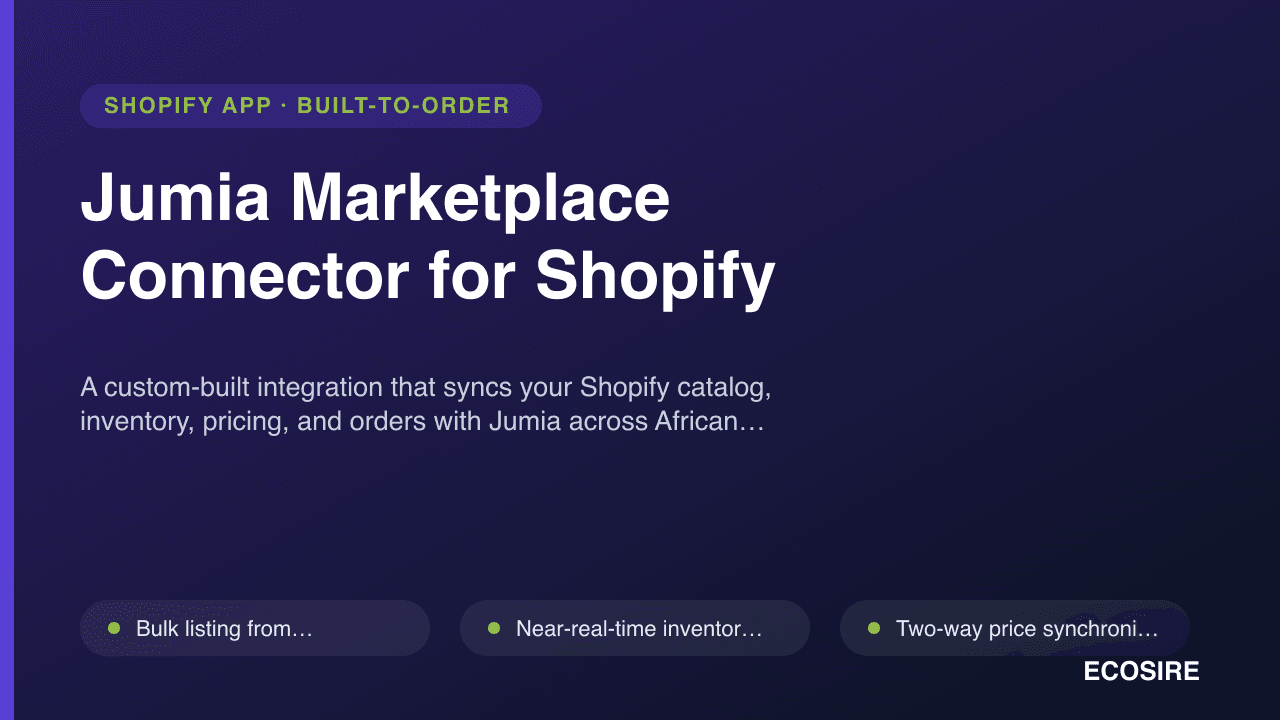
 Illustrative preview
A custom-built integration that syncs your Shopify catalog,
inventory, pricing, and orders with Jumia across African markets. Built, installed, and supported by
ECOSIRE for your specific store.
What is Jumia Marketplace Connector for Shopify?
A custom-built integration that syncs your Shopify catalog, inventory, pricing, and orders with Jumia across African markets. Built, installed, and supported by ECOSIRE for your specific store. Built to order by ECOSIRE for Shopify (build-to-order) — indicative price from $999.00 USD; request a quote for a scoped proposal.
Key Features
Built to order, done for you
No DIY setup — a working app, built, installed and supported by ECOSIRE.
- 1
You order
Start with a one-time build price. We scope it with you at kickoff.
- 2
We build & install
ECOSIRE builds, configures and installs it on your Shopify.
- 3
Go live + support
You go live in about one working week, with two weeks of go-live support. Defects in the code we deliver are fixed free of charge.
About this Product
The Jumia Marketplace Connector for Shopify is a private integration that ECOSIRE builds, installs, and maintains for your specific store — it is not an instant App Store download. After purchase we provision the connector against your Shopify store and your Jumia Seller Center account, then hand it over fully configured.
The connector keeps Shopify as your single source of truth. It reads your catalog through the Shopify Admin GraphQL API, maps your products to Jumia's category and attribute taxonomy, and pushes listings in bulk to the Jumia Seller Center / Vendor API. Variants, images, prices, and stock levels are projected onto Jumia listings, and a product-to-Jumia mapping table is stored so re-syncs stay idempotent.
Inventory and pricing stay aligned in near-real time. We subscribe to Shopify inventory_levels/update, products/update, and orders/create webhooks (with scheduled reconciliation as a fallback) so a sale or restock on either side propagates to the other — respecting your chosen multi-location inventory source. Jumia orders are imported back into Shopify as native orders with line items, customer, and shipping data, and fulfillment status (including Jumia Express / JEX drop-off vs. pickup) is mapped to Shopify fulfillments and tracking.
The build supports per-country operation — Nigeria, Egypt, Kenya, and Morocco — each with its own Seller Center endpoint, currency, and category tree. Configuration, country credentials, and field mappings are stored in Shopify metafields and an admin settings panel so your team can adjust without touching code.
Because every Shopify catalog and Jumia category structure differs, we scope the attribute and category mapping with you during the build. You get a working, documented connector tailored to how you actually sell — plus a support window for fixes and Jumia API changes.
What you get
- A custom Shopify app/connector installed on your store and connected to your Jumia Seller Center account(s) via OAuth
- Configured product-to-Jumia category and attribute mapping for your catalog
- Webhook subscriptions and scheduled jobs for inventory, price, and order synchronization
- Per-country setup for the Jumia markets you sell in (NG, EG, KE, MA as scoped)
- Admin settings panel and Shopify metafield configuration for ongoing self-service adjustments
- Handover documentation covering sync behavior, mapping logic, and troubleshooting
- A post-delivery support window for bug fixes and adaptation to Jumia API changes
Who this is for
Pan-African Shopify retailer
A merchant running their primary store on Shopify who wants to capture Jumia's marketplace traffic across multiple African countries without re-keying products or stock by hand.
Cross-border brand expanding into Africa
An international brand entering Nigeria, Egypt, Kenya, or Morocco that needs Shopify to stay the source of truth while Jumia listings, pricing, and orders stay in sync automatically.
Operations lead drowning in manual marketplace work
An ops or e-commerce manager who currently maintains Jumia listings and reconciles orders in spreadsheets and wants automated, idempotent sync with clear error visibility.
How Jumia Marketplace Connector for Shopify Compares
| Criterion | ECOSIRE | Custom Build | Competitor | Shopify Native |
|---|---|---|---|---|
| Jumia listing, inventory, and order sync for Shopify out of the box | Included | Partial support | Partial support | Not included |
| Per-country support (NG, EG, KE, MA) with separate currencies and category trees | Included | Partial support | Partial support | Not included |
| Mapping tailored to your exact catalog and Jumia attribute taxonomy | Included | Included | Not included | Not included |
| Instant self-service install from the Shopify App Store | Not included | Not included | Included | Partial support |
| Jumia Express / JEX fulfillment status mapping | Included | Partial support | Partial support | Not included |
| One-time price with build, install, and a support window included | Included | Not included | Not included | Not included |
| Ongoing adaptation to Jumia API changes by the builder | Included | Partial support | Partial support | Not included |
Frequently Asked Questions about Jumia Marketplace Connector
How long does it take to build and install the connector?
This is a build-to-order integration, not an instant download. Typical delivery is about one working week from the point we receive Shopify admin access and Jumia Seller Center API credentials. Scope drives the timeline — the number of countries, the complexity of your category and attribute mapping, and any custom fulfillment rules can shorten or extend it. We confirm a firm timeline with you at kickoff.
What ongoing support and updates are included?
Every build includes a post-delivery support window for bug fixes and for adapting the connector when Jumia changes its Seller Center API or category taxonomy. We can also provide an ongoing maintenance arrangement for proactive monitoring, new-country rollouts, and feature additions. Jumia's API is third-party, so we do not control its uptime, but we keep your connector working against it.
Does Shopify or Jumia stay the source of truth for inventory?
Shopify is the source of truth by default. We subscribe to Shopify inventory and product webhooks and project stock and pricing onto Jumia, with a scheduled reconciliation pass as a safety net. You choose which Shopify location feeds Jumia stock. If you need Jumia-side changes to flow back, we scope that direction explicitly during the build.
Which Jumia countries and which Jumia features are supported?
The connector supports Nigeria, Egypt, Kenya, and Morocco, each with its own Seller Center endpoint, currency, and category tree. Jumia Express / JEX fulfillment is mapped to Shopify fulfillments. We enable only the countries you sell in at launch and can add others later. Support depends on what Jumia's Vendor API exposes in each market.
Do I need to access Jumia's API myself, and what access do you need from me?
You provide your Jumia Seller Center account and API credentials and grant ECOSIRE the Shopify admin and OAuth access needed to install the connector. We handle the API integration, mapping, and configuration. Your team manages day-to-day selling through the admin settings panel and Shopify metafields without writing any code.
Related Modules
India GST E-Invoicing & E-Way Bill for Shopify
A custom-built Shopify app that turns your India orders into IRP-cleared GST e-invoices (IRN + signed QR) and e-way bills, with GSTIN validation, HSN mapping, and GSTR-ready exports. Built, installed, and supported by ECOSIRE.
Inventory Management & Multi-Location Sync
A custom-built Shopify app that keeps stock accurate across every warehouse, location and sales channel in real time—with bundle tracking, reorder alerts and supplier purchase orders. Built to order, installed and supported by ECOSIRE.
LATAM Multichannel Connector for Shopify
A custom-built Shopify app that connects your store to LATAM marketplaces — Mercado Libre, Falabella, Ripley, Paris, Linio and more — centralizing stock, pricing and orders. Built, installed and supported by ECOSIRE.
Lightweight WMS for Shopify
A custom-built warehouse management layer for Shopify that adds bin and shelf locations, barcode-scanned receiving and putaway, cycle counts, and multi-warehouse transfers on top of your native Shopify locations. Built, installed, and supported by ECOSIRE.
Jumia Marketplace Connector
A custom-built integration that syncs your Shopify catalog, inventory, pricing, and orders with Jumia across African markets. Built, installed, and supported by ECOSIRE for your specific store.
- Bulk listing from Shopify to Jumia Seller Center with variant, image, and price projection via the Admin GraphQL API
- Near-real-time inventory sync driven by Shopify inventory_levels/update webhooks with scheduled reconciliation fallback
- Two-way price synchronization with per-country currency handling (NGN, EGP, KES, MAD)
- Order import: Jumia orders pulled into Shopify as native orders with customer, line item, and shipping data