¿Qué es Multi-Entity Bill of Material Governance?
A quote-only Sage X3 design for Bill of Material Governance, with multi-entity controls, owned exceptions and document-level reconciliation. Built to order by ECOSIRE for Sage X3 (build-to-order) — indicative price from $999.00 USD; request a quote for a scoped proposal.
Los detalles del producto se muestran en inglés. Próximamente traducciones.
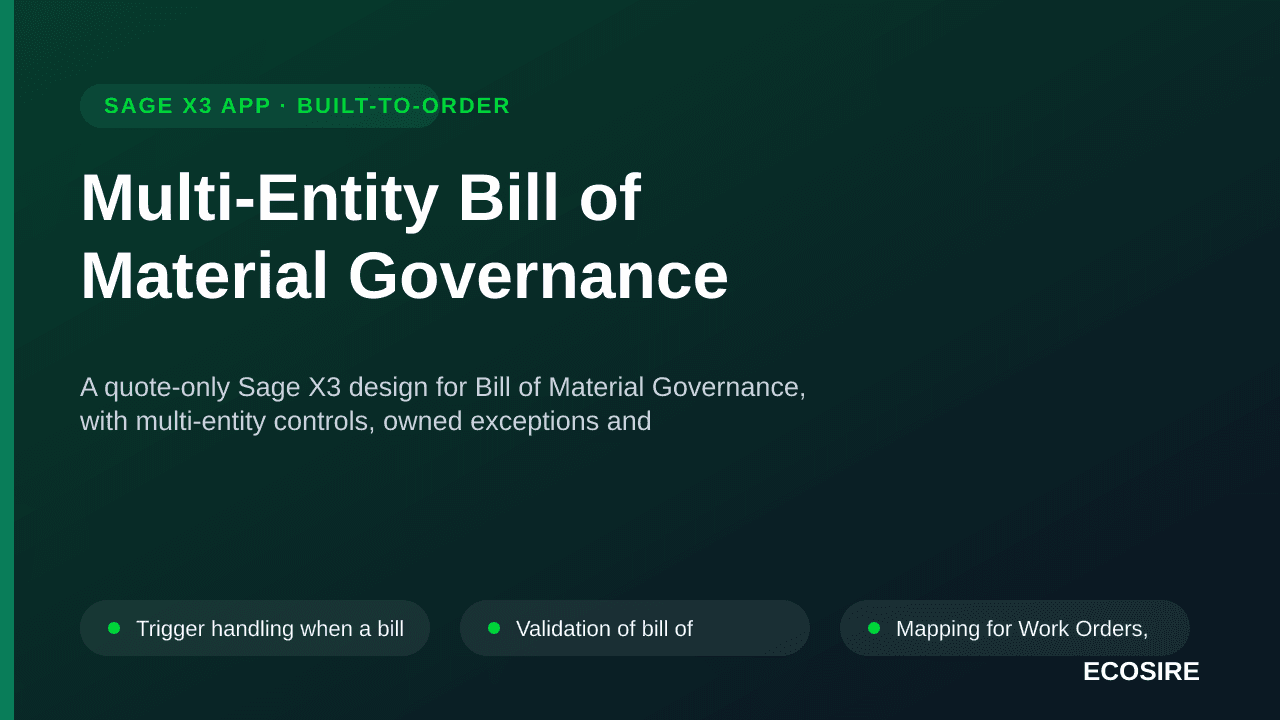 Vista previa ilustrativa
A quote-only Sage X3 design for Bill of Material Governance,
with multi-entity controls, owned exceptions and document-level reconciliation.
Características clave
Trigger handling when a bill of material governance request reaches the ERP boundary within the multi-entity scope, with an immutable source correlation key.
Validation of bill of material governance policy, organization mapping and accountable ownership, plus company, site and organizational boundaries before any Sage X3 write is proposed.
Mapping for Work Orders, Bills of Materials and Operations used in the bill of material governance process and governed by company, site and organizational boundaries within the agreed organization scope.
Implementation through classic SOAP web services for exposed objects configured for the bill of material governance process in a multi-entity context, selected from enabled supported interfaces.
Idempotent replay that returns the original ERP reference for duplicate events.
Exception routing for an invalid or unreconciled bill of material governance record in the multi-entity queue, with owner, reason and source payload reference.
Field-level validation that separates mapping defects from authorization defects.
Least-privilege execution identity with explicit read and write boundaries.
Control totals for received, accepted, rejected, replayed and reversed records.
Reconciliation output connecting source identity to ERP document and status.
Configuration for company, site and organizational boundaries without hard-coded organization assumptions.
Operational audit evidence covering owning entity and cross-entity references for the bill of material governance process and each manual intervention.
Hecho a medida, listo para ti
Sin configuración por tu cuenta: una app funcional creada, instalada y con soporte de ECOSIRE.
- 1
Haces el pedido
Empieza con un precio único de desarrollo. Definimos el alcance contigo en el arranque.
- 2
Creamos e instalamos
ECOSIRE la crea, la configura y la instala en tu Sage X3.
- 3
En marcha + soporte
Sales en vivo en unas 2–4 semanas, con un periodo de soporte posterior al lanzamiento.
Sobre este producto
Teams led by a quality lead responsible for multi-entity controls often coordinate the bill of material governance process across disconnected forms, messages and ERP screens. References are copied by hand, organizational rules are applied unevenly, and an exception can lose its owner before the underlying document is corrected. In this multi-entity design, the requirements for company, site and organizational boundaries are embedded in the workflow rather than kept on a separate checklist.
Proposed build
ECOSIRE would first scope and quote a build-to-order Sage X3 extension. This page is a candidate design, not an existing software package. Processing would start when a bill of material governance request reaches the ERP boundary within the multi-entity scope. The extension would validate bill of material governance policy, organization mapping and accountable ownership, plus company, site and organizational boundaries, resolve Work Orders, Bills of Materials and Operations used in the bill of material governance process and governed by company, site and organizational boundaries, and route an invalid or unreconciled bill of material governance record in the multi-entity queue to a named work queue. It would not invent a mapping or advance a document when a required control is missing.
Sage X3 implementation
The proposed technical path uses classic SOAP web services for exposed objects configured for the bill of material governance process in a multi-entity context. Discovery would confirm which released interfaces are enabled in the target environment and which native lifecycle must remain authoritative. The extension would keep the initiating reference beside the ERP key, allowing an operator to trace a request through validation, posting, correction, reversal and reconciliation. Native posting logic would remain in control of the business document.
Exceptions and recovery
Each request would receive a stable correlation key. A repeated request would resolve to its earlier outcome instead of producing another document. Transport faults could be retried from a checkpoint, while business-rule faults would stay non-posting until an authorized user corrects the cause. The exception record would show the rejected field, rule, organization, owner and related ERP reference without requiring access to raw application logs.
Reconciliation
Operational reconciliation would compare received, accepted, rejected, replayed and reversed records. It would retain owning entity and cross-entity references for the bill of material governance process and expose unmatched source references separately from ERP posting failures. This distinction matters because a successful interface call is not proof that the business transaction reached its intended accounting or operational state.
Prerequisites and acceptance
Before construction, discovery would confirm modules, organizational structure, security roles, master-data ownership, interface availability, code lists, posting policy and representative test cases. A least-privilege integration identity would be used. Acceptance scenarios would cover valid processing, duplicate delivery, missing mapping, authorization failure, partial rejection, controlled replay, reversal and control-total reconciliation. The final scope would remain quote-only and build-to-order.
lo que obtienes
- Approved solution specification for bill of material governance governed by company, site and organizational boundaries and multi-entity controls.
- Field, code-list and organization mapping workbook for Work Orders, Bills of Materials and Operations used in the bill of material governance process and governed by company, site and organizational boundaries.
- Source package using the agreed Sage X3 extension surface.
- Configuration package for validation, routing and exception ownership.
- Automated test evidence for posting, duplicate, failure, replay and reversal cases.
- Operations runbook covering monitoring, correction, replay and reconciliation.
- Deployment and rollback checklist aligned to the customer's change process.
¿Para quién es esto?
quality lead responsible for multi-entity controls
Owns bill of material governance governed by company, site and organizational boundaries, needs visible exceptions, and requires organization rules to be applied consistently.
Sage X3 application owner
Protects native document behavior, supported interfaces, security roles and transport governance.
integration operations analyst
Monitors correlation, retries and reconciliation without bypassing business controls.
Cómo se compara Multi-Entity Bill of Material Governance
| Criterio | ECOSIRE | Construcción personalizada | Competidor | Nativo de Sage X3 |
|---|---|---|---|---|
| Bill of Material Governance source correlation | Incluido | Apoyo parcial | Apoyo parcial | Apoyo parcial |
| Multi-Entity policy validation | Incluido | Apoyo parcial | Apoyo parcial | Apoyo parcial |
| Bill of Material Governance duplicate protection | Incluido | Apoyo parcial | Apoyo parcial | Incluido |
| Owned exception queue for bill of material governance processing | Incluido | Apoyo parcial | Apoyo parcial | No incluido |
| Replay controls for multi-entity processing | Incluido | Apoyo parcial | Incluido | No incluido |
| Bill of Material Governance control-total reconciliation | Incluido | Apoyo parcial | Apoyo parcial | No incluido |
| Least-privilege Sage X3 access | Incluido | Apoyo parcial | Apoyo parcial | Apoyo parcial |
| Change evidence for owning entity and cross-entity references for the bill of material governance process | Incluido | Incluido | Apoyo parcial | Apoyo parcial |
Preguntas frecuentes sobre Multi-Entity Bill of Material Governance
What does quote-only and build-to-order mean?
This is a solution specification rather than existing software. Construction starts only after scope, interfaces and acceptance criteria are agreed.
Which Sage X3 editions are supported?
Edition and release compatibility must be confirmed during discovery because enabled modules, released interfaces and extension policies differ. The build would use interfaces supported in the customer's environment.
How are duplicate events handled?
The proposed design uses a source identity and organization scope as an idempotency key, returning the existing ERP correlation instead of creating another document.
What happens when an invalid or unreconciled bill of material governance record in the multi-entity queue occurs?
The record remains non-posting, receives a reason and owner, and can be corrected and explicitly replayed while preserving the original correlation.
What access is required?
A least-privilege integration identity, access to the agreed supported interfaces, and only the business objects included in the approved scope.
How is reconciliation performed?
Control totals compare received, accepted, rejected, replayed and reversed records, while owning entity and cross-entity references for the bill of material governance process links source events to ERP documents.
Módulos relacionados
Bajo pedido
Sage X3
Event-Driven Bill of Material Governance
A quote-only Sage X3 design for Bill of Material Governance, with event-driven controls, owned exceptions and document-level reconciliation.
Desde $999.00Precio de partida: se presupuesta según su alcance
Bajo pedido
Sage X3
Event-Driven Demand Forecast Import
A quote-only Sage X3 design for Demand Forecast Import, with event-driven controls, owned exceptions and document-level reconciliation.
Desde $999.00Precio de partida: se presupuesta según su alcance
Bajo pedido
Sage X3
Event-Driven Distribution Order Allocation
A quote-only Sage X3 design for Distribution Order Allocation, with event-driven controls, owned exceptions and document-level reconciliation.
Desde $999.00Precio de partida: se presupuesta según su alcance
Bajo pedido
Sage X3
Event-Driven Lot and Serial Traceability
A quote-only Sage X3 design for Lot and Serial Traceability, with event-driven controls, owned exceptions and document-level reconciliation.
Desde $999.00Precio de partida: se presupuesta según su alcance
Solicitar presupuesto
Multi-Entity Bill of Material Governance
A quote-only Sage X3 design for Bill of Material Governance, with multi-entity controls, owned exceptions and document-level reconciliation.
- Trigger handling when a bill of material governance request reaches the ERP boundary within the multi-entity scope, with an immutable source correlation key.
- Validation of bill of material governance policy, organization mapping and accountable ownership, plus company, site and organizational boundaries before any Sage X3 write is proposed.
- Mapping for Work Orders, Bills of Materials and Operations used in the bill of material governance process and governed by company, site and organizational boundaries within the agreed organization scope.
- Implementation through classic SOAP web services for exposed objects configured for the bill of material governance process in a multi-entity context, selected from enabled supported interfaces.