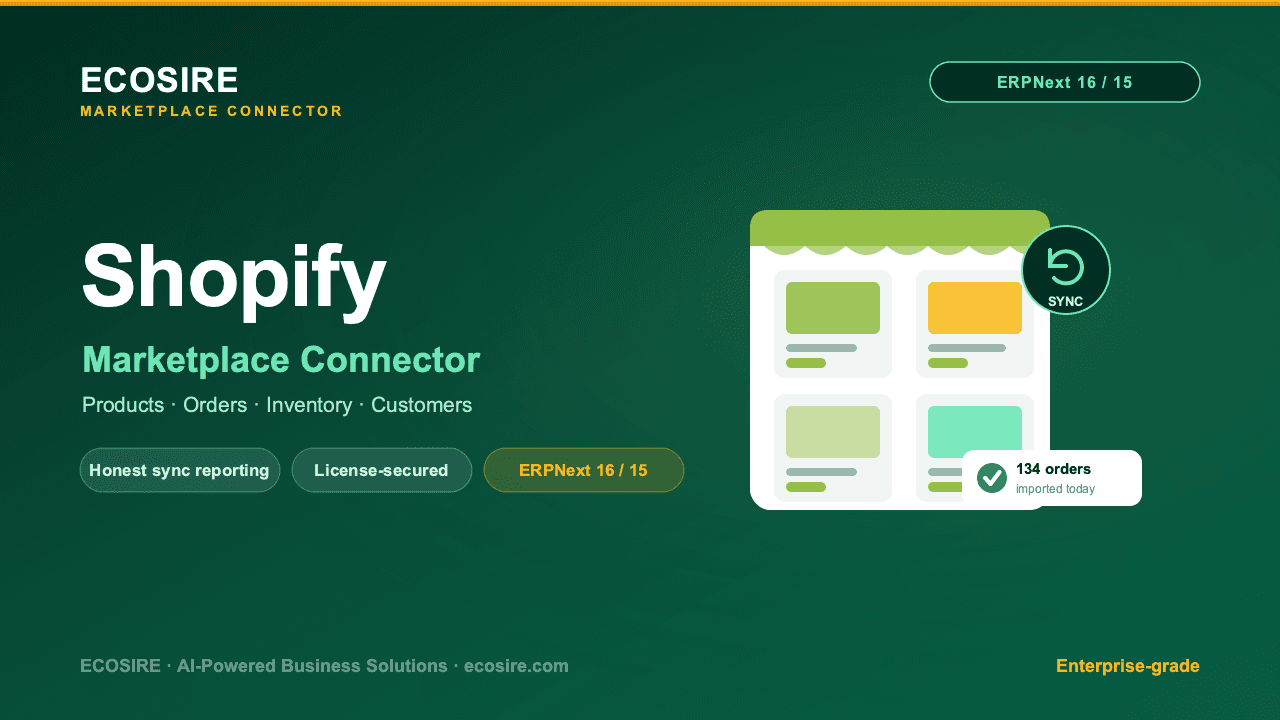
 Vista previa ilustrativa
Shopify connector for ERPNext (pilot release) - products,
orders, customers, inventory with honest sync reporting
¿Qué es Shopify Store Management (ERPNext)?
Connects Shopify and ERPNext v15 and v16 in its pilot release: products, variants, customers and orders come into ERPNext on a schedule, ERPNext stock levels go back to Shopify, and every sync run is logged with per-item results. One-time license from $499.00 USD for ERPNext 15, 16 — includes 12 months of updates and support.
Descripción general de la instalación
- 1
Descargar desde ECOSIRE
Compre la licencia en ecosire.com y descargue la aplicación ZIP de Shopify Store Management (ERPNext) desde el panel de su cuenta.
- 2
Añade la aplicación a tu banco
Extraiga el ZIP en la carpeta de aplicaciones de su banco o ejecute `bench get-app` con la ruta a la aplicación extraída.
- 3
Instalar en su sitio
Ejecute `bench --site SITE_NAME install-app APP_NAME` seguido de `bench migrar` para instalar Shopify Store Management (ERPNext) y aplicar su esquema.
- 4
Activa tu licencia
Abra la configuración de licencia de ECOSIRE en su sitio y active su clave de licencia. Requiere las aplicaciones gratuitas ecosire_connect y ecosire_license_client.
Especificaciones técnicas
- Compatibilidad con ERPNext
- ERPNext 15, ERPNext 16
- Licencia
- La licencia requiere confirmación
- Requisito de Python
- Python 3.10+
- Base de datos
- MariaDB 10.6+
Sobre este producto
Shopify Store Management connects Shopify with ERPNext v15 and v16 in its pilot release: products, variants and customers come from Shopify into ERPNext every hour, orders arrive as draft Sales Orders every 15 minutes, and ERPNext, as the stock master, pushes stock levels to Shopify every 10 minutes. Prices are not synced. It installs as a standard Frappe app and ships with a one-time license — no recurring platform fees.
Shopify connector for ERPNext (pilot release) - products, orders, customers, inventory with honest sync reporting
Shopify connector for ERPNext by ECOSIRE — products, orders, customers, and inventory with honest sync reporting (every run records created / updated / skipped / failed with per-item reasons — never an unconditional green toast).
This repository hosts BOTH implementations of the product: Odoo on branches17.0/18.0/19.0(+main), ERPNext on branchesversion-15/version-16. One license key covers your platform — the license server differentiates byplatform.
Requirements (ERPNext branches)
- Frappe / ERPNext v16 (
version-16) or v15 (version-15) - [
ecosire_connect](https://github.com/ecosire/ecosire_connect) — ECOSIRE connector framework - [
ecosire_license_client](https://github.com/ecosire/ecosire_license_client) (branchesversion-15/16) — license client - A valid ECOSIRE license key for
shopify_store_management(get one)
Setup
1. License: create an Ecosire License record — App Name shopify_store_management, your key → Activate. 2. Shopify token: in your Shopify admin create a custom app (Settings → Apps → Develop apps) with scopes read_products, read_orders, read_customers, read_inventory, write_inventory, read_locations and copy the Admin API access token. 3. Store: create a Shopify Store record — shop URL (mystore.myshopify.com), token, ERPNext defaults (company, warehouse, item group, price list) → Test Connection (captures the Shopify location used for inventory push). 4. Enable the syncs you want. Manual "Sync Now" buttons are on the store form; results land in Ecosire Sync Log.
Sync matrix (pilot)
| Flow | Direction | Schedule | Notes | |---|---|---|---| | Products/variants | Shopify → ERPNext Items + mappings | hourly | match SKU → barcode → name, else create | | Customers | Shopify → ERPNext Customers | hourly | idempotent by Shopify customer id | | Orders | Shopify → DRAFT Sales Orders | 15 min | unmapped line / foreign currency ⇒ skipped with reason | | Inventory | ERPNext Bin qty → Shopify | 10 min | ERP is stock master |
Deferred to parity releases
Webhooks (real-time), refunds → credit notes, fraud/risk scoring, payouts, analytics dashboard, collections, product export, OAuth app flow. The Odoo branches already ship most of these; ERPNext parity lands by wave.
Requirements
- ERPNext v15 or v16 (Frappe Framework)
- ECOSIRE Connect (
ecosire_connect) — included foundation app - ECOSIRE License Client (
ecosire_license_client) — included foundation app
Preguntas frecuentes sobre Shopify
¿Qué versiones de ERPNext admite Shopify Store Management (ERPNext)?
Shopify Store Management (ERPNext) está disponible para sitios ERPNext v15 y v16 que se ejecutan en Frappe bench (autohospedado o Frappe Cloud). La insignia de compatibilidad en esta página muestra las versiones exactas que se envían actualmente.
¿Puedo probarlo antes de comprar?
Sí, en nuestra demo alojada. Cada aplicación cuenta con un sitio de demostración en vivo con datos de ejemplo que su equipo puede explorar a su ritmo; pídanos el enlace y las credenciales. No entregamos instalaciones de prueba: el paquete se entrega después de la compra y, a continuación, lo instalamos y configuramos sin costo en su propio sitio.
¿Qué incluye la licencia?
Una licencia perpetua para un sitio de ERPNext, el código fuente completo, 12 meses de soporte por correo electrónico y 12 meses de actualizaciones gratuitas para la versión de ERPNext que haya adquirido.
¿Cuánto tiempo lleva la instalación?
La mayoría de las aplicaciones ECOSIRE se instalan en menos de 30 minutos en un sitio ERPNext limpio a través de un banco. Las integraciones con las API del mercado (Amazon, Shopify, eBay) generalmente requieren una llamada de configuración de 1 hora para configurar las credenciales y los webhooks.
¿Qué pasa después de los primeros 12 meses?
Su licencia permanece activa para siempre en la versión de ERPNext que compró. La renovación opcional de soporte + actualizaciones es del 50% del precio original por año, o compre una nueva licencia cuando actualice a una versión más nueva de ERPNext.
¿Ofrecen ayuda para la implementación?
Sí. Nuestro equipo puede instalar, configurar, migrar datos, capacitar a su personal y ejecutar las dos primeras semanas de soporte operativo. Consulte nuestros servicios de implementación para conocer paquetes y precios.
Módulos relacionados
2Checkout / Verifone Gateway for ERPNext
A build-to-order 2Checkout (Verifone) payment integration for ERPNext, giving global digital-goods sellers card acceptance, 45+ local payment methods, multi-currency checkout, and reconciled invoices. ECOSIRE scopes, builds, installs, and supports it on your ERPNext v15/v16 instance.
Habla con un experto de ECOSIRE sobre Shopify
Obtenga una cotización personalizada, una demostración en vivo o ayuda para evaluar la idoneidad.

ERPNext and Shopify: choose the right connector
ERPNext’s documented Shopify integration ships in Frappe’s open-source ecommerce_integrations app. Shopify Store Management is ECOSIRE’s alternative for ERPNext v15 and v16, activated with an ECOSIRE licence key, that records every sync run with per-item results. Its current release is a pilot: the sync matrix below runs on schedules, not webhooks, so compare its flows and intervals with what your store needs.
What it covers
- Products and variants from Shopify to ERPNext Items every hour, matched by SKU, then barcode, then name.
- Customers from Shopify to ERPNext every hour, keyed by the Shopify customer ID so a re-run creates no duplicates.
- Orders from Shopify to draft ERPNext Sales Orders every 15 minutes; an unmapped line or a foreign-currency order is skipped with its reason.
- Stock levels from ERPNext to Shopify every 10 minutes, with ERPNext as the stock master, and a sync log that records each item as created, updated, skipped or failed.
What it does not cover
- Webhook-driven, real-time sync: every flow runs on the schedules above.
- Refunds to credit notes, payouts, fraud and risk scoring, Shopify collections and an analytics dashboard: deferred to later releases.
- Product export from ERPNext to Shopify and a Shopify OAuth app flow: access uses a custom-app Admin API token.
Key facts, with sources
- Frappe’s ecommerce_integrations app (GPL-3.0) lists Shopify among its supported integrations and installs with bench or from the Frappe Cloud Marketplace. Frappe: ecommerce_integrations on GitHub
- In Frappe’s integration, orders pulled from Shopify become ERPNext Sales Orders, and inventory is pushed to Shopify by an hourly scheduled job with ERPNext as the stock master. Frappe documentation: Shopify integration
Sources checked on .
Bring these details to the scope review
- Confirm ERPNext v15 or v16, the company, warehouse, item group and price list each Shopify store should use, and whether ecommerce_integrations already syncs that store, so two apps never own the same records.
- Create a Shopify custom app with read access to products, orders, customers, inventory and locations and write access to inventory; keep the Admin API token in your ERPNext site, never in an inquiry.
- Prepare representative SKUs, variants and barcodes, plus order volumes and currencies, so unmapped items and foreign-currency orders are known before go-live.
Agree what acceptance will prove
On a staging site, run each sync by hand and read the sync log: a new product with variants, a returning customer, a paid order with a mapped and an unmapped line, and a stock change. Run each sync again to confirm it creates no duplicate records, then finish with a reconciliation of Shopify stock against ERPNext bins.
Do we also need Frappe’s ecommerce_integrations app?
No. Shopify Store Management depends on ECOSIRE Connect and the ECOSIRE License Client, both included foundation apps. If ecommerce_integrations already syncs your store, decide which app owns each flow before enabling both.
Is the sync real time?
No. Orders sync every 15 minutes, stock every 10 minutes, and products and customers hourly. Webhook-based sync is deferred to a later release.
What if we need webhooks, refunds as credit notes or Shopify POS orders?
That scope is the build-to-order ERPNext Shopify Connector Pro, linked below. A scoped proposal confirms its stores, mappings and acceptance tests before work begins.