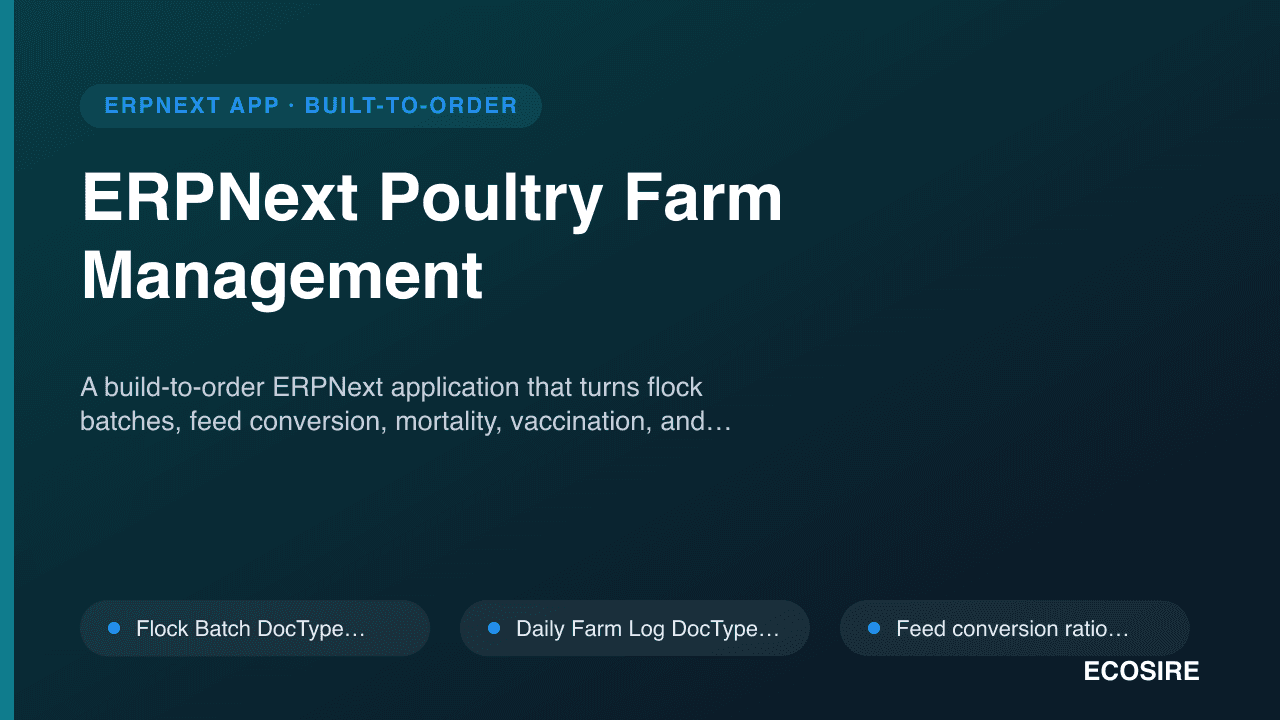
 Vista previa ilustrativa
A build-to-order ERPNext application that turns flock batches,
feed conversion, mortality, vaccination, and egg/meat yield into native DocTypes wired to your existing Item, Stock Entry, and Warehouse records.
ECOSIRE scopes, builds, installs, and supports it — this is not an instant Marketplace download.
¿Qué es ERPNext Poultry Farm Management?
A build-to-order ERPNext application that turns flock batches, feed conversion, mortality, vaccination, and egg/meat yield into native DocTypes wired to your existing Item, Stock Entry, and Warehouse records. ECOSIRE scopes, builds, installs, and supports it — this is not an instant Marketplace download. Built to order by ECOSIRE for ERPNext v15, v16 — indicative price from $999.00 USD; request a quote for a scoped proposal.
Características clave
Hecho a medida, listo para ti
Sin configuración por tu cuenta: una app funcional creada, instalada y con soporte de ECOSIRE.
- 1
Haces el pedido
Empieza con un precio único de desarrollo. Definimos el alcance contigo en el arranque.
- 2
Creamos e instalamos
ECOSIRE la crea, la configura y la instala en tu ERPNext.
- 3
En marcha + soporte
Sales en vivo en aproximadamente una semana laboral, con dos semanas de soporte tras la puesta en marcha. Los defectos en el código que entregamos se corrigen sin coste.
Especificaciones técnicas
- Compatibilidad con ERPNext
- —
- Licencia
- La licencia requiere confirmación
- Requisito de Python
- Python 3.10+
- Base de datos
- MariaDB 10.6+
Sobre este producto
Poultry operations run on batch economics that ERPNext core was never shaped to hold. Out of the box, ERPNext gives you Items, Warehouses, Stock Entries, and BOMs — but it has no concept of a placed flock, a day-age curve, a feed conversion ratio, a mortality event tied to a house, or a vaccination schedule keyed to bird age. Teams end up tracking flocks in spreadsheets alongside ERPNext, so feed cost never reconciles against live-bird weight and the FCR that decides whether a cycle was profitable is calculated days after the birds have already gone to market. This is exactly where ERPNext native runs out of road: the transactions exist, but the operational objects that give them meaning do not.
ECOSIRE builds a proper Frappe app — a versioned, installable module with its own DocTypes — rather than bending Stock and Manufacturing into shapes they were not designed for. Core DocTypes include Flock Batch (breed, placement date, house/Warehouse, opening headcount, source hatchery), Daily Farm Log (date, feed issued, mortality, culls, average weight, water intake), Vaccination Schedule and Vaccination Event (bird-age triggers linked to the batch), and Egg Collection / Harvest Entry for layer and broiler yield. Feed and medication draw from your existing Item master, so every gram of feed issued posts a real Stock Entry against the batch and is costed at your actual valuation rate — no parallel ledger.
The logic lives where Frappe expects it. A hooks.py doc-event on Daily Farm Log.on_submit decrements the batch's live headcount, appends the day's mortality, and recomputes cumulative feed against cumulative weight gain so the feed conversion ratio is always current, not month-end. Scheduler events (scheduler_events in hooks.py) run the daily roll-up and raise alerts when a vaccination falls due by bird age or when mortality in a house breaches a threshold. Server scripts handle the batch-close routine; client scripts add in-form validation and one-click actions on the Flock Batch form. Everything is exposed over the standard Frappe REST API, and any custom operation (batch close-out, FCR recompute, yield summary) is a @frappe.whitelist() method your dashboards, mobile data-entry app, or scale integrations can call. Role profiles and DocType permissions keep farm-hand data entry, supervisor sign-off, and management reporting cleanly separated. Built and tested against Frappe/ERPNext v15 and v16.
Because this is build-to-order, nothing ships until we agree on scope. We start with a short scoping call, confirm your breeds, house layout, feed items, vaccination protocols, and reporting needs in writing, then build against that spec on a staging bench. Typical delivery is one working week from confirmed scope depending on how many integrations and custom reports you need. You get the source code for your build, a documented install, UAT on staging before anything touches production, a rollback plan, training for your team, and a post-go-live support window. It is your app, on your bench, tuned to how your farm actually runs.
lo que obtienes
- Installable source code for your version of the poultry app (a proper Frappe app, `bench install-app` ready)
- Installation and configuration on your environment, wired to your existing Item master, Warehouses, and role setup
- Technical documentation: DocType schema, doc events, scheduler jobs, whitelisted API methods, and permission model
- End-user guide plus a live training session for farm-hands, supervisors, and management
- UAT on a staging bench with sample data before any change reaches production, including a documented rollback plan
- Post-go-live support window for defect fixes and configuration adjustments
- Git repository handover with full commit history and README
- Seeded reference data where useful: vaccination protocol templates and report definitions
¿Para quién es esto?
Integrated broiler / layer operators
Companies running multiple houses across one or more sites that already use ERPNext for purchase, sales, and finance and need flock, feed, and yield to live in the same system rather than in disconnected spreadsheets.
Farm operations and production managers
The people accountable for feed conversion ratio, mortality, and cost-per-bird who need same-day FCR and mortality curves per house instead of month-end reconciliations, and clean data-entry roles for their farm-hands.
ERPNext partners and internal IT teams
Implementers who want a maintainable, upgrade-safe Frappe app with proper DocTypes, hooks, and whitelisted API — not customizations bolted onto Stock and Manufacturing — that they can support against v15/v16.
Hatchery and breeder units
Operations tracking placement sources, bird-age vaccination protocols, and yield hand-offs into grow-out that need batch traceability from placement through harvest or lay cycle.
Cómo se compara ERPNext Poultry Farm Management
| Criterio | ECOSIRE | Construcción personalizada | Competidor | Nativo de ERPNext |
|---|---|---|---|---|
| Flock & batch tracking | Dedicated `Flock Batch` DocType with live headcount and history | Possible, but you design and maintain the schema yourself | Often a fixed batch model you can't reshape | No flock concept — only Items and Warehouses |
| Feed conversion ratio | Auto-recomputed on every daily log via doc event | Whatever you code and keep in sync | Sometimes present, rarely to your formula | Not available; manual spreadsheet math |
| Feed / stock costing | Real `Stock Entry` against batch at your valuation rate | Depends on your integration effort | May keep a separate feed ledger | Stock exists but not tied to a flock |
| Fit to your operation | Built to your breeds, houses, and protocols | Fully bespoke, at full build cost and time | Take the app as shipped | Generic; heavy manual configuration |
| Delivery model | Build-to-order, one working week from confirmed scope | Months of in-house build and QA | Instant install, then you adapt | Already installed, but no poultry features |
| Version support | Built and tested on ERPNext v15 & v16 | You own compatibility as you upgrade | Varies; may lag core releases | Ships with the core version you run |
| Source & ownership | Full source + git repo handed over to you | You own it, having paid to build it | Usually closed or license-restricted | Core is open but has no poultry code |
| Support & updates | Post-go-live window + optional ongoing agreement | Your team carries all maintenance | Vendor roadmap, not your priorities | Community/partner support, no vertical fit |
Preguntas frecuentes sobre ERPNext Poultry Farm Management
Is this an instant download from the Frappe Marketplace?
No. This is build-to-order. ECOSIRE scopes your requirements, builds the app against your breeds, houses, feed items, and vaccination protocols, then installs and supports it. You receive the source code for your build, but there is no self-service instant download — every deployment is fitted to your operation.
How long does delivery take?
Typical delivery is one working week from confirmed scope. The clock starts once we've agreed in writing on DocTypes, reports, roles, and any integrations after the scoping call. Larger builds with multiple integrations or scale-hardware hookups sit at the upper end; a focused single-site build can land sooner.
Which ERPNext versions are supported?
We build and test against Frappe/ERPNext v15 and v16. During scoping we confirm your exact version and bench setup so the app installs cleanly and stays upgrade-safe. If you're on an older version we'll discuss an upgrade path or a targeted backport.
How does support and updates work after go-live?
Every build includes a post-go-live support window for defect fixes and configuration adjustments. Because you receive the git repository, your own team or partner can maintain it afterward, or you can retain ECOSIRE for ongoing enhancements, version upgrades, and new reports under a support agreement.
Will it interfere with our existing ERPNext data or customizations?
No. It ships as a separate, versioned Frappe app with its own DocTypes. Feed and medication reuse your existing Item master and post standard Stock Entries, so there's no parallel inventory ledger. We test everything on a staging bench with a rollback plan before touching production.
Can it integrate with weighing scales, IoT sensors, or a mobile data-entry app?
Yes. Custom operations are exposed as whitelisted (`@frappe.whitelist()`) methods over the Frappe REST API, so scales, environmental sensors, or a lightweight mobile form can push daily weights, feed, and mortality straight into the batch. We scope which integrations you need up front and quote them into the build.
Do we own what you build?
Yes. You receive the full source code and git repository for your version at handover. It's your app on your bench — you're free to maintain, extend, or hand it to another partner.
Módulos relacionados
ERPNext Pakistan FBR Sales Tax & WHT Suite
A build-to-order Frappe app that turns your ERPNext sales, purchase, and payment data into FBR sales-tax returns, withholding statements, and provincial SRB/PRA filings with correctly formatted annexure exports. ECOSIRE scopes, builds, installs, and supports it — it is not an off-the-shelf download.
ERPNext Pharma Distribution & Batch Compliance
A build-to-order ERPNext app that adds pharma-grade batch/expiry FEFO, drug license tracking, schedule-drug compliance, and cold-chain handling on top of ERPNext Stock and Selling. ECOSIRE scopes, builds, installs, and supports it for your v15/v16 site.
ERPNext Qatar VAT & E-Invoicing Readiness
A build-to-order ERPNext app that aligns your tax reporting to Qatar's General Tax Authority requirements and prepares your invoicing for the coming e-invoicing mandate. ECOSIRE scopes, builds, installs, and supports it — this is not an off-the-shelf download.
ERPNext Romania E-Invoicing (RO e-Factura / SAF-T)
A build-to-order ERPNext app that turns your Sales Invoices into compliant RO e-Factura UBL, clears them through the ANAF SPV, and produces D406 SAF-T exports — installed and supported by ECOSIRE.
ERPNext Poultry Farm Management
A build-to-order ERPNext application that turns flock batches, feed conversion, mortality, vaccination, and egg/meat yield into native DocTypes wired to your existing Item, Stock Entry, and Warehouse records. ECOSIRE scopes, builds, installs, and supports it — this is not an instant Marketplace download.
- `Flock Batch` DocType: breed, placement date, house/Warehouse link, opening headcount, source hatchery, and live running headcount
- `Daily Farm Log` DocType capturing feed issued, mortality, culls, average sample weight, and water intake per house per day
- Feed conversion ratio (FCR) recomputed on every `Daily Farm Log.on_submit` via a `hooks.py` doc event — cumulative feed over cumulative weight gain, always current
- Feed and medication issued as real `Stock Entry` transactions against the batch, costed at your existing ERPNext valuation rate — no parallel inventory ledger