 Vista previa ilustrativa
A build-to-order AL extension that turns Dynamics 365 Business Central into a working car rental system:
vehicle availability, rental agreements and rates, check-out/check-in with damage capture, traffic fine and toll recharges, and preventive fleet maintenance.
ECOSIRE builds, installs and supports it after you request a quotation.
¿Qué es Car Rental & Fleet Management?
A build-to-order AL extension that turns Dynamics 365 Business Central into a working car rental system: vehicle availability, rental agreements and rates, check-out/check-in with damage capture, traffic fine and toll recharges, and preventive fleet maintenance. ECOSIRE builds, installs and supports it after you request a quotation. Built to order by ECOSIRE for Dynamics 365 BC (build-to-order) — indicative price from $999.00 USD; request a quote for a scoped proposal.
Características clave
Hecho a medida, listo para ti
Sin configuración por tu cuenta: una app funcional creada, instalada y con soporte de ECOSIRE.
- 1
Haces el pedido
Empieza con un precio único de desarrollo. Definimos el alcance contigo en el arranque.
- 2
Creamos e instalamos
ECOSIRE la crea, la configura y la instala en tu Dynamics 365 Business Central.
- 3
En marcha + soporte
Sales en vivo en aproximadamente una semana laboral, con dos semanas de soporte tras la puesta en marcha. Los defectos en el código que entregamos se corrigen sin coste.
Sobre este producto
Business Central was designed to sell and ship items, not to rent the same physical asset over and over. A rental company's core question — "is registration ABC-1234 free from Thursday 09:00 to Sunday 18:00, including the two-hour cleaning buffer, and is its service due before then?" — has no answer on a standard Item Availability page, because inventory quantity is not the constraint; a time interval on one serialised unit is. Teams end up running the actual business outside the system: a colour-coded booking grid, a Word contract template, a phone gallery of damage photos, and a folder of unrecharged traffic fines. Business Central then only ever sees the invoice at the end, so utilisation, damage recovery and cost per vehicle stay invisible exactly where the accounting lives.
We close that gap with an AL extension delivered as a per-tenant extension or, where you prefer, an AppSource-shaped app package. A Vehicle master table carries registration, VIN, category or ACRISS-style class, a link to the Fixed Asset card for depreciation, odometer, fuel or charge type, branch and current status; a Rental Reservation table holds the datetime interval, pickup and return location, rate plan and the linked Customer record. Overlap is prevented in AL rather than by convention: an availability codeunit evaluates candidate intervals against confirmed reservations, blocked periods, turnaround buffers and scheduled maintenance windows, and a validation event subscriber on reservation insert and modify blocks the double booking before it is committed. A matrix-style availability page renders vehicles down the rows and days across the columns, so a counter agent sees the same picture they used to keep on paper — but drillable into the agreement, damage record or workshop task behind any cell.
Rates are table-driven, not hardcoded. A Rental Rate Plan structure resolves hourly, daily, weekly and monthly tiers with mileage allowance, excess-kilometre pricing, deposits, insurance and waiver options, extras such as child seat, GPS or additional driver, and customer- or contract-specific pricing, then produces the charge lines. Because we build on native posting, a completed rental converts into a standard Sales Invoice or a recurring contract invoice — G/L, dimensions, VAT and posting groups all behave as your accountant already expects, and dimensions carry vehicle, branch and rate plan so utilisation and revenue slice correctly in the standard analysis views and in Power BI. Check-out and check-in are page-driven flows capturing odometer, fuel or charge level, signature and damage marks against a body-diagram grid; photos attach through the standard Document Attachment framework so the evidence travels with the record instead of a chat thread.
Traffic fines and toll charges are logged against a vehicle and offence datetime, matched automatically to the reservation covering that moment, and recharged with your admin fee — either as an invoice line or a deduction against the held deposit, with unmatched offences parked in a review queue rather than silently absorbed. Fleet maintenance runs off both interval and odometer triggers: a job queue entry evaluates service thresholds nightly, raises the workshop task, and marks the vehicle unavailable for that booking window so it cannot be rented out of the shop. Everything is exposed for integration rather than locked in the client — API pages published as REST API v2.0 / OData v4 endpoints serve availability search, quote calculation and booking creation to a website or mobile app, and the same surface feeds Power Automate flows and Dataverse-connected canvas apps for tablet-first forecourt check-in. Dedicated permission sets separate counter agent, fleet controller, workshop and finance, and the extension is built for current Business Central release waves on both SaaS online and on-premises.
This is build-to-order, not an instant download. You request a quotation, we run a short scoping call, and we confirm exactly what your operation needs — vehicle classes, rate structure, deposit and insurance handling, branches, fine sources, integrations — before a line of AL is written. Typical delivery is one working week from confirmed scope, targeted at your Business Central version. You receive the installable app and full AL source, deployment on your sandbox for UAT with a documented rollback plan, technical and end-user documentation, a live training session, a post-go-live support window, and the git repository handed over so you are never locked to us.
lo que obtienes
- Installable `.app` package plus the complete AL source code, built and targeted for your specific Business Central version and release wave
- Installation and configuration on your environment — vehicle classes, rate plans, numbering series, posting setup, permission sets and job queue entries
- Technical documentation: object ID ranges, table and page extension map, event subscribers used, API endpoint reference and integration notes
- End-user guide covering the counter workflow, check-out and check-in, fine recharge and maintenance scheduling, plus a live training session with your team
- UAT deployment on your sandbox environment with a documented test script, sign-off checklist and a rollback plan before the production publish
- Post-go-live support window for defect fixes and configuration questions on the delivered scope
- Git repository handover with full commit history, so your team or any other Business Central partner can maintain the extension
- Data migration assistance for existing vehicle master data, open reservations and rate cards from spreadsheets or a legacy rental system
¿Para quién es esto?
Rental operations manager
Runs the daily fleet and the booking board. Needs one reliable answer on what is free, what is due back and what is in the workshop, without reconciling a spreadsheet against a whiteboard every morning — and without a double booking reaching a customer at the counter.
Finance manager or controller
Owns revenue recognition, VAT and fleet cost. Needs rentals to post as normal Business Central documents with dimensions for vehicle, branch and rate plan, so utilisation, damage recovery and cost per vehicle come from standard analysis rather than a side model in Excel.
Fleet and workshop supervisor
Tracks service intervals, odometer readings, tyres, insurance and registration renewals. Needs a maintenance due date to actually remove a vehicle from the booking pool, and every damage record tied back to the rental that caused it.
Business Central partner or internal IT lead
Responsible for upgrade safety and integrations. Wants an event-subscriber-based AL extension with clean object ID ranges, published API pages for the website and mobile check-in, proper permission sets, and source code in a repository they control.
Cómo se compara Car Rental & Fleet Management
| Criterio | ECOSIRE | Construcción personalizada | Competidor | Nativo de Dynamics 365 Business Central |
|---|---|---|---|---|
| Fit to how you actually rent | Built to your rate tiers, deposit rules, branches and turnaround buffers, confirmed at scoping before any coding | Fits exactly — if the spec is complete and the developer stays available | Fits the vendor's model of rental; your exceptions become manual workarounds | No rental concept at all — inventory quantity, not a time interval on one unit |
| Double-booking prevention | Interval overlap validated in AL on insert and modify, including buffers and maintenance windows | Depends whether the developer treated it as a validation problem or only a UI one | Usually solid, though buffer and workshop rules may not be configurable | None — handled on a spreadsheet or colour-coded calendar outside the system |
| Financial posting | Native Sales Invoices and recurring contracts with dimensions for vehicle, branch and rate plan | Varies; rushed builds often post summary journals and lose the analysis detail | Posts through Business Central, but the dimension design is the vendor's choice | Posting is correct, but there is nothing upstream to post from |
| Upgrade safety across release waves | Event subscribers and table/page extensions only — no base-object modification | Depends on discipline; older builds often carry modified base objects | Vendor handles it, on the vendor's release schedule rather than yours | Nothing to break, because nothing is there |
| Source code and ownership | Full AL source plus git repository handed over at delivery | Yours, assuming the contract says so and the repository was actually maintained | Closed source — you license it, you do not own it | Not applicable |
| Integration surface | Published API pages on REST API v2.0 / OData v4, ready for website, Power Automate and Dataverse | Built if specified; frequently deferred and then never added | Vendor API where offered, sometimes only on a higher tier | Standard Business Central APIs exist, but no rental entities to expose |
| Cost shape | One-off build quoted at scoping, then optional support — no per-vehicle metering | Open-ended day rate; scope creep is the usual outcome | Recurring subscription, often per user or per vehicle, indefinitely | Included in your licence, and unusable for rental without something on top |
| Time to a working system | Typically one working week from confirmed scope, including UAT on your sandbox | Months, and the first version is rarely the last | Fast to install, slower to bend to your rules | Immediate, but the rental process stays in spreadsheets |
Preguntas frecuentes sobre Car Rental & Fleet Management
How long does delivery take, and what happens first?
This is a build-to-order extension, not an AppSource download. We start with a scoping call of roughly 30 minutes to confirm vehicle classes, rate structure, deposit and insurance handling, branches, fine sources and integrations. Typical delivery is one working week from confirmed scope, targeted at your Business Central version. Larger scopes — multi-country VAT, a public booking site, or a legacy data migration — are quoted with their own timeline before any work starts.
What support and updates do I get after go-live?
You get a post-go-live support window for defect fixes and configuration questions on the delivered scope, agreed in writing at quotation. Because the extension uses event subscribers rather than base-object modification, it carries forward across Business Central release waves; when Microsoft ships a wave affecting an object we subscribe to, we rebuild and revalidate the app for your environment. Capability beyond the delivered scope is quoted as a change. You also receive the git repository, so your own team or another partner can maintain it.
Does this work on Business Central SaaS online, or only on-premises?
Both. The extension is written in AL against the current release wave and validated on SaaS online and on-premises. On SaaS it is normally deployed as a per-tenant extension, which lets us keep customer-specific behaviour that an AppSource-published app would not permit. If you want an AppSource-shaped package for your own listing, we build to those constraints instead — decided at scoping, not afterwards.
Will rentals post correctly to my chart of accounts and VAT setup?
Yes. We do not build a parallel ledger. A completed rental produces standard Business Central Sales Invoices or recurring contract invoices, so your existing posting groups, VAT setup, currencies and payment terms apply unchanged. We add dimensions for vehicle, branch and rate plan so revenue, utilisation and fleet cost slice correctly in the analysis views and Power BI reporting you already use.
Can our website or a mobile app create bookings directly?
Yes. We publish API pages exposed through REST API v2.0 / OData v4 for availability search, quote calculation and reservation creation, secured with standard Business Central authentication. The same endpoints drive Power Automate flows and Dataverse-connected canvas apps, which is the usual route for a tablet-based forecourt check-in with photo and signature capture.
How are traffic fines and toll charges handled?
Fines and tolls are logged against a vehicle with the offence datetime, entered manually or imported from your authority's file format. The extension matches the offence to the reservation covering that moment, identifies the responsible renter, applies your admin fee, and creates the recharge — as a new invoice line or a deduction against the held deposit. Unmatched offences stay in a review queue rather than being silently absorbed as a fleet cost.
What if we already have a rental system and only need Business Central integration?
That is a valid scope and we will say so at the scoping call. If your rental front end works, we can build a thinner integration extension — API pages and posting logic that pull completed rentals into Business Central as invoices with correct dimensions — instead of rebuilding the booking engine. We would rather quote the smaller job than sell you the larger one.
Módulos relacionados
Bank Reconciliation & Open Banking Feeds for Business Central
Custom-built Business Central extension that pulls bank statements over open-banking APIs, matches transactions with AI, and posts reconciliations and payment journals automatically — installed per-tenant and supported by ECOSIRE.
Batch & Potency Compliance
A build-to-order Dynamics 365 Business Central extension that adds potency-aware inventory, auto-adjusted consumption, electronic batch records, and QA quarantine/release gating for chemical, nutraceutical, and pharma manufacturers.
Cleaning Services Management for Business Central
A build-to-order Dynamics 365 Business Central AL extension that runs recurring cleaning job schedules, site checklists and inspections, supplies consumption, staff hours and contract invoicing inside your existing Business Central company. ECOSIRE scopes, builds, installs and supports it — it is not an AppSource download.
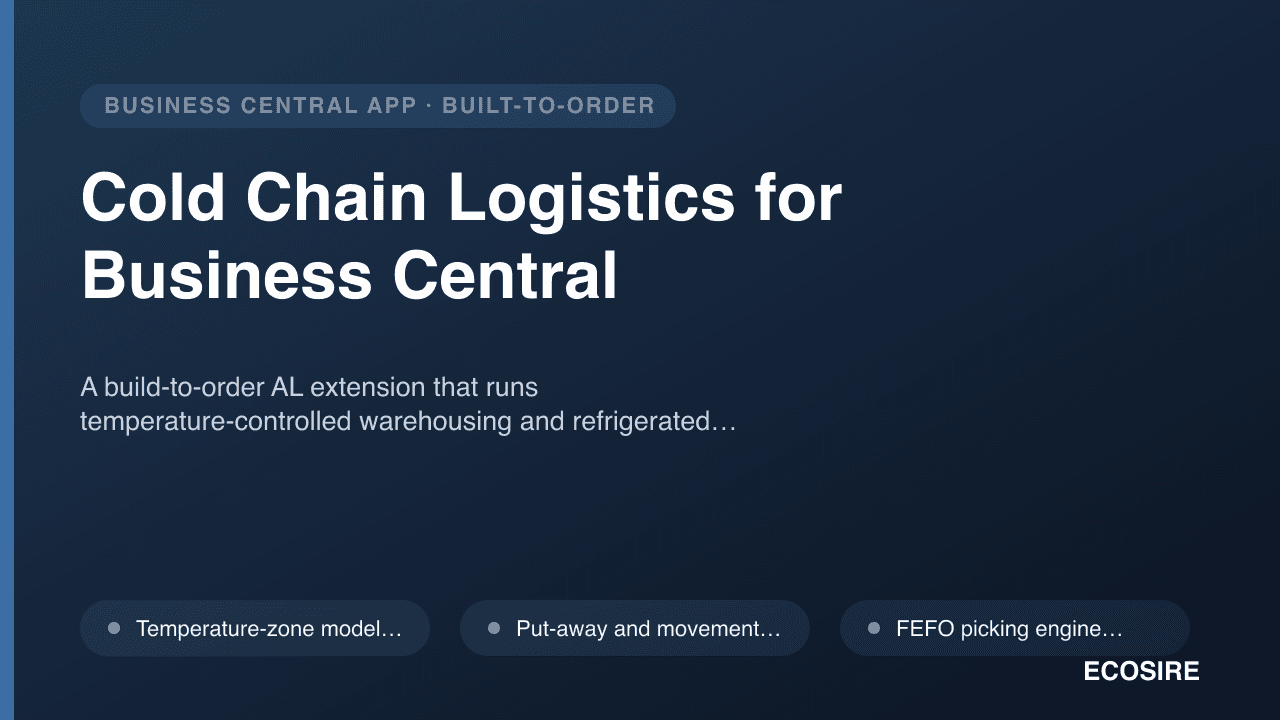
Cold Chain Logistics for Business Central
A build-to-order AL extension that runs temperature-controlled warehousing and refrigerated delivery inside Dynamics 365 Business Central — zone-aware stock, FEFO picking, excursion logging and reefer trip planning. ECOSIRE scopes, builds, installs and supports it for your tenant.
Car Rental & Fleet Management
A build-to-order AL extension that turns Dynamics 365 Business Central into a working car rental system: vehicle availability, rental agreements and rates, check-out/check-in with damage capture, traffic fine and toll recharges, and preventive fleet maintenance. ECOSIRE builds, installs and supports it after you request a quotation.
- `Vehicle` master table with registration, VIN, ACRISS-style class, odometer, fuel or charge type, branch and a link to the Fixed Asset card for depreciation and disposal
- Interval-based availability engine in AL that blocks overlapping reservations, honours turnaround and cleaning buffers, and excludes vehicles inside a scheduled maintenance window
- Matrix availability page — vehicles down, days across — with drill-down from any cell to the reservation, agreement, damage record or workshop task behind it
- Table-driven `Rental Rate Plan` resolving hourly, daily, weekly and monthly tiers with mileage allowance, excess-kilometre rate, deposit, insurance and waiver options