 उदाहरणात्मक पूर्वावलोकन
A build-to-order Odoo module that turns your warehouse into a multi-client third-party logistics operation,
with per-client inventory segregation, activity-based storage and handling billing, and a customer fulfillment portal.
ECOSIRE scopes, builds, installs, and supports it.
3PL Logistic Company क्या है?
A build-to-order Odoo module that turns your warehouse into a multi-client third-party logistics operation, with per-client inventory segregation, activity-based storage and handling billing, and a customer fulfillment portal. ECOSIRE scopes, builds, installs, and supports it. Built to order by ECOSIRE for Odoo 17, 18, 19 — indicative price from $999.00 USD; request a quote for a scoped proposal.
प्रमुख सुविधाएँ
ऑर्डर पर निर्मित, पूरी तरह आपके लिए तैयार
स्वयं सेटअप की ज़रूरत नहीं — ECOSIRE द्वारा निर्मित, इंस्टॉल और समर्थित एक कार्यशील ऐप।
- 1
आप ऑर्डर करते हैं
एक बार के निर्माण मूल्य से शुरू करें। किकऑफ़ पर हम आपके साथ मिलकर दायरा तय करते हैं।
- 2
हम बनाते और इंस्टॉल करते हैं
ECOSIRE इसे आपके Odoo पर बनाता, कॉन्फ़िगर और इंस्टॉल करता है।
- 3
लाइव + समर्थन
आप लगभग एक कार्य सप्ताह में लाइव हो जाते हैं, गो-लाइव के बाद दो सप्ताह के समर्थन के साथ। हमारे द्वारा दिए गए कोड की खामियाँ निःशुल्क ठीक की जाती हैं।
तकनीकी विनिर्देश
- Odoo संगतता
- Odoo 17, Odoo 18, Odoo 19
- संस्करण
- Enterprise और Community
- लाइसेंस
- लाइसेंस की पुष्टि आवश्यक है
- Python आवश्यकता
- Python 3.10+
- डेटाबेस
- PostgreSQL 12+
इस उत्पाद के बारे में
Running a third-party logistics operation on stock Odoo means constantly fighting the fact that Odoo core is built for a company that owns its own inventory — not for one that stores and ships other companies' goods for a fee. Out of the box there is no clean concept of a "client owner" on a stock quant, no way to bill a client for occupied pallet positions or per-line pick-and-pack activity, and no isolated portal where each of your customers sees only their own stock and orders. Teams end up bolting on analytic tags, spreadsheets for storage invoices, and separate Odoo databases per client — which fragments reporting and makes onboarding a new client a multi-day project instead of a form.
The 3PL Logistic Company module closes that gap by adding a first-class 3PL client dimension across the inventory, sales, and accounting stacks. We introduce a res.partner-linked logistics-client model and stamp an owner field onto stock.quant, stock.move, and stock.picking via a proper inherited model in models/, enforced by ir.model.access.csv plus record rules so a client user physically cannot query another client's quants. Warehousing is modeled with configurable storage units (bin / pallet / shelf classes) and occupancy computed through @api.depends compute fields, while a scheduled ir.cron snapshots daily occupancy so storage billing is based on real dwell time rather than a month-end guess. Fulfillment runs on Odoo's native stock.picking engine — receiving, put-away, wave and batch picking, packing, and carrier dispatch — but every step is tagged to the owning client and to a rate card.
Billing is where the module earns its keep. An activity-based rate engine reads the tagged movements and occupancy snapshots and drafts periodic account.move invoices per client — storage by unit-days, inbound handling per line or per unit, outbound pick-and-pack per order and per line, plus value-added service charges — all with QWeb PDF statements that itemize exactly what the client is paying for. A branded customer portal (OWL/website controllers) lets each client submit inbound ASNs and outbound orders, watch live stock levels, and download their billing statements, while the JSON-RPC / XML-RPC API and inbound webhooks let their WMS, ERP, or store platform push orders straight into your queue. Automated actions handle low-stock alerts, SLA breach flags, and status notifications.
Because this is build-to-order, nothing is a shrink-wrapped download. After a short scoping call we confirm the exact rate-card logic, portal scope, and integrations you need, then build the module against your Odoo 17.0, 18.0, or 19.0 (Community or Enterprise) environment, deliver on staging for UAT, and cut over to production. Typical delivery is one working week from confirmed scope. Pricing starts from $999 (indicative, single-company base scope); multi-warehouse topology, additional client-facing integrations (carriers, marketplaces, external WMS), localization depth, and historical data-migration volume increase the quoted scope.
What you get
- Installable module source code targeting your Odoo major version (17.0 / 18.0 / 19.0, Community or Enterprise) with a complete `__manifest__.py` and dependency declaration
- Installation and configuration on your environment: rate cards, storage units, warehouses, portal, and security groups wired to your data
- Technical documentation covering data model, security matrix, cron/automation logic, API endpoints, and extension points
- End-user guide plus a live training session for warehouse, billing, and account-management staff
- UAT on a staging database with a documented test plan and a rollback plan before production cutover
- Post-go-live support window for defect fixes and configuration adjustments after launch
- Git repository handover with full commit history and tagged release for your version
- Sample data and rate-card templates you can clone when onboarding new logistics clients
Who this is for
3PL / fulfillment operations manager
Runs a warehouse that stores and ships goods for multiple client brands and needs each client's stock, orders, and billing cleanly segregated inside one Odoo database instead of separate systems or spreadsheets.
Finance and billing lead at a logistics provider
Owns storage and handling invoicing and wants defensible, activity-based charges — unit-days, pick-and-pack, VAS — drafted automatically into itemized customer statements rather than reconstructed by hand each month.
Odoo administrator / ERP owner
Already runs the business on Odoo and wants the 3PL capability delivered as a maintainable module with proper models, record-rule security, and API hooks — not a fragile pile of studio fields and manual analytic tags.
Client-onboarding / account manager
Brings new brands onto the platform and needs a repeatable onboarding flow plus a self-service portal so clients can submit orders, watch stock, and pull their own billing statements.
How 3PL Logistic Company Compares
| Criterion | ECOSIRE | Custom Build | Competitor | Odoo नेटिव |
|---|---|---|---|---|
| Multi-client inventory ownership | Owner field on quants/moves/pickings, isolated by record rules | Possible but you design and secure the model yourself | Often analytic tags only; weak isolation | No concept of client-owned stock |
| Activity-based storage & handling billing | Rate-card engine drafts itemized invoices from occupancy snapshots | Build the entire billing logic from scratch | Basic or fixed-fee billing, rarely unit-day storage | Manual invoices; no dwell-time capture |
| Client self-service portal | Branded portal for ASN, orders, stock, and statements, scoped per client | Custom controllers you build and maintain | Generic portal, limited 3PL fields | Standard portal, not 3PL-aware |
| Odoo version & edition fit | Built for your 17/18/19, Community or Enterprise | Whatever your team targets | Fixed versions; upgrades on vendor timeline | Ships with your instance |
| Data isolation & security | ORM-level record rules + access CSV per client group | You author and audit the security matrix | Varies; sometimes UI-filter only | Company-level only, no client tenant layer |
| Integrations (carriers, WMS, stores) | JSON/XML-RPC and webhook intake scoped to your needs | Full integration build on you | Preset connectors, hard to extend | Base API only, no 3PL intake |
| Ownership & support | Full Git repo handover + post-go-live support window | You own it; you support it | Vendor-locked; per-seat or subscription | Covered by your Odoo support contract |
| Time to running solution | one working week from confirmed scope, UAT on staging | Months of in-house dev and testing | Fast install but heavy reconfiguration to fit | Immediate but missing 3PL capability |
Frequently Asked Questions about 3PL Logistic Company
How long does delivery take?
This is a build-to-order module, not an instant download. After a scoping call to confirm rate-card logic, portal scope, and integrations, typical delivery is one working week from confirmed scope. We build against your Odoo version, deliver on staging for UAT, then cut over to production.
How does pricing and scoping work?
Pricing starts from $999 as an indicative figure for a single-company base scope. The final number is a fixed quote issued after the scoping call, once we know your warehouse topology, number of client-facing integrations, localization needs, and any historical data migration. Multi-warehouse setups and extra integrations increase the quoted scope.
What about support and updates after go-live?
Delivery includes a post-go-live support window for defect fixes and configuration adjustments. Because you receive the full Git repository, you own the code outright. We also offer ongoing support and version-upgrade engagements — for example migrating the module when you move to a newer Odoo major version — quoted separately.
Does it work on Community or only Enterprise?
It targets Odoo 17.0, 18.0, and 19.0 on both Community and Enterprise. The core inventory, sales, accounting, and portal features it builds on exist in Community. Where a feature you request depends on an Enterprise-only app, we flag that during scoping so there are no surprises.
How is one client's data kept separate from another's?
Each client is a first-class record linked to a `res.partner`, and the owning client is stamped onto stock quants, moves, and pickings. Access is enforced by `ir.model.access.csv` plus record rules, so a client's portal users can only ever see their own inventory, orders, and statements — isolation is at the ORM security layer, not just filtered views.
Can our clients' systems push orders in automatically?
Yes. Inbound and outbound orders can be created over Odoo's JSON-RPC / XML-RPC API or via signed webhooks, so a client's ERP, WMS, or e-commerce platform can drop orders straight into your fulfillment queue. Which integrations we wire up is part of scoping and affects the quote.
How is storage and handling actually billed?
A scheduled job snapshots occupancy daily, and every movement is tagged to a client rate card. The billing engine converts that into activity-based charges — storage by unit-days, inbound handling, outbound pick-and-pack, and value-added services — then drafts an itemized `account.move` per client per period with a QWeb PDF statement for review before posting.
Related Modules
Advanced Catalog Visibility for Multi-Website eCommerce
A made-to-order Odoo module that governs which products and categories appear on each of your websites, with user- and group-based restrictions layered on top. ECOSIRE builds, installs, and supports it against your exact multi-website setup.
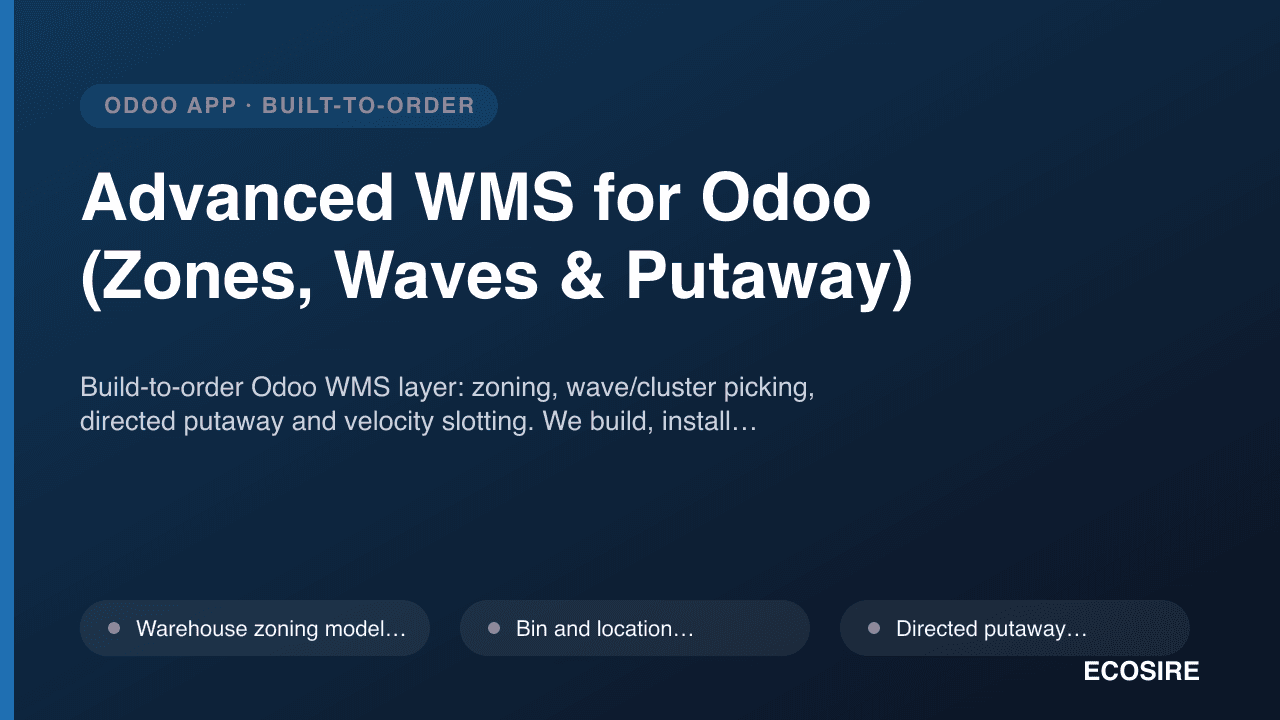
Advanced WMS for Odoo (Zones, Waves & Putaway)
Build-to-order Odoo WMS layer: zoning, wave/cluster picking, directed putaway and velocity slotting. We build, install and support it.
3PL Logistic Company
A build-to-order Odoo module that turns your warehouse into a multi-client third-party logistics operation, with per-client inventory segregation, activity-based storage and handling billing, and a customer fulfillment portal. ECOSIRE scopes, builds, installs, and supports it.
- Logistics-client model linked to `res.partner`, with an owner field stamped onto `stock.quant`, `stock.move`, and `stock.picking` via inherited models
- Per-client data isolation enforced by `ir.model.access.csv` plus record rules so a client portal user can never read another client's quants or orders
- Configurable storage-unit hierarchy (zone / aisle / rack / bin / pallet position) with `@api.depends` occupancy and capacity compute fields
- Daily occupancy snapshot via scheduled `ir.cron` so storage billing uses real unit-day dwell time, not a month-end estimate