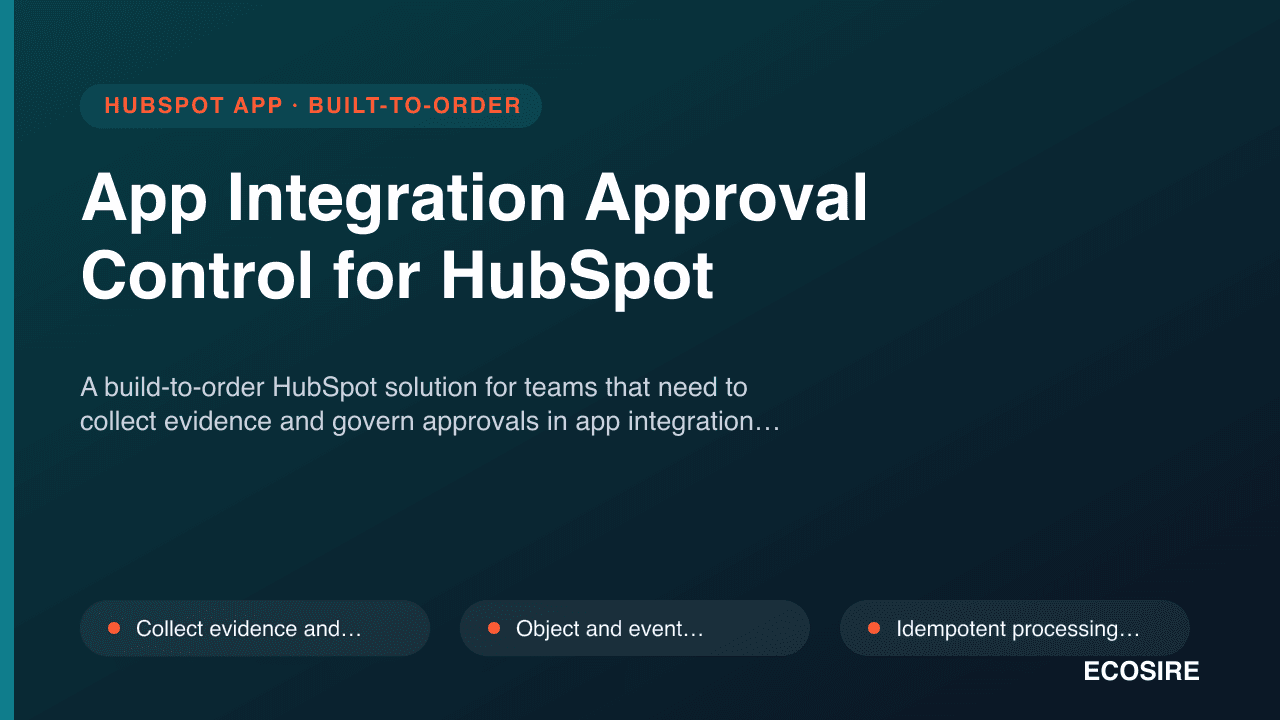
 उदाहरणात्मक पूर्वावलोकन
A build-to-order HubSpot solution for teams that need to collect evidence and govern approvals in app
integration, with idempotent processing, visible exceptions, and reconciliation.
App Integration Approval Control for HubSpot क्या है?
A build-to-order HubSpot solution for teams that need to collect evidence and govern approvals in app integration, with idempotent processing, visible exceptions, and reconciliation. Built to order by ECOSIRE for HubSpot (build-to-order) — indicative price from $999.00 USD; request a quote for a scoped proposal.
प्रमुख सुविधाएँ
ऑर्डर पर निर्मित, पूरी तरह आपके लिए तैयार
स्वयं सेटअप की ज़रूरत नहीं — ECOSIRE द्वारा निर्मित, इंस्टॉल और समर्थित एक कार्यशील ऐप।
- 1
आप ऑर्डर करते हैं
एक बार के निर्माण मूल्य से शुरू करें। किकऑफ़ पर हम आपके साथ मिलकर दायरा तय करते हैं।
- 2
हम बनाते और इंस्टॉल करते हैं
ECOSIRE इसे आपके HubSpot पर बनाता, कॉन्फ़िगर और इंस्टॉल करता है।
- 3
लाइव + समर्थन
आप लगभग एक कार्य सप्ताह में लाइव हो जाते हैं, गो-लाइव के बाद दो सप्ताह के समर्थन के साथ। हमारे द्वारा दिए गए कोड की खामियाँ निःशुल्क ठीक की जाती हैं।
इस उत्पाद के बारे में
A build-to-order HubSpot solution for teams that need to collect evidence and govern approvals in app integration, with idempotent processing, visible exceptions, and reconciliation.
The buyer job
Compliance operations leads need to collect evidence and govern approvals without losing ownership when records cross system boundaries. This concept starts with the business decision and evidence required at each stage, then maps that intent to supported HubSpot surfaces.
Workflow and object design
Receive a app integration signal, validate its source and required fields, resolve webhook subscription, sync cursor and audit log, apply the approval control decision rules, write the approved state, then record a correlated audit result. The source event is integration.approve.requested; the resulting audit event is integration.approve.recorded. The mapped business surface is webhook subscription, sync cursor and audit log.
Technical approach
The scoped design may use OAuth 2.0 authorization, granular app scopes, CRM Objects APIs, associations APIs, webhook subscriptions, custom workflow actions, app settings UI. Authentication is based on HubSpot OAuth with only the CRM, webhook, workflow, or settings scopes confirmed in discovery. The implementation accounts for HubSpot per-app request limits, search limits and webhook retry behavior.
Failure and reconciliation design
Every request uses the idempotency key hubspot-integration-approve:source-id:revision. Retryable transport and throttle responses enter bounded backoff; validation and mapping failures enter a visible exception queue. A reconciliation pass compares source revision, target identifier and recorded state, then permits controlled replay without duplicating the business action.
Build-to-order boundary
This page describes a solution concept, not a prebuilt or immediately available product. Exact fields, actions, interfaces, data retention and acceptance checks are confirmed before a build is authorized.
What you get
- HubSpot solution package or source bundle for the scoped extension
- Object, event and field mapping workbook for webhook subscription, sync cursor and audit log
- Authentication, scope and connection configuration guide
- Exception taxonomy, retry policy and reconciliation runbook
- Automated checks for happy path, duplicates, invalid input, throttling and replay
- Administrator guide covering configuration, audit evidence and safe disablement
- Build-to-order acceptance checklist tied to the approved scope
Who this is for
Compliance operations lead
Owns the collect evidence and govern approvals process and needs its decisions, exceptions and audit state represented consistently in HubSpot.
HubSpot administrator
Controls authentication, permissions, configuration and safe promotion while keeping the extension supportable.
Integration support analyst
Investigates correlated failures, runs reconciliation, and replays only the records that are safe to process again.
How App Integration Approval Control for HubSpot Compares
| Criterion | ECOSIRE | मैन्युअल विकल्प |
|---|---|---|
| App Integration scope | Build-to-order mapping for webhook subscription, sync cursor and audit log | A generic procedure that does not encode the app integration object model |
| Approval Control decision | Versioned rules and evidence for “collect evidence and govern approvals” | Operator interpretation recorded outside the transaction |
| App Integration event | Correlated integration.approve.requested to integration.approve.recorded processing | Periodic manual review without a durable event key |
| Approval Control duplicate control | Persistent key hubspot-integration-approve:source-id:revision | Ad hoc checks against recently processed records |
| App Integration failure handling | Typed exception queue governed by HubSpot per-app request limits, search limits and webhook retry behavior | Unstructured notification followed by a manual restart |
| Approval Control reconciliation | Source revision, target identifier and recorded-state comparison | Spot checks across the webhook subscription, sync cursor and audit log involved |
| HubSpot change control | Versioned app integration configuration and documented promotion | Direct configuration edits without a repeatable release record |
Frequently Asked Questions about App Integration Approval Control
Is App Integration Approval Control for HubSpot a prebuilt product?
No. It is a build-to-order concept. ECOSIRE confirms the workflow, objects, permissions and acceptance criteria before implementation.
How are duplicate events prevented?
The design persists a source identifier and revision under a deterministic idempotency key, then checks the audit record before any repeat write.
What happens when a request is throttled?
Throttle responses are separated from permanent failures and retried with bounded backoff designed around the platform limits in your environment.
How are failed records reconciled?
A reconciliation view compares the source revision, target identifier and recorded state. Operators can correct mappings and use guarded replay.
Which permissions are required?
Only the OAuth scopes, permission sets, roles or connections required for the confirmed objects and actions are included in the design.
Can the operator interface match our process?
Yes. The scoped operator experience can use an app settings page, CRM card, or workflow-action configuration panel selected during scoping when the approved user journey requires it.
Related Modules
App Integration Access & Policy Governance for HubSpot
A build-to-order HubSpot solution for teams that need to govern access, policy and change in app integration, with idempotent processing, visible exceptions, and reconciliation.

App Integration Financial Reconciliation for HubSpot
A build-to-order HubSpot solution for teams that need to reconcile transactions and exceptions in app integration, with idempotent processing, visible exceptions, and reconciliation.
App Integration Fulfilment Orchestration for HubSpot
A build-to-order HubSpot solution for teams that need to orchestrate fulfilment handoffs in app integration, with idempotent processing, visible exceptions, and reconciliation.
App Integration Intake & Capture for HubSpot
A build-to-order HubSpot solution for teams that need to capture validated inbound records in app integration, with idempotent processing, visible exceptions, and reconciliation.
App Integration Approval Control
A build-to-order HubSpot solution for teams that need to collect evidence and govern approvals in app integration, with idempotent processing, visible exceptions, and reconciliation.
- Collect evidence and govern approvals through a governed app integration workflow with explicit intake, decision, write and closure states.
- Object and event mapping from integration.approve.requested across webhook subscription, sync cursor and audit log to integration.approve.recorded, documented against the approved business rules.
- Idempotent processing keyed by hubspot-integration-approve:source-id:revision, retaining the source revision and resulting target identifier.
- Approval Control exception handling that separates authentication, validation, mapping, throttling and downstream rule failures.