Product details are displayed in English. Translations coming soon.
 उदाहरणात्मक पूर्वावलोकन
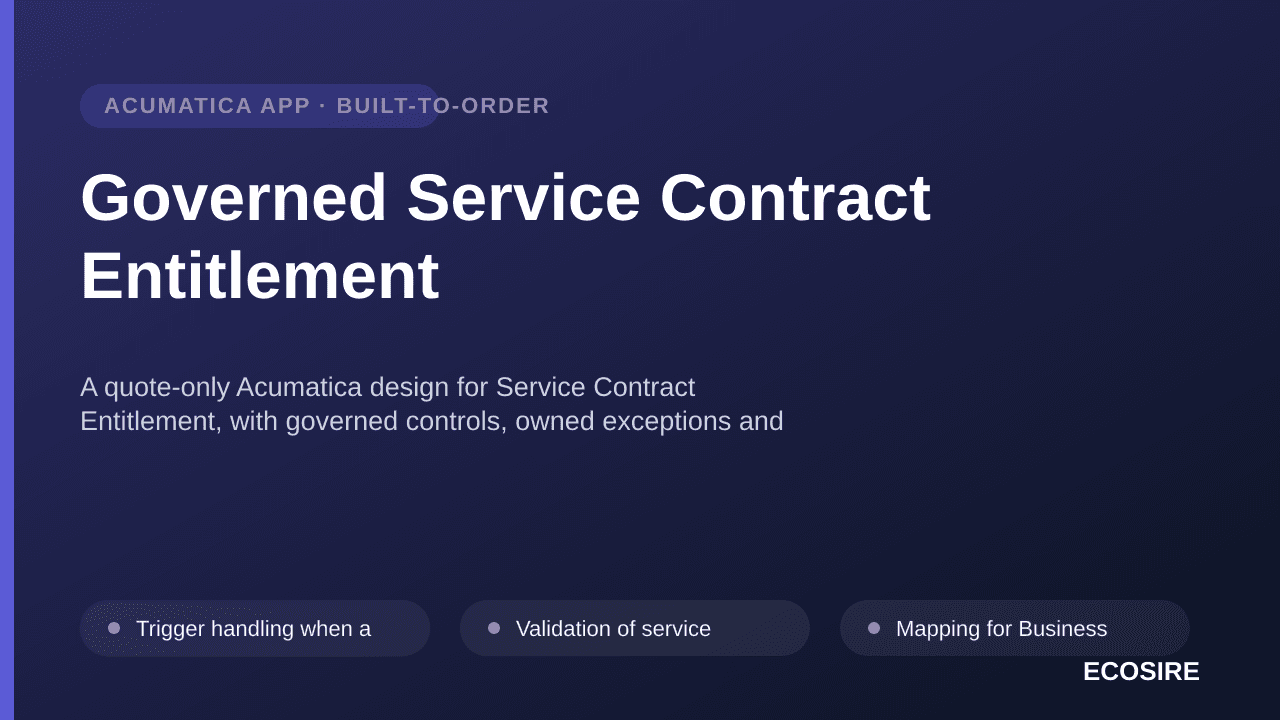
A quote-only Acumatica design for Service Contract Entitlement,
with governed controls, owned exceptions and document-level reconciliation.
प्रमुख सुविधाएँ
Trigger handling when a service contract entitlement request reaches the ERP boundary within the governed scope, with an immutable source correlation key.
Validation of service contract entitlement policy, organization mapping and accountable ownership, plus role-based approvals and controlled master data before any Acumatica write is proposed.
Mapping for Business Accounts, Sales Orders, Shipments and AR Invoices used in the service contract entitlement process and governed by role-based approvals and controlled master data within the agreed organization scope.
Implementation through generic inquiries and OData feeds configured for the service contract entitlement process in a governed context, selected from enabled supported interfaces.
Idempotent replay that returns the original ERP reference for duplicate events.
Exception routing for an invalid or unreconciled service contract entitlement record in the governed queue, with owner, reason and source payload reference.
Field-level validation that separates mapping defects from authorization defects.
Least-privilege execution identity with explicit read and write boundaries.
Control totals for received, accepted, rejected, replayed and reversed records.
Reconciliation output connecting source identity to ERP document and status.
Configuration for role-based approvals and controlled master data without hard-coded organization assumptions.
Operational audit evidence covering approval identity and configuration revision for the service contract entitlement process and each manual intervention.
ऑर्डर पर निर्मित, पूरी तरह आपके लिए तैयार
स्वयं सेटअप की ज़रूरत नहीं — ECOSIRE द्वारा निर्मित, इंस्टॉल और समर्थित एक कार्यशील ऐप।
- 1
आप ऑर्डर करते हैं
एक बार के निर्माण मूल्य से शुरू करें। किकऑफ़ पर हम आपके साथ मिलकर दायरा तय करते हैं।
- 2
हम बनाते और इंस्टॉल करते हैं
ECOSIRE इसे आपके Acumatica पर बनाता, कॉन्फ़िगर और इंस्टॉल करता है।
- 3
लाइव + समर्थन
आप लगभग 2–4 सप्ताह में लाइव हो जाते हैं, लॉन्च के बाद समर्थन अवधि के साथ।
इस उत्पाद के बारे में
Teams led by a field service manager responsible for governed controls often coordinate the service contract entitlement process across disconnected forms, messages and ERP screens. References are copied by hand, organizational rules are applied unevenly, and an exception can lose its owner before the underlying document is corrected. In this governed design, the requirements for role-based approvals and controlled master data are embedded in the workflow rather than kept on a separate checklist.
Proposed build
ECOSIRE would first scope and quote a build-to-order Acumatica extension. This page is a candidate design, not an existing software package. Processing would start when a service contract entitlement request reaches the ERP boundary within the governed scope. The extension would validate service contract entitlement policy, organization mapping and accountable ownership, plus role-based approvals and controlled master data, resolve Business Accounts, Sales Orders, Shipments and AR Invoices used in the service contract entitlement process and governed by role-based approvals and controlled master data, and route an invalid or unreconciled service contract entitlement record in the governed queue to a named work queue. It would not invent a mapping or advance a document when a required control is missing.
Acumatica implementation
The proposed technical path uses generic inquiries and OData feeds configured for the service contract entitlement process in a governed context. Discovery would confirm which released interfaces are enabled in the target environment and which native lifecycle must remain authoritative. The extension would keep the initiating reference beside the ERP key, allowing an operator to trace a request through validation, posting, correction, reversal and reconciliation. Native posting logic would remain in control of the business document.
Exceptions and recovery
Each request would receive a stable correlation key. A repeated request would resolve to its earlier outcome instead of producing another document. Transport faults could be retried from a checkpoint, while business-rule faults would stay non-posting until an authorized user corrects the cause. The exception record would show the rejected field, rule, organization, owner and related ERP reference without requiring access to raw application logs.
Reconciliation
Operational reconciliation would compare received, accepted, rejected, replayed and reversed records. It would retain approval identity and configuration revision for the service contract entitlement process and expose unmatched source references separately from ERP posting failures. This distinction matters because a successful interface call is not proof that the business transaction reached its intended accounting or operational state.
Prerequisites and acceptance
Before construction, discovery would confirm modules, organizational structure, security roles, master-data ownership, interface availability, code lists, posting policy and representative test cases. A least-privilege integration identity would be used. Acceptance scenarios would cover valid processing, duplicate delivery, missing mapping, authorization failure, partial rejection, controlled replay, reversal and control-total reconciliation. The final scope would remain quote-only and build-to-order.
What you get
- Approved solution specification for service contract entitlement governed by role-based approvals and controlled master data and governed controls.
- Field, code-list and organization mapping workbook for Business Accounts, Sales Orders, Shipments and AR Invoices used in the service contract entitlement process and governed by role-based approvals and controlled master data.
- Source package using the agreed Acumatica extension surface.
- Configuration package for validation, routing and exception ownership.
- Automated test evidence for posting, duplicate, failure, replay and reversal cases.
- Operations runbook covering monitoring, correction, replay and reconciliation.
- Deployment and rollback checklist aligned to the customer's change process.
Who this is for
field service manager responsible for governed controls
Owns service contract entitlement governed by role-based approvals and controlled master data, needs visible exceptions, and requires organization rules to be applied consistently.
Acumatica application owner
Protects native document behavior, supported interfaces, security roles and transport governance.
integration operations analyst
Monitors correlation, retries and reconciliation without bypassing business controls.
How Governed Service Contract Entitlement Compares
| Criterion | ECOSIRE | Custom Build | Competitor | Acumatica नेटिव |
|---|---|---|---|---|
| Service Contract Entitlement source correlation | Included | Partial support | Partial support | Not included |
| Governed policy validation | Included | Partial support | Partial support | Partial support |
| Service Contract Entitlement duplicate protection | Included | Partial support | Partial support | Partial support |
| Owned exception queue for service contract entitlement processing | Included | Partial support | Partial support | Not included |
| Replay controls for governed processing | Included | Partial support | Partial support | Not included |
| Service Contract Entitlement control-total reconciliation | Included | Partial support | Partial support | Included |
| Least-privilege Acumatica access | Included | Partial support | Not included | Partial support |
| Change evidence for approval identity and configuration revision for the service contract entitlement process | Included | Partial support | Partial support | Partial support |
Frequently Asked Questions about Governed Service Contract Entitlement
What does quote-only and build-to-order mean?
This is a solution specification rather than existing software. Construction starts only after scope, interfaces and acceptance criteria are agreed.
Which Acumatica editions are supported?
Edition and release compatibility must be confirmed during discovery because enabled modules, released interfaces and extension policies differ. The build would use interfaces supported in the customer's environment.
How are duplicate events handled?
The proposed design uses a source identity and organization scope as an idempotency key, returning the existing ERP correlation instead of creating another document.
What happens when an invalid or unreconciled service contract entitlement record in the governed queue occurs?
The record remains non-posting, receives a reason and owner, and can be corrected and explicitly replayed while preserving the original correlation.
What access is required?
A least-privilege integration identity, access to the agreed supported interfaces, and only the business objects included in the approved scope.
How is reconciliation performed?
Control totals compare received, accepted, rejected, replayed and reversed records, while approval identity and configuration revision for the service contract entitlement process links source events to ERP documents.
Related Modules
ऑर्डर पर निर्मित
Acumatica
Event-Driven Commerce Order Synchronization
A quote-only Acumatica design for Commerce Order Synchronization, with event-driven controls, owned exceptions and document-level reconciliation.
From $999.00प्रारंभिक मूल्य — आपके कार्यक्षेत्र के अनुसार तय किया जाएगा
ऑर्डर पर निर्मित
Acumatica
Event-Driven Construction Project Cost Capture
A quote-only Acumatica design for Construction Project Cost Capture, with event-driven controls, owned exceptions and document-level reconciliation.
From $1499.00प्रारंभिक मूल्य — आपके कार्यक्षेत्र के अनुसार तय किया जाएगा
ऑर्डर पर निर्मित
Acumatica
Event-Driven Expense Receipt Approval
A quote-only Acumatica design for Expense Receipt Approval, with event-driven controls, owned exceptions and document-level reconciliation.
From $999.00प्रारंभिक मूल्य — आपके कार्यक्षेत्र के अनुसार तय किया जाएगा
ऑर्डर पर निर्मित
Acumatica
Event-Driven Field Inventory Replenishment
A quote-only Acumatica design for Field Inventory Replenishment, with event-driven controls, owned exceptions and document-level reconciliation.
From $999.00प्रारंभिक मूल्य — आपके कार्यक्षेत्र के अनुसार तय किया जाएगा
कोटेशन का अनुरोध करें
Governed Service Contract Entitlement
A quote-only Acumatica design for Service Contract Entitlement, with governed controls, owned exceptions and document-level reconciliation.
- Trigger handling when a service contract entitlement request reaches the ERP boundary within the governed scope, with an immutable source correlation key.
- Validation of service contract entitlement policy, organization mapping and accountable ownership, plus role-based approvals and controlled master data before any Acumatica write is proposed.
- Mapping for Business Accounts, Sales Orders, Shipments and AR Invoices used in the service contract entitlement process and governed by role-based approvals and controlled master data within the agreed organization scope.
- Implementation through generic inquiries and OData feeds configured for the service contract entitlement process in a governed context, selected from enabled supported interfaces.