 Aperçu illustratif
A build-to-order Frappe app that bridges ERPNext to ShipStation,
pushing Sales Orders and Delivery Notes out for label printing across 100+ carriers and writing tracking numbers and status back into ERPNext automatically.
ECOSIRE scopes, builds, installs, and supports it for your environment.
Qu'est-ce que ERPNext ShipStation Connector ?
A build-to-order Frappe app that bridges ERPNext to ShipStation, pushing Sales Orders and Delivery Notes out for label printing across 100+ carriers and writing tracking numbers and status back into ERPNext automatically. ECOSIRE scopes, builds, installs, and supports it for your environment. Built to order by ECOSIRE for ERPNext v15, v16 — indicative price from $999.00 USD; request a quote for a scoped proposal.
Fonctionnalités clés
Fait sur commande, clé en main
Aucune configuration à faire vous-même — une app fonctionnelle conçue, installée et prise en charge par ECOSIRE.
- 1
Vous commandez
Commencez par un prix de développement unique. Nous cadrons le projet avec vous au lancement.
- 2
Nous développons et installons
ECOSIRE la développe, la configure et l'installe sur votre ERPNext.
- 3
Mise en ligne + assistance
Vous êtes en ligne en une semaine ouvrée environ, avec deux semaines d’assistance après la mise en production. Les défauts du code que nous livrons sont corrigés gratuitement.
Spécifications techniques
- Compatibilité ERPNext
- —
- Licence
- Licence à confirmer
- Version Python requise
- Python 3.10+
- Base de données
- MariaDB 10.6+
À propos de ce produit
Multichannel sellers running ERPNext hit a wall at the shipping desk. ERPNext models the order, stock, and Delivery Note cleanly, but it has no native carrier-rate engine and no connection to ShipStation, so warehouse staff end up re-keying every order into ShipStation by hand, printing labels in a separate system, and copying tracking numbers back into ERPNext one at a time. That double entry is slow, error-prone, and it breaks the tracking link customers see. ERPNext's built-in Shipment DocType covers only a narrow set of integrations and does not reach ShipStation's aggregated network of 100+ carriers, rate shopping, and batch label workflows.
ECOSIRE builds a proper Frappe app — a versioned, installable module with its own DocTypes, not a pile of ad-hoc server scripts — that wires ERPNext directly into the ShipStation API. When a Sales Order or Delivery Note reaches a state you define, a hooks.py document event (or a scheduler-driven batch) serializes the order, ship-to address, item weights and package dimensions into ShipStation's schema and creates the order there over authenticated REST calls. Staff pick a carrier and service, or let rate shopping choose across the carriers ShipStation aggregates, then generate the shipping label and packing slip without leaving the flow. Credentials live in an encrypted ShipStation Settings single DocType, and a background job handles retries and rate limits so a slow carrier API never blocks the transaction.
The write-back path is where the integration earns its keep. A scheduler event polls ShipStation (or receives its webhooks through a whitelisted endpoint) and writes the tracking number, carrier, service, and shipment status onto the matching ERPNext document — updating the Delivery Note, stamping the tracking URL, and optionally triggering the customer notification ERPNext already knows how to send. Multi-warehouse routing is handled by mapping each ERPNext Warehouse to a ShipStation ship-from location and store, so an order fulfilled from your Texas warehouse ships and reports back distinctly from one fulfilled in the UK. Every mapping, field transform, and status rule is configurable through DocTypes rather than hard-coded, so your ops team can adjust behavior without a redeploy.
Because this is built to order, nothing ships until we agree on scope. We start with a short scoping call to confirm your ERPNext version (v15 or v16), your channels and warehouses, which documents trigger export, and how you want rate selection and status write-back to behave. We build against a staging bench, run UAT with your real order patterns, and only then install on production behind a rollback plan. Permissions are enforced with dedicated role profiles so only fulfillment roles can trigger label creation, and the whole app is handed over as a git repository you own. Typical delivery is one working week from confirmed scope, depending on the number of carriers, channels, and custom field mappings involved.
Ce que vous obtenez
- Installable source code for your pinned ERPNext version (v15 or v16), delivered as a proper Frappe app
- Installation and configuration on your staging and production benches, including ShipStation Settings and warehouse/store mappings
- Technical documentation covering DocTypes, hooks, scheduler events, whitelisted endpoints, and configuration options
- End-user guide plus a live training session for your fulfillment and ops team
- Post-go-live support window for bug fixes and adjustments after production launch
- UAT on a staging bench against your real order patterns, with a documented rollback plan before production install
- Handover of the complete git repository, which you own outright
- Sync-log and error-handling runbook so your team can diagnose and re-sync failed shipments unaided
Pour qui c'est
Multichannel fulfillment manager
Runs a busy shipping desk across Amazon, Shopify, and eBay orders landing in ERPNext, and needs one label workflow across 100+ carriers instead of re-keying every order into ShipStation by hand.
ERPNext operations lead
Owns the ERPNext instance for a growing US/UK seller and wants tracking numbers and shipment status flowing back into Delivery Notes automatically so customer notifications and the audit trail stay accurate.
Warehouse and logistics director
Coordinates fulfillment across multiple warehouses and carrier accounts, and needs each ERPNext Warehouse mapped to the right ShipStation ship-from location with rate shopping to control freight cost.
IT lead or Frappe partner
Responsible for the ERPNext stack and wary of brittle server scripts; wants a versioned, git-tracked app with proper DocTypes, role profiles, encrypted credentials, and clean upgrade paths across v15/v16.
Comment ERPNext ShipStation Connector se compare
| Critère | ÉCOSIRE | Construction personnalisée | Concurrent | Natif ERPNext |
|---|---|---|---|---|
| Fit to your ERPNext | Built to your v15/v16, channels, and warehouse map | Fully bespoke but you own all the design risk | Generic; you bend your process to fit it | No ShipStation path at all |
| ShipStation carrier reach | Full 100+ carriers with rate shopping | Whatever your team wires and maintains | Often a fixed carrier subset | Limited built-in Shipment integrations only |
| Tracking write-back to ERPNext | Auto write-back to Delivery Note via scheduler/webhook | Must be designed and built from scratch | Varies; often one-way export only | Manual copy-paste per order |
| Multi-warehouse routing | Warehouse to ship-from/store mapping via DocTypes | Possible but hand-built | Rarely configurable per warehouse | Not applicable |
| Architecture quality | Proper Frappe app: DocTypes, hooks, role profiles, git | Depends entirely on the developer | Black box; limited configurability | Core, but no connector |
| Delivery model | one working week from scope, UAT + rollback plan | Open-ended, scope creep common | Instant install, no scoping | N/A |
| Support and ownership | Post-go-live window, you own the git repo | You maintain it yourself | Vendor-locked, per-seat or subscription | Community/self-support |
| Cost shape | One-time build; optional retainer | High and unpredictable dev spend | Recurring subscription, may cap volume | Free but manual labor cost |
Foire aux questions sur ERPNext ShipStation Connector
Is this an existing app I can download and install right now?
No. It is build-to-order. ECOSIRE builds the ShipStation Connector to fit your ERPNext version, channels, warehouses, and fulfillment rules, then installs and supports it. There is no instant download — we scope it first, build against staging, and install on production behind a rollback plan.
How long does delivery take?
Typical delivery is one working week from confirmed scope. The exact timeline depends on how many carriers and channels you use, your warehouse count, and the number of custom field mappings and status rules. We confirm a firm date after the scoping call and UAT plan are agreed.
Which ERPNext versions do you support?
Frappe/ERPNext v15 and v16. We pin the build to your version, test on a matching staging bench, and package the app so it upgrades cleanly. If you are mid-migration, we scope for the target version.
How is tracking written back into ERPNext?
A scheduler event polls ShipStation, or a whitelisted webhook endpoint receives its updates, and the app writes the tracking number, carrier, service, and shipment status onto the originating Delivery Note. It can also fire ERPNext's existing customer tracking notification once the number is written.
Do I own the code, and how do updates work?
Yes — the complete git repository is handed to you and you own it outright. Every deployment includes a post-go-live support window for fixes and adjustments. Beyond that, we offer ongoing support and enhancement retainers, but you are never locked in; any Frappe developer can maintain the app from the repo and docs.
How are ShipStation credentials and permissions secured?
API credentials are stored encrypted in a dedicated ShipStation Settings single DocType, never in source or plain config. Access to create orders, buy labels, and void shipments is gated by dedicated role profiles, so only fulfillment roles can trigger those actions.
Can it handle multiple warehouses and carrier accounts?
Yes. Each ERPNext Warehouse is mapped to a specific ShipStation ship-from location and store, so an order fulfilled from one warehouse ships and reports back distinctly from another. Rate shopping across your connected carriers lets you control freight cost per shipment.
Modules associés
ERPNext Sendcloud Connector
A build-to-order Frappe app that wires Sendcloud's EU multi-carrier network into ERPNext, so labels, returns, tracking, and cross-border customs docs all flow from your Delivery Notes. ECOSIRE scopes, builds, installs, and supports it — this is not an instant marketplace download.
ERPNext Shein Marketplace Connector
A build-to-order Frappe app that connects your Shein Marketplace seller account to ERPNext, syncing orders, inventory, prices, listings, shipments and returns both ways. ECOSIRE scopes, builds, installs and supports it for your exact catalog and warehouse setup.
ERPNext Shopify Connector Pro
An enterprise-grade Shopify to ERPNext connector for merchants who outgrew the basic ecommerce_integrations app — multi-store, real-time webhook sync, two-way inventory and pricing, POS orders, and refund-to-credit-note automation. ECOSIRE scopes, builds, installs, and supports it for you.
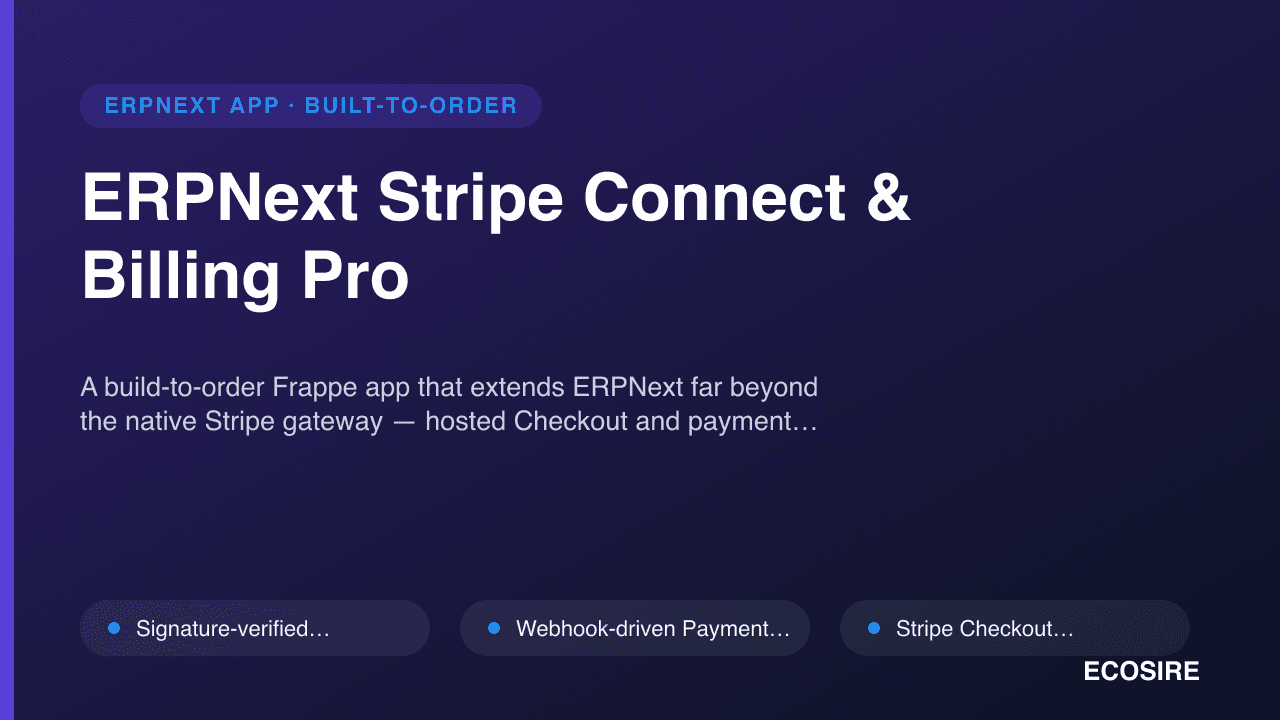
ERPNext Stripe Connect & Billing Pro
A build-to-order Frappe app that extends ERPNext far beyond the native Stripe gateway — hosted Checkout and payment links, subscription sync, Connect payout automation, and webhook-driven reconciliation. ECOSIRE scopes, builds, installs, and supports it on your v15/v16 site.
ERPNext ShipStation Connector
A build-to-order Frappe app that bridges ERPNext to ShipStation, pushing Sales Orders and Delivery Notes out for label printing across 100+ carriers and writing tracking numbers and status back into ERPNext automatically. ECOSIRE scopes, builds, installs, and supports it for your environment.
- Order export from ERPNext Sales Order and Delivery Note to ShipStation via authenticated REST API calls, triggered by hooks.py document events on states you define
- Access to ShipStation's 100+ aggregated carriers, including rate shopping to auto-select the cheapest qualifying service per shipment
- Shipping label and packing-slip generation returned as PDFs and attached to the ERPNext document via the File DocType
- Tracking, carrier, service, and shipment-status write-back onto the originating Delivery Note through a scheduler event or a whitelisted webhook receiver endpoint