 مثالی پیش منظر
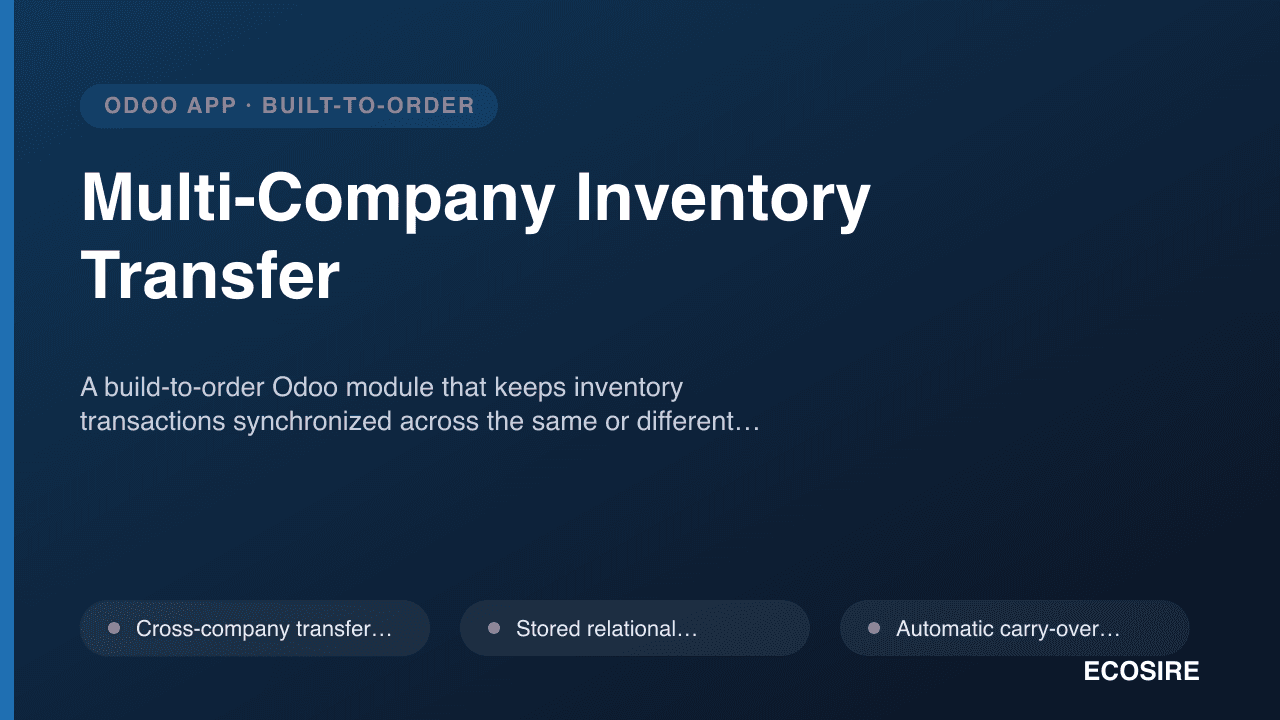
A build-to-order Odoo module that keeps inventory transactions synchronized across the same or different
companies, with automatically paired deliveries and receipts, unit-cost carry-over, and a full audit trail.
ECOSIRE scopes, builds, installs, and supports it for you.
Multi-Company Inventory Transfer کیا ہے؟
A build-to-order Odoo module that keeps inventory transactions synchronized across the same or different companies, with automatically paired deliveries and receipts, unit-cost carry-over, and a full audit trail. ECOSIRE scopes, builds, installs, and supports it for you. Built to order by ECOSIRE for Odoo 17, 18, 19 — indicative price from $999.00 USD; request a quote for a scoped proposal.
اہم خصوصیات
آرڈر پر تیار، مکمل طور پر آپ کے لیے
خود سیٹ اپ کی ضرورت نہیں — ایک کام کرنے والی ایپ جو ECOSIRE بناتا، انسٹال اور سپورٹ کرتا ہے۔
- 1
آپ آرڈر دیتے ہیں
ایک بار کی تعمیر کی قیمت سے آغاز کریں۔ آغاز پر ہم آپ کے ساتھ مل کر دائرہ کار طے کرتے ہیں۔
- 2
ہم بناتے اور انسٹال کرتے ہیں
ECOSIRE اسے آپ کے Odoo پر بناتا، ترتیب دیتا اور انسٹال کرتا ہے۔
- 3
لائیو + معاونت
آپ تقریباً ایک کاروباری ہفتے میں لائیو ہو جاتے ہیں، گو لائیو کے بعد دو ہفتوں کی معاونت کے ساتھ۔ ہمارے فراہم کردہ کوڈ کی خرابیاں مفت درست کی جاتی ہیں۔
تکنیکی تفصیلات
- Odoo ہم آہنگی
- Odoo 17, Odoo 18, Odoo 19
- ایڈیشنز
- Enterprise اور Community
- لائسنس
- لائسنس کی تصدیق درکار ہے
- Python کی ضرورت
- Python 3.10+
- ڈیٹابیس
- PostgreSQL 12+
اس مصنوع کے بارے میں
Groups running several legal entities on one Odoo database hit a recurring wall the moment stock has to move between companies. Odoo core handles internal transfers cleanly inside a single company, but a delivery from Company A to Company B is not one stock move — it is a sale/purchase pair or a manual double entry someone has to remember to reconcile. Teams create a delivery order in the source company, then hand-key a matching receipt in the destination company, re-typing quantities, lots, serials and costs, and hope the two sides agree at month-end. Valuation drifts, in-transit stock is invisible, and inter-company reconciliation becomes a spreadsheet exercise. A typical off-the-shelf apps.odoo.com module tends to cover one narrow flavour of this and rarely matches your chart of accounts, costing method, or approval rules.
This is what we build to order: a Multi-Company Inventory Transfer module that treats a cross-company movement as a single, governed transaction. At the ORM layer we add a transfer document model (models.Model) that, on confirmation, orchestrates the paired stock.picking records in the source and destination companies and links them with stored relational fields so each side always knows its counterpart. Quantities, stock.lot/serial numbers, packages, and unit cost are carried across via @api.depends computes and create()/write() overrides, so the receiving company inherits the same traceability and valuation basis instead of a re-keyed guess. An optional in-transit location and a two-step (send/receive) flow make goods that have left one company but not yet arrived at the other fully visible on both stock ledgers.
Because this rides on Odoo's own multi-company plumbing, we wire it to your real structure: res.company boundaries, per-company warehouses and operation types, and — where the entities also transact financially — the inter-company journal/pricing rules so a stock transfer can optionally raise the matching internal invoice or leave accounting untouched, per your policy. Access is locked down with ir.model.access.csv plus record rules scoped by company_ids/company_id so a user only ever sees transfers their companies are party to; automated actions or scheduled jobs can auto-confirm receipts or flag stuck in-transit lines. The UI is delivered as standard form/list/kanban views (XML, with OWL where an interaction warrants it) and a QWeb transfer note/report for the warehouse floor, and everything is reachable over the XML-RPC/JSON-RPC API for external systems. We build against your target release — Odoo 17.0, 18.0, or 19.0 — and account for Community vs Enterprise differences (for example, native inter-company rules and some valuation features differ by edition), so the module behaves correctly on the exact stack you run.
Delivery is build-to-order. We start with a short scoping call to confirm which companies, warehouses, costing method (standard/FIFO/AVCO), lot/serial requirements, whether accounting entries are in or out of scope, and your target Odoo version and edition. You approve a fixed quote and scope, we build and unit-test on a staging copy of your database, run UAT with your team, then install to production with a rollback plan. Typical delivery is one working week from confirmed scope, depending on complexity and how many entities and integrations are in play. Pricing starts from $999 (indicative, single-company base scope); additional companies, inter-company accounting/invoicing, multi-warehouse and in-transit routing, and data migration volume increase the quoted scope.
What you get
- Installable source code for your Odoo version (17.0, 18.0, or 19.0), scoped to your company/warehouse structure
- Installation and configuration on your environment (companies, operation types, in-transit location, record rules, optional accounting hook)
- Technical documentation: data model, `__manifest__.py`, security matrix, and extension/integration points
- End-user guide plus a live training session for warehouse and finance users
- Post-go-live support window for defect fixes and configuration questions
- UAT on a staging copy of your database with a documented rollback plan before production install
- Git repository handover with tagged release and commit history
- Signed-off scope document and fixed quote from the scoping call
Who this is for
Multi-entity group controller
Runs several legal entities on one Odoo database and needs inter-company stock moves that reconcile automatically and keep valuation consistent, instead of month-end spreadsheet clean-up.
Warehouse / inventory manager
Wants a single action to send stock from one company's warehouse and have the receiving company's receipt appear with the same lots, serials, and quantities — with in-transit stock visible on both sides.
Odoo administrator / internal IT
Owns the database and needs a maintainable, security-scoped module (record rules per company, clean `ir.model.access.csv`) that survives upgrades across 17.0/18.0/19.0 and exposes an API for downstream systems.
Finance / inter-company accountant
Needs cross-company physical transfers to optionally tie to the correct internal invoice/bill and journals, or stay accounting-neutral, matching the group's inter-company policy.
How Multi-Company Inventory Transfer Compares
| Criterion | ECOSIRE | Custom Build | Competitor | Odoo نیٹو |
|---|---|---|---|---|
| Cross-company transfer as one action | Single governed document pairs both pickings automatically | Achievable but you design and maintain the orchestration | Often covers one flow only; varies by module | Manual delivery + separate receipt keyed by hand |
| Lot/serial & cost carry-over | Propagated to destination, aligned to its costing method | Whatever you build and test | Partial; frequently mismatched costs | Re-typed manually, error-prone |
| In-transit visibility | Optional in-transit location, visible on both ledgers | Build it yourself | Rarely included | No cross-company in-transit concept |
| Per-company security | Record rules scoped by company via `ir.model.access.csv` | You author and audit the rules | Generic, often not company-scoped | Standard multi-company rules only |
| Inter-company accounting | Optional internal invoice/journal hook, per your policy | Your responsibility to implement | Usually out of scope | Separate manual sale/purchase entries |
| Fit to your Odoo version & edition | Built for 17.0/18.0/19.0, Community/Enterprise aware | Depends on your team's coverage | Version support varies; may lag releases | Whatever core ships |
| Support & ownership | Post-go-live support window + git repo handover | You own all maintenance | Vendor SLA varies; source may be closed | Community/Enterprise support channels |
| Cost & time to live | Fixed quote from $999 base, one working week from scope | Higher effort, longer, uncertain | Low upfront but customization/fixes extra | Free but manual process overhead ongoing |
Frequently Asked Questions about Multi-Company Inventory Transfer
Is this an existing app I can download and install today?
No. This is a build-to-order module. ECOSIRE builds, installs, and supports it for your specific company structure and Odoo version — it is not an off-the-shelf instant download. You get source code you own after we build it to your confirmed scope.
How long does delivery take?
Typical delivery is one working week from confirmed scope. The exact timeline depends on how many companies and warehouses are involved, whether inter-company accounting is in scope, and any data migration or integrations. We commit to a date in writing after the scoping call.
How does pricing and scoping work?
Pricing starts from $999 as an indicative, single-company base scope. We hold a short scoping call, then give you a fixed quote and scope before any build starts. Additional companies, inter-company invoicing, in-transit routing, and data migration increase the quoted amount — but the number you approve is fixed, not open-ended.
What about support and future Odoo updates?
Every build includes a post-go-live support window for defect fixes and configuration questions. We build against your target release (17.0, 18.0, or 19.0); migrating the module to a future major Odoo version is a separate, quotable engagement, and you keep the git repository either way.
Does it work with different companies, or only branches of the same company?
Both. It handles transfers within the same company and between different `res.company` entities on the same database, with per-company security so users only see transfers their companies are party to.
Will it keep inventory valuation and lot/serial traceability correct across companies?
Yes. Quantities, lots, serials, and unit cost are carried to the destination picking, and cost propagation is aligned to the destination company's costing method (standard/FIFO/AVCO) so valuation stays consistent. We confirm your exact costing setup during scoping.
Can it post the inter-company accounting entries too?
Optionally. We can wire the transfer to raise the matching internal invoice/bill and journal entries per your inter-company rules, or keep it accounting-neutral (physical stock only). That decision is part of the scoping call and affects the quote.
Related Modules
Multi-Channel Order Fulfillment Router for Odoo
Auto-route orders from every sales channel to the best warehouse, 3PL, or dropship source in Odoo. Built, installed, and supported by ECOSIRE.
Multi-Channel Product Feed Builder (Meta, TikTok, Pinterest, Bing)
One Odoo feed engine that exports your catalog to Meta, TikTok, Pinterest, Bing and any custom CSV/XML spec — built, installed & supported by ECOSIRE.
Naqel Express Shipping Connector for Odoo
A build-to-order Odoo integration that connects Naqel Express to your delivery workflow — create shipments, print AWB labels, fetch live rates, handle COD reconciliation and sync tracking, all from the Odoo backend. Scoped, built, installed and supported by ECOSIRE.
Natural-Language Inventory & Supply Assistant for Odoo
A build-to-order Odoo module that lets supply-chain managers ask inventory, replenishment and vendor questions in plain English and get answers grounded in their own `stock`, `sale` and `purchase` data. ECOSIRE builds, installs and supports it — no off-the-shelf download.
Multi-Company Inventory Transfer
A build-to-order Odoo module that keeps inventory transactions synchronized across the same or different companies, with automatically paired deliveries and receipts, unit-cost carry-over, and a full audit trail. ECOSIRE scopes, builds, installs, and supports it for you.
- Cross-company transfer document model (`models.Model`) that atomically orchestrates paired `stock.picking` records in the source and destination companies on confirmation
- Stored relational links between the outbound and inbound pickings so each side always resolves its counterpart for reconciliation and drill-down
- Automatic carry-over of quantities, `stock.lot`/serial numbers, and packages so destination-company traceability mirrors the source with no re-keying
- Unit-cost propagation aligned to the destination company's costing method (standard/FIFO/AVCO) to keep inventory valuation consistent across entities