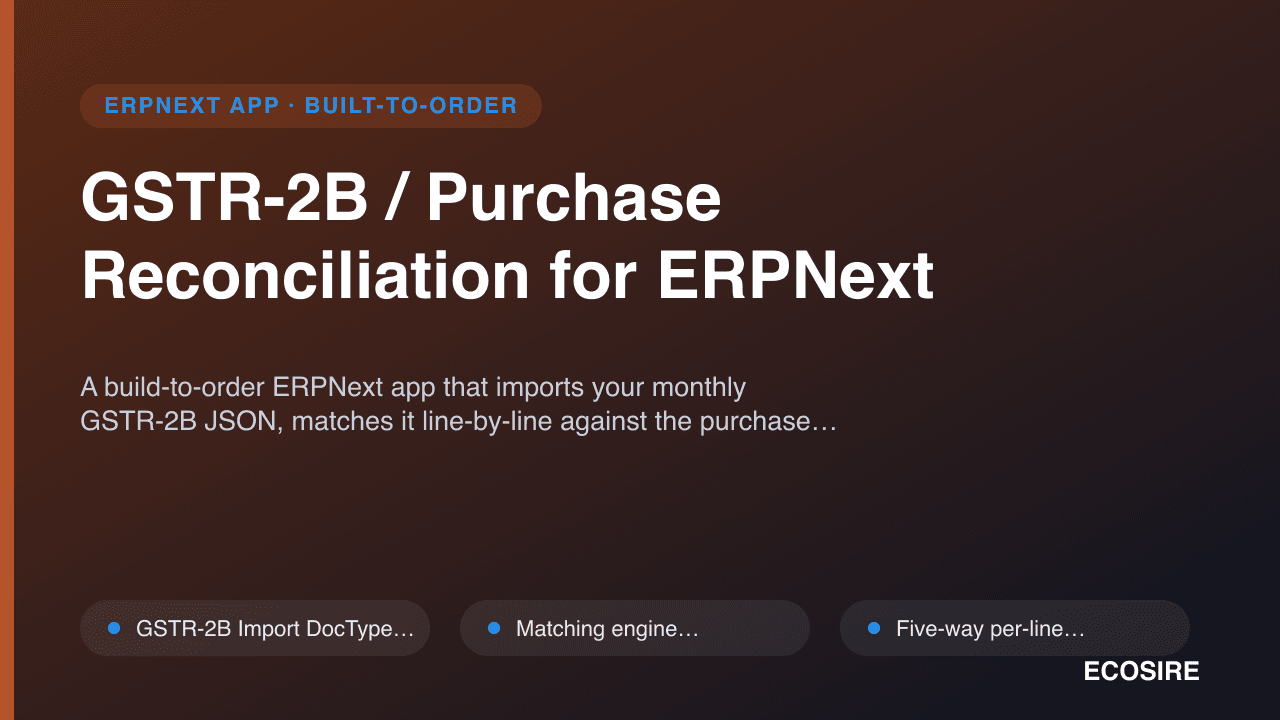
 イメージプレビュー
A build-to-order ERPNext app that imports your monthly GSTR-2B JSON,
matches it line-by-line against the purchase register, and flags mismatches, missing invoices, and ITC-ineligible entries so your Input Tax Credit claim is both maximised and defensible.
ECOSIRE scopes, builds, installs, and supports it — this is not an off-the-shelf marketplace download.
GSTR-2B / Purchase Reconciliation for ERPNextとは?
A build-to-order ERPNext app that imports your monthly GSTR-2B JSON, matches it line-by-line against the purchase register, and flags mismatches, missing invoices, and ITC-ineligible entries so your Input Tax Credit claim is both maximised and defensible. ECOSIRE scopes, builds, installs, and supports it — this is not an off-the-shelf marketplace download. Built to order by ECOSIRE for ERPNext v15, v16 — indicative price from $999.00 USD; request a quote for a scoped proposal.
主な機能
受注生産、すべておまかせ
自分での設定は不要 — ECOSIRE が構築・インストール・サポートする実働アプリです。
- 1
ご注文
一回限りの構築料金から始めます。キックオフで一緒に範囲を決めます。
- 2
構築とインストール
ECOSIRE がお客様の ERPNext 上で構築・設定・インストールします。
- 3
本番稼働 + サポート
約1週間(営業日ベース)で稼働し、本番稼働後2週間のサポートが付きます。納品したコードの不具合は無償で修正します。
技術仕様
- ERPNext互換性
- —
- ライセンス
- ライセンスの確認が必要です
- Python要件
- Python 3.10+
- データベース
- MariaDB 10.6+
この製品について
Every GST-registered business in India loses Input Tax Credit the same way: a supplier files late or wrong, an invoice that sits in your purchase register never shows up in GSTR-2B, or a GSTIN/invoice-number typo means the two records never match — and the ITC quietly slips through the cracks at return-filing time. Stock ERPNext gives you the GST accounting backbone (Purchase Invoice, GSTIN fields, tax templates, the GSTR-3B/GSTR-1 reports), but it has no native workspace to pull the government's GSTR-2B JSON back in and reconcile it against what you actually booked. Accounting teams end up exporting to spreadsheets, doing VLOOKUPs by hand every month, and hoping they caught everything before the ITC claim window closes — which is exactly where audit exposure and lost credit come from.
ECOSIRE builds a dedicated reconciliation app as a proper Frappe application (bench get-app installable), namespaced with its own module so it upgrades cleanly and never patches ERPNext core. At its heart is a GSTR-2B Import DocType that ingests the raw JSON downloaded from the GST portal (B2B, CDNR, amendments, and ISD sections), parsing it into child-table rows, plus a Purchase Reconciliation document that pairs each portal invoice against the matching Purchase Invoice in your books. The matching engine — implemented as whitelisted server-side methods (@frappe.whitelist()) rather than fragile client logic — keys on GSTIN, document number, document date, and taxable/tax values with configurable tolerance bands, then classifies every row as Exact Match, Probable Match (fuzzy on invoice number or ±rupee/±date tolerance), Mismatch, Only-in-2B, or Only-in-Books. ITC eligibility is flagged per line using the section, reverse-charge, and place-of-supply data so ineligible or blocked credit is separated out before you file.
Around that engine we build the workflow your team actually needs: a vendor-wise reconciliation summary (grouped Query Report with drill-down to the offending invoices), bulk accept/reject actions that write an audit trail back onto the linked Purchase Invoice, and a follow-up mechanism that can raise a ToDo or draft a supplier email for every Only-in-2B or mismatched line so your GSTIN owner has a concrete list to chase. hooks.py doc events keep the reconciliation status in sync when a Purchase Invoice is amended or cancelled, a scheduler event can auto-flag periods that still have unreconciled ITC as the filing date approaches, and Client Scripts add the one-click "Import 2B" and "Run Match" buttons where accountants expect them. Role profiles and permission rules scope who can import portal data versus who can approve/reject credit, and everything is exposed through the Frappe REST API if you want to trigger reconciliation from an external tax tool.
Because this is build-to-order, nothing ships until we understand your exact GST footprint. We start with a scoping call to confirm your ERPNext version (v15 or v16), number of GSTINs, invoice volume, tolerance rules, and how strict your ITC policy is, then build against a written scope. Typical delivery is one working week from confirmed scope. You get installable source, a git repository handover, UAT on a staging site with a rollback plan, user training, and a post-go-live support window — so the reconciliation runs on your own bench, on your own data, with no dependency on a third-party SaaS holding your purchase records.
得られるもの
- Installable Frappe app source code for your ERPNext version (v15 or v16), namespaced in its own module
- Installation and configuration on your bench, including tolerance rules, role profiles, and scheduler setup
- Technical documentation covering DocType schema, whitelisted methods, hooks, and REST endpoints
- User guide plus a live training session for your GST/accounting team
- UAT on a staging site with sample GSTR-2B JSON and a documented rollback plan
- Git repository handover with full commit history and branch/tag conventions
- Post-go-live support window for defect fixes and configuration adjustments
- Sample data set and reconciliation walkthrough for onboarding new team members
これは誰のためのものですか
GST Accountant / ITC Owner
Runs the monthly reconciliation and owns the ITC claim figure. Needs the mismatch and missing-invoice list produced automatically instead of hand-built in Excel, with a clear audit trail for every accept/reject decision.
Finance Controller / CFO
Accountable for the accuracy of the return and for ITC not leaking. Wants period-level assurance, vendor-wise exposure visibility, and a defensible record when the return is scrutinised.
ERPNext Administrator / Implementation Partner
Maintains the bench and must keep customisations upgrade-safe. Needs a clean namespaced app with hooks and permissions rather than core patches, plus a git repo they can maintain across v15/v16 upgrades.
Tax Compliance Manager (multi-GSTIN)
Oversees reconciliation across several GSTINs and states. Needs consistent tolerance rules, role separation between data import and credit approval, and API access to plug into a broader compliance stack.
GSTR-2B / Purchase Reconciliation for ERPNext の比較方法
| 基準 | エコシエール | カスタムビルド | 競合他社 | ERPNext 標準機能 |
|---|---|---|---|---|
| Fit to your GST footprint | Built to your GSTINs, tolerances, and ITC policy from a written scope | Fully bespoke but only as good as your in-house spec | Generic feature set, one-size-fits-all rules | No dedicated reconciliation workspace at all |
| GSTR-2B JSON import | Dedicated DocType parsing B2B, CDNR, amendments, ISD | Possible but you design and test the parser | Usually supported, sections vary by vendor | Not available — manual export/spreadsheet |
| Matching intelligence | Exact + fuzzy/probable with configurable ±amount/±date bands | Whatever you build and validate | Fixed matching logic, limited tolerance tuning | None |
| ITC eligibility flagging | Per-line by section, reverse-charge, place-of-supply | Build it yourself against GST rules | Basic eligibility, often not tunable | Not handled |
| Upgrade safety (v15/v16) | Namespaced app, hooks only, no core patches | Depends on developer discipline | Varies; some patch core or lag versions | N/A |
| Ownership & handover | Installable source + full git repo handover | You own it but carry all build cost/risk | Licensed; source often closed | N/A |
| Delivery time | one working week from confirmed scope | Months incl. hiring, spec, build, test | Instant install, but generic | Immediate, but no capability |
| Support model | Post-go-live support window + ECOSIRE follow-on | Self-supported or contractor-dependent | Vendor SLA, tied to their roadmap | Community/partner only |
GSTR-2B / Purchase Reconciliation に関するよくある質問
Is this an app I can download and install myself from a marketplace?
No. This is a build-to-order engagement — ECOSIRE scopes, builds, installs, and supports the app against your specific GST footprint. You receive installable source and the git repository on handover, so it runs on your own bench, but it is not an existing Frappe Cloud Marketplace download.
How long does delivery take?
Typical delivery is one working week from confirmed scope. We start with a short scoping call to lock down your ERPNext version, number of GSTINs, invoice volume, and tolerance/ITC rules, then build against a written scope. Complex multi-GSTIN or high-volume setups sit at the longer end of that range.
Which ERPNext versions do you support?
Frappe/ERPNext v15 and v16. We build the app namespaced in its own module against your target version so it stays upgrade-safe and never patches ERPNext core. Tell us your exact version on the scoping call and we build to match.
How does the matching actually work — will it catch supplier typos?
The engine keys on GSTIN, document number, document date, and taxable/tax values with configurable tolerance bands. Beyond exact matches it produces Probable Matches using fuzzy invoice-number logic plus ±amount and ±date tolerances, so a transposed invoice number or a one-rupee rounding difference is surfaced as a likely pair rather than a false mismatch — you confirm or reject it.
What about ITC eligibility and reverse charge?
Each reconciled line is flagged for ITC eligibility using the GSTR-2B section, reverse-charge indicator, and place-of-supply data, so ineligible or blocked credit is separated out before you file. The rules are configurable during scoping to match how strictly your finance team treats provisional or blocked credit.
What do we get for support and updates after go-live?
Every engagement includes a post-go-live support window for defect fixes and configuration adjustments, and you get the full git repository so your own team or partner can maintain it. Longer-term support, feature additions, and version-upgrade work (for example a future GST portal schema change) can be arranged as a follow-on.
Does it modify ERPNext core or our existing Purchase Invoices?
It does not patch core. The app is a separate namespaced module that reads your `Purchase Invoice` data and writes only a reconciliation status and audit trail back onto matched invoices via controlled `hooks.py` doc events. UAT runs on a staging site with a rollback plan before anything touches production.
関連モジュール
Google Sheets Two-Way Sync for ERPNext
A no-code, scheduled bridge between Google Sheets and any ERPNext DocType, with insert and upsert modes, incremental sync, and an optional two-way write-back. ECOSIRE builds, installs, and supports it for your v15/v16 site after a scoping call.
GPS Geofence Field Attendance
A build-to-order Frappe app that enforces radius-based geofences for field staff and salesmen, capturing GPS selfie punches with timestamp and coordinates and turning valid punches into ERPNext Attendance automatically. ECOSIRE designs, builds, installs and supports it for your ERPNext v15/v16 site.
HR Analytics & Workforce Dashboard
Executive HR dashboards for ERPNext that turn Employee, Attendance, Salary Slip and Job Applicant records into headcount, attrition, payroll cost and diversity insight. Built to your definitions, installed on your instance, and supported by ECOSIRE.
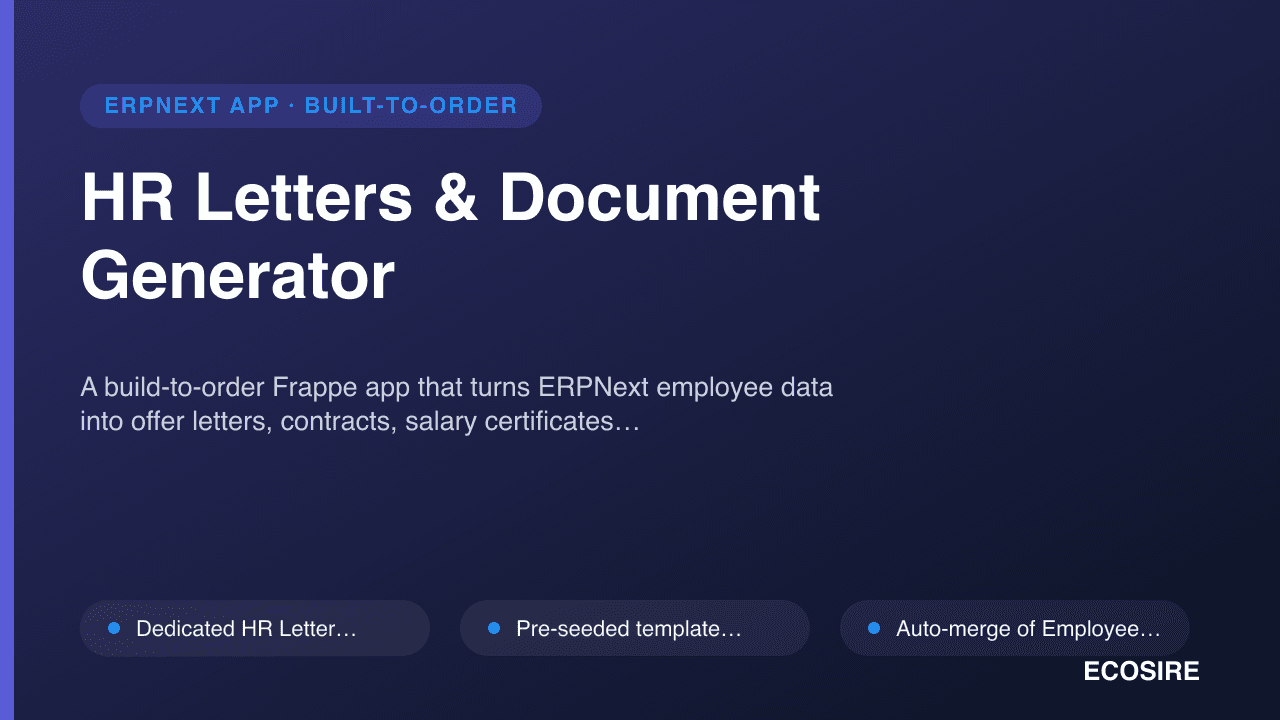
HR Letters & Document Generator
A build-to-order Frappe app that turns ERPNext employee data into offer letters, contracts, salary certificates, experience letters and NOCs, complete with an e-signature workflow, bilingual English/Arabic templates and document expiry tracking. ECOSIRE scopes, builds, installs and supports it on your bench.
GSTR-2B / Purchase Reconciliation
A build-to-order ERPNext app that imports your monthly GSTR-2B JSON, matches it line-by-line against the purchase register, and flags mismatches, missing invoices, and ITC-ineligible entries so your Input Tax Credit claim is both maximised and defensible. ECOSIRE scopes, builds, installs, and supports it — this is not an off-the-shelf marketplace download.
- `GSTR-2B Import` DocType that parses the raw portal JSON (B2B, CDNR/CDNRA, amendments, ISD) into structured child-table rows with source-section retained per line
- Matching engine implemented as whitelisted server methods keying on GSTIN + document number + date + taxable value + tax amount, with configurable tolerance bands
- Five-way per-line classification: Exact Match, Probable Match (fuzzy invoice-no / ±amount / ±date), Mismatch, Only-in-2B, and Only-in-Books
- Per-line ITC eligibility flagging driven by section, reverse-charge indicator, and place-of-supply so ineligible or blocked credit is separated before filing