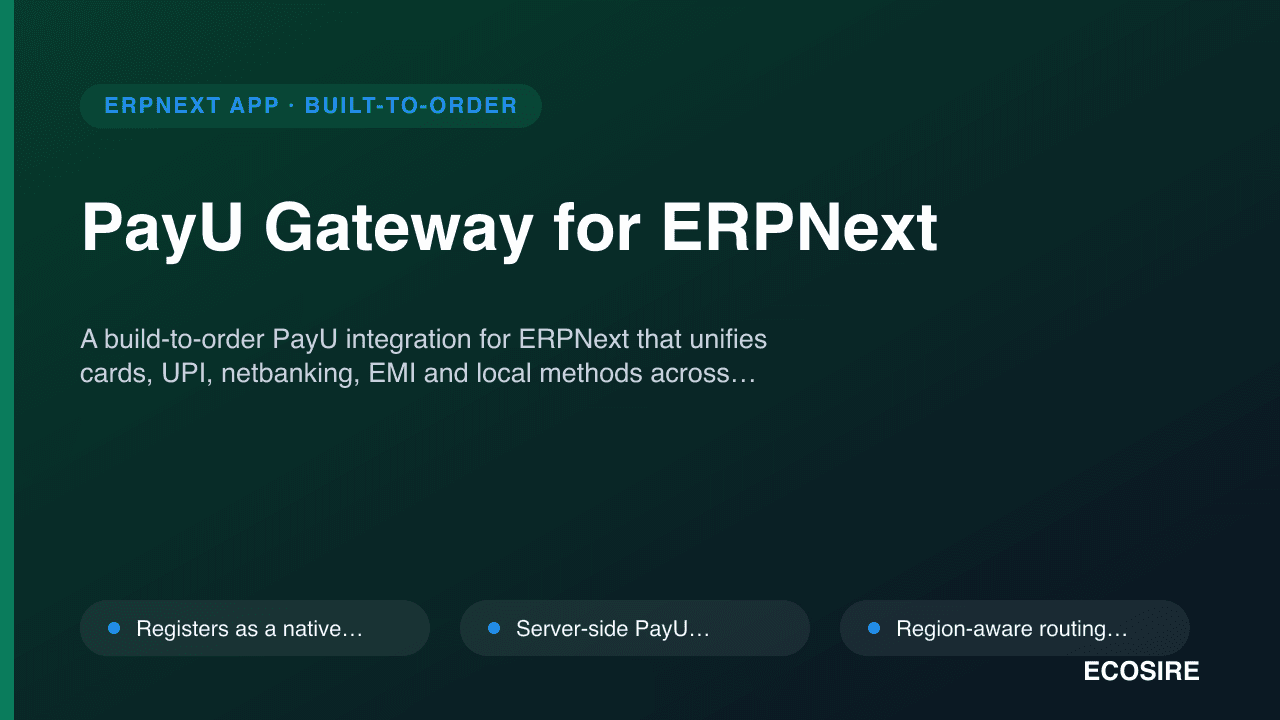
 उदाहरणात्मक पूर्वावलोकन
A build-to-order PayU integration for ERPNext that unifies cards,
UPI, netbanking, EMI and local methods across India, LATAM and EMEA.
ECOSIRE builds it as a proper Frappe app, installs it on your bench, and supports it after go-live.
PayU Gateway for ERPNext क्या है?
A build-to-order PayU integration for ERPNext that unifies cards, UPI, netbanking, EMI and local methods across India, LATAM and EMEA. ECOSIRE builds it as a proper Frappe app, installs it on your bench, and supports it after go-live. Built to order by ECOSIRE for ERPNext v15, v16 — indicative price from $999.00 USD; request a quote for a scoped proposal.
प्रमुख सुविधाएँ
ऑर्डर पर निर्मित, पूरी तरह आपके लिए तैयार
स्वयं सेटअप की ज़रूरत नहीं — ECOSIRE द्वारा निर्मित, इंस्टॉल और समर्थित एक कार्यशील ऐप।
- 1
आप ऑर्डर करते हैं
एक बार के निर्माण मूल्य से शुरू करें। किकऑफ़ पर हम आपके साथ मिलकर दायरा तय करते हैं।
- 2
हम बनाते और इंस्टॉल करते हैं
ECOSIRE इसे आपके ERPNext पर बनाता, कॉन्फ़िगर और इंस्टॉल करता है।
- 3
लाइव + समर्थन
आप लगभग एक कार्य सप्ताह में लाइव हो जाते हैं, गो-लाइव के बाद दो सप्ताह के समर्थन के साथ। हमारे द्वारा दिए गए कोड की खामियाँ निःशुल्क ठीक की जाती हैं।
तकनीकी विनिर्देश
- ERPNext संगतता
- —
- लाइसेंस
- लाइसेंस की पुष्टि आवश्यक है
- Python आवश्यकता
- Python 3.10+
- डेटाबेस
- MariaDB 10.6+
इस उत्पाद के बारे में
Multi-region ERPNext merchants hit a wall quickly with payments. ERPNext ships a generic Payment Gateway framework and a few first-party integrations, but PayU is not one of them — and PayU itself is really three different acquiring stacks (PayU India, PayU LATAM/EBANX-adjacent flows, and PayU EMEA) with distinct API hosts, credential formats, hashing schemes and supported instruments. Bolting one region's flow onto a Payment Request with a custom server script gets a demo working, but it breaks the moment you need UPI intent alongside saved cards, EMI tenures, netbanking bank lists, or a webhook that reconciles an asynchronous UPI collect request hours later. Reconciliation, refunds, idempotency and multi-currency settlement are exactly where the native path runs out of road.
We build a proper Frappe app (for example payu_erpnext) with its own module, not a pile of loose server scripts. It registers as a first-class ERPNext Payment Gateway so Payment Request, the web checkout, and Sales Invoice payment entries all route through it. A PayU Settings (Single) DocType holds per-region credentials (merchant key, salt/secret, client credentials) with the salt stored as a Password field, plus a sandbox/live toggle and a chosen instrument set. Region and instrument routing is data-driven through child tables, so one install can serve an India entity on UPI/netbanking/EMI and an EMEA entity on cards from the same codebase.
Technically, the checkout server flow is a whitelisted method (@frappe.whitelist()) that builds and signs the PayU request hash server-side, so the salt never reaches the browser, and returns either a hosted-checkout redirect or a Server SDK payload for an embedded flow. Return and webhook handlers are whitelisted, allow_guest endpoints that re-verify the response hash before trusting any status, then update the linked Payment Request/Payment Entry and create the payment against the invoice. hooks.py wires doc_events on Sales Invoice and Payment Request for state transitions, and scheduler_events run a reconciliation job that polls PayU for pending/async transactions (UPI collect, delayed netbanking) and closes them out — so a customer who completes payment after the browser closes still gets reconciled. Tokenization and recurring are modeled as their own DocTypes storing the PayU token reference (never raw PAN), enabling one-click and saved-card charges and subscription debits. Client Scripts drive the checkout UX on the web form, a dedicated Role Profile and permission rules gate the settings and transaction logs, and every request/response is written to an auditable log DocType. The whole thing targets Frappe/ERPNext v15 and v16 and is delivered against your bench, respecting your existing site_config.json and app structure.
Because this is build-to-order, nothing ships until we agree on scope. We start with a short scoping call to confirm your PayU regions and MID setup, the instruments you actually need, your ERPNext version, and how checkout should behave (hosted redirect vs. embedded, guest vs. logged-in). From there ECOSIRE builds the app against a staging copy of your site, runs UAT with real sandbox transactions, then installs on production with a rollback plan and hands over the git repository. Typical delivery is one working week from confirmed scope, followed by a post-go-live support window. No instant download, no shortcuts, no fabricated benchmarks — a maintained Frappe app built for your acquiring setup.
What you get
- Installable Frappe app source code for your ERPNext version (v15 or v16), pinned to your bench
- Installation and configuration on your staging then production site, including PayU credential and region setup
- Technical documentation: app architecture, DocTypes, hooks, whitelisted endpoints and webhook contract
- End-user guide plus a live training session for your finance/ops team
- UAT on a staging copy with real PayU sandbox transactions, plus a documented production rollback plan
- Post-go-live support window for defect fixes and configuration help
- Git repository handover with full commit history and tagged release
- PayU sandbox-to-live cutover checklist and reconciliation runbook
Who this is for
Multi-region ERPNext merchant
Runs one ERPNext instance across India, LATAM and/or EMEA entities and needs a single PayU integration that handles each region's instruments, currencies and settlement without three separate hacks.
Indian D2C / retail operator on ERPNext
Needs UPI, netbanking and EMI live at checkout with reliable async reconciliation, so payments made after the browser closes still post correctly against the Sales Invoice.
Finance / accounts lead
Wants every PayU payment, refund and token action auditable inside ERPNext, mapped to the right company and account, with permissions restricting who can touch gateway settings.
ERPNext delivery partner or in-house Frappe team
Wants a clean, maintainable Frappe app with proper DocTypes, hooks and tests they can own and extend, not undocumented server scripts glued to a Payment Request.
How PayU Gateway for ERPNext Compares
| Criterion | ECOSIRE | Custom Build | Competitor | ERPNext नेटिव |
|---|---|---|---|---|
| PayU multi-region support (India/LATAM/EMEA) | Data-driven region routing built to your MIDs | Whatever you scope and code yourself | Usually single-region, often India-only | No PayU support at all |
| Instruments (UPI, netbanking, EMI, cards) | Full set, per-region, as scoped | Add each one by hand | Cards plus a subset, varies by app | Generic gateway framework, no PayU instruments |
| Async reconciliation (UPI collect, delayed) | scheduler_events polling + webhook re-verify | You must build the polling job | Often webhook-only, gaps on async | Manual matching |
| Tokenization & recurring | Token DocTypes, one-click and subscription debits | Design and store tokens yourself | Sometimes, rarely full recurring | Not available |
| Security of gateway secrets | Encrypted Password field, server-side hashing | Depends on your discipline | Varies; some leak keys client-side | N/A |
| Fit to your ERPNext & bench | Built for your v15/v16 site and structure | Fully bespoke by definition | Generic, may not match your version | Core only |
| Ownership & maintainability | Clean Frappe app + git repo handover | You own it, and all the maintenance | Vendor-controlled, black-box updates | N/A |
| Support & delivery model | Build-to-order, UAT, post-go-live window | Your team's time and risk | Best-effort marketplace support | Community support only |
Frequently Asked Questions about PayU Gateway
How long does delivery take?
This is a build-to-order product, so typical delivery is one working week from confirmed scope. The clock starts once we've agreed on your PayU regions, the instruments you need, your ERPNext version and the checkout behaviour on the scoping call. Complex multi-region or multi-entity setups sit at the longer end; a single-region India card/UPI build is faster.
Is this a download I can install myself right now?
No. It is not an existing Frappe Cloud Marketplace app you download instantly. ECOSIRE builds the Frappe app for your specific PayU and ERPNext setup, installs it on your bench, and supports it after go-live. You receive the full source and git repository at handover.
Which ERPNext versions are supported?
We build and test against Frappe/ERPNext v15 and v16. Tell us your exact version and bench setup on the scoping call and we target that; if you're on an older version we'll advise whether an upgrade or a backport is the better path.
How does support and updates work after go-live?
Every build includes a post-go-live support window for defect fixes and configuration help. Because you own the git repository, your own Frappe team can also maintain it. For ongoing changes — new PayU regions, added instruments, or a version upgrade — we offer a maintenance arrangement scoped separately.
Does it handle all three PayU regions (India, LATAM, EMEA)?
It can. PayU India, LATAM and EMEA use different API hosts, credential formats and hashing schemes, so region routing is data-driven through child tables and per-region PayU Settings. We build the regions and instruments you actually need — confirm those on the scoping call so we don't over-build.
Is card and PCI data handled safely?
Yes. The PayU salt/secret is stored as an encrypted Password field and request hashing happens server-side, so it never reaches the browser. Saved cards and recurring use PayU tokenization — we store the PayU token reference, never the raw PAN — keeping card data out of your ERPNext database.
How do asynchronous payments like UPI collect get reconciled?
A scheduler_events job polls PayU for pending and delayed transactions (UPI collect, some netbanking) and closes them out, and the webhook handler re-verifies status before updating documents. So a customer who completes payment after the browser closes still gets reconciled and posted against the correct Sales Invoice.
Related Modules
Paystack Gateway for ERPNext
A build-to-order Paystack payment integration for ERPNext that adds cards, bank transfer, USSD, QR, and mobile money to your invoices, payment links, and subscriptions. ECOSIRE scopes, builds, installs, and supports it for your African commerce workflows.
PayTabs Payment Gateway for ERPNext
A build-to-order Frappe app that wires PayTabs into ERPNext's Payment Gateway framework, so MENA merchants can accept mada, Visa, Mastercard, Amex, Apple Pay and STC Pay across 168+ currencies with hosted or seamless checkout. ECOSIRE builds, installs and supports it for your scope.
Peppol EU E-Invoicing (BIS 3.0 / EN16931)
A build-to-order ERPNext app that generates, sends and receives Peppol BIS Billing 3.0 (UBL 2.1, EN16931) e-invoices through your EU Access Point provider. ECOSIRE scopes, builds, installs and supports it — this is not a one-click marketplace download.
Performance Management & OKR Suite
A build-to-order Frappe app that adds cascading OKRs, KPI scorecards, KRA-linked appraisals and continuous check-ins to ERPNext HR. ECOSIRE scopes, builds, installs and supports it on your bench — this is not an instant marketplace download.
PayU Gateway
A build-to-order PayU integration for ERPNext that unifies cards, UPI, netbanking, EMI and local methods across India, LATAM and EMEA. ECOSIRE builds it as a proper Frappe app, installs it on your bench, and supports it after go-live.
- Registers as a native ERPNext Payment Gateway so Payment Request, web checkout and Sales Invoice payment entries all route through PayU
- Server-side PayU request-hash generation and response-hash verification inside whitelisted methods — the salt/secret never reaches the browser
- Region-aware routing across PayU India, LATAM and EMEA via data-driven child tables (distinct API hosts, credential formats and hashing per region)
- Supports cards, UPI (intent and collect), netbanking with live bank lists, and EMI tenure selection