 उदाहरणात्मक पूर्वावलोकन
A build-to-order Dynamics 365 Business Central extension that exposes dark-store level availability to
quick-commerce platforms, accepts slot- and cut-off-aware orders, and drives courier handoff plus channel fee reconciliation.
ECOSIRE scopes, builds, installs and supports it for your tenant.
Quick Commerce Connector क्या है?
A build-to-order Dynamics 365 Business Central extension that exposes dark-store level availability to quick-commerce platforms, accepts slot- and cut-off-aware orders, and drives courier handoff plus channel fee reconciliation. ECOSIRE scopes, builds, installs and supports it for your tenant. Built to order by ECOSIRE for Dynamics 365 BC (build-to-order) — indicative price from $999.00 USD; request a quote for a scoped proposal.
प्रमुख सुविधाएँ
ऑर्डर पर निर्मित, पूरी तरह आपके लिए तैयार
स्वयं सेटअप की ज़रूरत नहीं — ECOSIRE द्वारा निर्मित, इंस्टॉल और समर्थित एक कार्यशील ऐप।
- 1
आप ऑर्डर करते हैं
एक बार के निर्माण मूल्य से शुरू करें। किकऑफ़ पर हम आपके साथ मिलकर दायरा तय करते हैं।
- 2
हम बनाते और इंस्टॉल करते हैं
ECOSIRE इसे आपके Dynamics 365 Business Central पर बनाता, कॉन्फ़िगर और इंस्टॉल करता है।
- 3
लाइव + समर्थन
आप लगभग एक कार्य सप्ताह में लाइव हो जाते हैं, गो-लाइव के बाद दो सप्ताह के समर्थन के साथ। हमारे द्वारा दिए गए कोड की खामियाँ निःशुल्क ठीक की जाती हैं।
इस उत्पाद के बारे में
Quick commerce breaks the assumptions Business Central was built on. A standard sales order assumes a shipment date measured in days, availability calculated across a location, and a picking process a warehouse operator starts when they get to it. Quick-commerce platforms assume the opposite: they ask what is on the shelf of one dark store right now, they close an order slot in ten minutes, and they expect a courier assignment and a live status stream back within seconds. Out of the box, Business Central gives you Item Ledger Entry, Warehouse Entry, locations and bins, and a solid sales order pipeline — but it has no notion of a delivery slot, no cut-off calendar, no substitution policy for an out-of-stock line, and no place to book a courier or reconcile a platform's commission and picking fees against the payout you actually received.
What we build is an AL extension — delivered as a per-tenant extension or, where you want it, an AppSource-track app — that adds those concepts natively rather than bolting on a middleware layer. Dark stores are modelled on Business Central locations with a Dark Store Setup table carrying the platform mapping, the buffer policy and the publishing cadence. A dedicated availability codeunit reads Item Ledger Entry and Warehouse Entry net of open reservations and open quick-commerce orders, applies your safety buffer per item category, and publishes a per-store, per-SKU quantity through a custom API page (REST API v2.0, OData v4) that the platform or your integration middleware polls or receives by webhook. Publishing runs on job queue entries so cadence is configurable per store — every few minutes for fast movers, on-change for the rest.
Order intake lands on a staging table with its own page, not straight into Sales Header. That matters: a quick-commerce order arriving after its slot cut-off, or referencing a store that is closed, must be rejected or re-routed before it becomes a document. The cut-off engine holds per-store slot calendars and lead times, and stamps every incoming order with its promised slot; only orders that pass validation are released into a sales order via a codeunit that maps SKUs, applies the platform's price list, and reserves inventory against the dark store location. Substitution and shortage handling is driven by policy tables — swap to a mapped alternate, part-ship, or cancel the line — and every decision is written back to the platform through the same API surface so the app and the customer see the truth.
Courier handoff creates a dispatch record, pushes the pick-ready signal, and consumes status callbacks (assigned, picked up, delivered, failed) that post through to warehouse shipment and, where you want it, to the posted sales invoice. Fee reconciliation imports the platform's settlement file, matches commission, picking and delivery fees line by line against the order, and posts the variance to a G/L account you nominate — so the payout that hits the bank is explainable. Event subscribers are used throughout rather than base-app modification, permission sets ship with the extension, and Dataverse / Power Platform connectivity is available where you want Power BI fill-rate dashboards or a Power Apps picking screen on top.
This is build-to-order, and we are explicit about what that means. There is no AppSource button to press today. You request a quotation, we run a scoping call, and we write down the platforms you sell through, your dark-store footprint, how your SKUs and barcodes map to each channel's catalogue, your slot calendar, your substitution rules and your Business Central version and deployment (SaaS or on-premises, current release wave). From that confirmed scope we build, and typical delivery is one working week. You get the AL source for your version, installation and configuration on your tenant, UAT on a sandbox before anything touches production, a documented rollback, training for your operations and finance teams, and a post-go-live support window while the first settlement cycles run through.
What you get
- Installable AL extension source code built and tested for your specific Business Central version and deployment type (SaaS or on-premises)
- Installation and configuration on your tenant: dark-store setup, channel mappings, slot calendars, substitution policies and job queue entries
- Technical documentation covering object ranges, table and page extensions, codeunit responsibilities, API page contracts with sample payloads, and permission set definitions
- End-user guide plus a live training session for operations and finance, covering order exceptions, substitutions, courier status and the settlement reconciliation run
- UAT on your sandbox environment with a scripted test pack and a written, rehearsed rollback plan before production deployment
- Post-go-live support window for defect fixes and configuration adjustments while your first settlement cycles complete
- Git repository handover with full commit history, branch strategy and build instructions so your team or another partner can maintain it
- Handover session with your Business Central partner or internal IT covering deployment, job queue monitoring and reading the activity log
Who this is for
Head of E-commerce / Quick Commerce, FMCG brand
Owns revenue through the quick-commerce platforms and is judged on availability and fill rate. Needs store-level stock published accurately and fast enough that the app does not sell what the shelf does not have, and needs substitution decisions to be policy-driven rather than a phone call to the store.
Supply Chain / Dark Store Operations Manager
Runs the network of dark stores and micro-fulfilment sites. Needs cut-offs respected so pickers are not handed impossible slots, shortages surfaced before the courier arrives, and one place inside Business Central to see the state of every live order instead of a browser tab per platform.
Finance Manager / Financial Controller
Has to explain the gap between gross order value and the payout that lands in the bank. Needs commission, picking and delivery fees matched line by line against orders, variances posted to a nominated G/L account, and a drill-down that survives an audit.
IT Manager / Business Central Solution Architect
Owns the tenant and the upgrade path. Needs an event-subscriber-based extension with no base-app modification, proper permission sets, documented API contracts and source code in their own repository, so release waves and future partner changes are never blocked.
How Quick Commerce Connector Compares
| Criterion | ECOSIRE | Custom Build | Competitor | Dynamics 365 Business Central नेटिव |
|---|---|---|---|---|
| Dark-store level availability | Purpose-built engine: per-store, per-SKU, net of reservations and open orders, with a tunable safety buffer | Achievable, but the netting and buffer logic is the hard part your team must specify and test from scratch | Usually publishes location on-hand; store-level netting and buffers vary widely by vendor | Availability is calculated per location for order promising — there is no channel-facing publishing mechanism |
| Slot and cut-off handling | Per-store slot calendars, lead times and blackout windows enforced before an order becomes a document | Designed from scratch; teams routinely underestimate blackout windows and store opening hours | Often a single global cut-off rather than per-store calendars | No concept of a delivery slot or cut-off anywhere in the sales order pipeline |
| Substitution and shortage handling | Policy tables per item and channel with swap, part-ship or cancel outcomes, written back to the platform | Buildable, but the write-back contract with each platform is the work most projects underscope | Frequently limited to line cancellation plus a notification | Item substitution exists on sales lines but has no channel write-back and no automated policy |
| Courier handoff and status sync | Dispatch records, pick-ready signalling and inbound status callbacks driving shipment and invoice posting | Each courier API is a separate integration effort plus a status state machine you own forever | Typically supports the vendor's own preselected courier partners only | Shipping agent and tracking number fields only — no live status ingestion |
| Channel fee reconciliation | Settlement import with line-level fee matching and variance posting to a nominated G/L account | Doable, but reconciliation logic and the audit drill-down are a project in their own right | Often out of scope, or a summary import without line-level matching | Settlement files are reconciled by hand in spreadsheets |
| Upgrade safety | Event subscribers, no base-app modification, own permission sets — recompile and regression-test per release wave | Depends entirely on the discipline of whoever wrote it; base-app changes are a common shortcut | Generally upgrade-safe, but you are tied to the vendor's release cadence | Nothing to upgrade, because the capability does not exist |
| Fit to your process | Built to your confirmed scope: your stores, SKU mapping, slot rules, platforms and courier services | Maximum fit, at the cost of your own analysis, build and long-term maintenance | You adapt your process to the vendor's model; deeper changes wait on their roadmap | Standard Business Central process only; the gaps are absorbed by manual work |
| Ownership and handover | Full AL source, git repository handover, technical docs, training and a post-go-live support window | You own everything, including the documentation and knowledge-transfer burden | Licensed binary; source is rarely provided and lock-in is real | Nothing to own beyond configuration |
Frequently Asked Questions about Quick Commerce Connector
How long does delivery take, and what happens first?
This is a build-to-order product, so there is nothing to download today. Delivery is typically one working week from confirmed scope. It starts with a short scoping call where we capture your quick-commerce platforms, dark-store footprint, SKU and barcode mapping, slot calendar, substitution rules and your Business Central version and deployment type. Once that scope is confirmed in writing, the build clock starts. A wider footprint, several platforms at once, or a non-standard courier API can extend the timeline — we tell you that during scoping, not afterwards.
What support and updates do I get after go-live?
The engagement includes a post-go-live support window covering defect fixes and configuration adjustments while your first settlement cycles run through, which is deliberately the period where real-world edge cases surface. Beyond that window we offer an optional annual support and maintenance agreement covering compatibility with new Business Central release waves, platform API changes and enhancement work. Because the extension uses event subscribers with no base-application modification, a release wave normally means recompiling against the new target and running the regression pack rather than a rewrite.
Does this work on Business Central SaaS, on-premises, or both?
Both. We build against current supported release waves and target your specific version. On SaaS we deliver a per-tenant extension, or an AppSource-track app if you intend to distribute it; on-premises you get the same AL source with deployment instructions for your environment. Outbound and inbound platform traffic uses the extension's own HTTP client and API pages. On-premises deployments may additionally need firewall and certificate work, which we cover in the scoping call.
Which quick-commerce platforms and couriers do you support?
We do not publish a fixed list, because platform APIs differ by market and change often. The connector is built around a channel abstraction: availability publishing, order intake, status write-back and settlement import are generic, and each platform gets a mapping layer built to its documented API. We build the platforms and courier services you name in the scope. Adding another platform later is usually configuration plus a mapping layer rather than a new build, and we size that separately when you ask.
How does it avoid overselling a dark store?
Published availability is computed net of open reservations and open quick-commerce orders, not raw on-hand, and a configurable safety buffer is applied per item or item category. Orders reserve against the publishing store at release and are re-checked at intake, so an order arriving against stock that has already gone hits the substitution policy instead of becoming a sales order nobody can pick. Some latency between publish and platform display always remains — that is a property of the platform, not the extension — so the buffer is the control you tune.
Will it modify the base application or block my upgrades?
No base application objects are modified. The extension uses its own tables and codeunits, table and page extensions, and event subscribers on standard publishers, and it ships with its own permission sets. That architecture is what keeps release-wave upgrades routine: recompile against the new target, run the regression pack, deploy. We hand over the source and the build instructions so your own team can do that if you prefer.
Can I get the source code, and who owns it?
Yes. You receive the full AL source built for your version, delivered through a git repository handover with commit history and build instructions. Licensing and ownership terms are set out in the quotation before any work starts, so there is no ambiguity about what you can modify, extend or hand to another partner later.
Related Modules
PrestaShop Connector for Business Central
A build-to-order AL extension that keeps PrestaShop storefronts and Business Central in real-time sync: orders, customers, invoices, products, combinations, stock and prices. Built, installed per-tenant, and supported by ECOSIRE on your BC environment.
Print-on-Demand Connector
An AL extension that connects your print-on-demand production partners to Dynamics 365 Business Central, pushing orders with the correct artwork and variant, tracking production status, importing shipments and tracking numbers, and reconciling partner costs against purchase invoices. Built to order by ECOSIRE for your Business Central version, partners and item structure.
Refurbished Marketplace Connector
A build-to-order Dynamics 365 Business Central AL extension that connects your refurbished-marketplace channel to Business Central with condition grades as first-class data — per-grade pricing and availability, order import, listing export, tracking push-back and settlement posting. ECOSIRE builds it against your version and hands over the source.
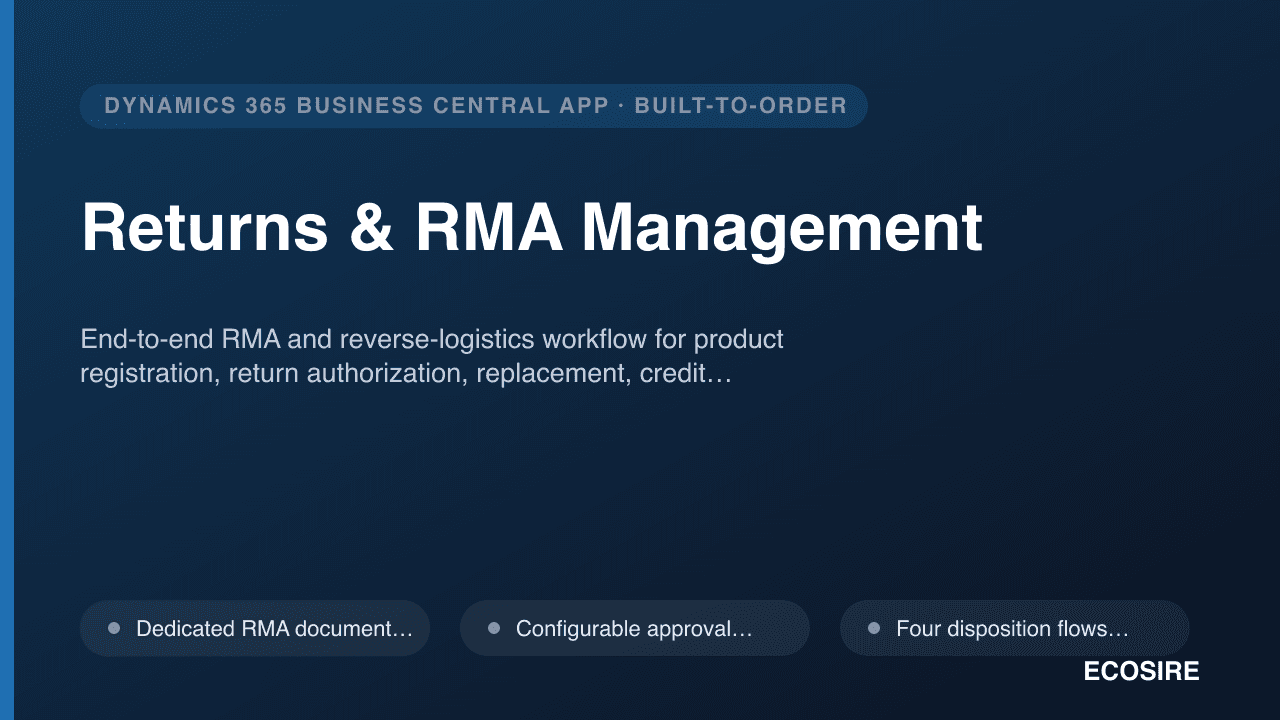
Returns & RMA Management
End-to-end RMA and reverse-logistics workflow for product registration, return authorization, replacement, credit, and repair, built as a per-tenant AL extension inside your Business Central environment.
Quick Commerce Connector
A build-to-order Dynamics 365 Business Central extension that exposes dark-store level availability to quick-commerce platforms, accepts slot- and cut-off-aware orders, and drives courier handoff plus channel fee reconciliation. ECOSIRE scopes, builds, installs and supports it for your tenant.
- Dark-store availability engine: per-location, per-SKU quantities computed from `Item Ledger Entry` and `Warehouse Entry` net of reservations, open quick-commerce orders and a configurable safety buffer
- Custom API pages (REST API v2.0 / OData v4) exposing store-level stock, order acknowledgement and status endpoints, with ETag-based concurrency so a stale platform write cannot overwrite newer state
- Slot and cut-off calendar per dark store, with lead times, blackout windows and store opening hours enforced before an order ever becomes a `Sales Header`
- Order intake staging table and page: incoming orders validate SKU mapping, store status and slot eligibility, with failures held in an exception queue and a retry action rather than silently disappearing