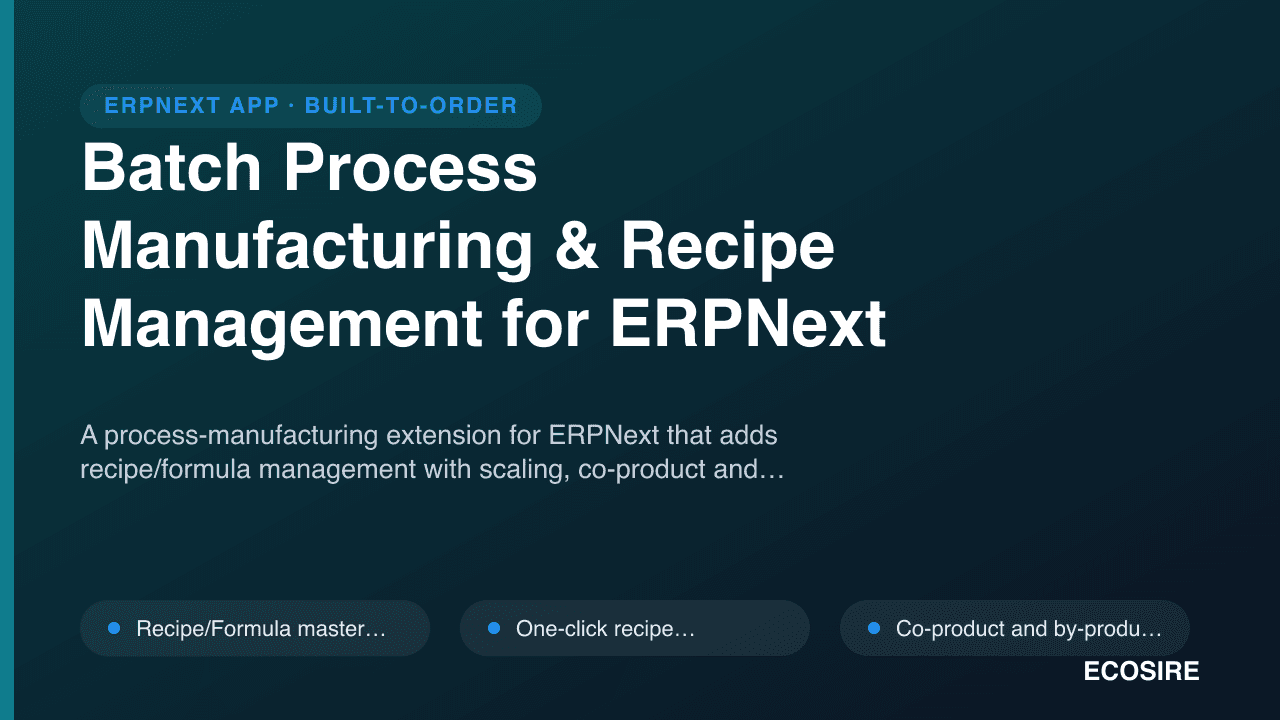
 示意预览
示意预览A process-manufacturing extension for ERPNext that adds recipe/formula management with scaling,
co-product and by-product yield allocation, theoretical-vs-actual yield variance, and full batch genealogy.
ECOSIRE builds it to your confirmed scope, installs it on your bench, and supports it after go-live.
什么是 Batch Process Manufacturing & Recipe Management for ERPNext?
A process-manufacturing extension for ERPNext that adds recipe/formula management with scaling, co-product and by-product yield allocation, theoretical-vs-actual yield variance, and full batch genealogy. ECOSIRE builds it to your confirmed scope, installs it on your bench, and supports it after go-live. Built to order by ECOSIRE for ERPNext v15, v16 — indicative price from $999.00 USD; request a quote for a scoped proposal.
核心功能
按需定制,全程代劳
无需自行搭建——由 ECOSIRE 构建、安装并提供支持的可用应用。
- 1
您下单
以一次性构建价格开始。我们在启动时与您共同确定范围。
- 2
我们构建与安装
ECOSIRE 在您的 ERPNext 上构建、配置并安装。
- 3
上线 + 支持
约一个工作周内上线,并包含两周上线支持。我们交付的代码中的缺陷免费修复。
技术规格
- ERPNext 兼容性
- —
- 许可证
- 许可证需要确认
- Python 要求
- Python 3.10+
- 数据库
- MariaDB 10.6+
关于此产品
Food, chemical, cosmetics, and nutraceutical plants don't build products by assembling discrete parts — they mix, react, cook, and blend ingredients where the output quantity is never exactly what the math predicted. ERPNext's native BOM and Work Order model was designed for discrete assembly: a fixed BOM of components produces a fixed quantity of one finished good. It has no first-class concept of a scalable formula, no way to record that one batch also produced a saleable by-product and a waste stream, no theoretical-versus-actual yield reconciliation, and no potency adjustment when an incoming raw material assays at 92% instead of the label 100%. Process teams end up running spreadsheets alongside ERPNext, and the two drift apart.
This build-to-order app closes that gap as a proper Frappe application installed on your bench (bench get-app / bench install-app), namespaced so it survives ERPNext upgrades. We introduce process DocTypes — a Recipe/Formula master with percentage- or quantity-based line items, a Batch Production Order that scales a recipe to a target batch size, and Yield Reconciliation records that capture actual outputs against theoretical. Co-products and by-products are modeled as distinct output lines with configurable cost-allocation methods (by weight, by market value, or fixed ratio), so ERPNext's stock ledger and valuation stay correct instead of dumping everything onto a single finished good. Potency/concentration handling reads an assay value on the incoming Batch (a Batch DocType custom field) and adjusts the charged quantity of that ingredient at Work Order creation so the active-ingredient target is met.
Technically it's wired the way a maintainable Frappe app should be: hooks.py document events (validate, on_submit, on_cancel) enforce the yield and allocation logic server-side rather than in fragile UI scripts; Server Scripts and whitelisted Python methods (@frappe.whitelist()) expose recipe-scaling and reconciliation to both the desk and the Frappe REST API (/api/method/...) for line/plant integrations; Client Scripts drive the batch-sizing and live yield-variance feedback in the Work Order form. Batch genealogy is built on ERPNext's existing Batch and Serial/Batch Bundle plumbing, extended with a traceability report that walks forward (where did this input batch end up?) and backward (what raw batches went into this finished lot?) — the foundation of a recall in a regulated plant. Role Profiles and permission rules keep formula IP visible only to the roles you authorize, and scheduler events can push nightly yield-variance and expiring-batch digests.
Because this is build-to-order, nothing ships until we agree on scope. A short scoping call maps your recipes, allocation rules, and traceability needs; we then build against ERPNext v15/v16 on a staging bench, run UAT with your real formulas, and hand over installable source plus a git repository. Typical delivery is one working week from confirmed scope, and every engagement includes a post-go-live support window and a documented rollback plan.
你得到什么
- Installable source code for your commissioned version of the app, packaged as a standard Frappe app
- Installation and configuration on your bench (staging first, then production) including custom fields, Role Profiles, and permissions
- Technical documentation: DocType reference, hooks/server-script logic, REST endpoints, and configuration notes
- End-user guide plus a live training session for production managers and operators
- Post-go-live support window for defect fixes and configuration questions
- UAT on a staging bench with your real recipes, plus a documented rollback plan before production cutover
- Handover of the full git repository so your team owns and can extend the code
- Compatibility validation against your ERPNext v15 or v16 version and existing customizations
这是给谁的
Process production manager
Runs mixing, reacting, or blending lines in food, chemical, cosmetics, or nutraceutical plants. Needs recipes that scale to any batch size and a true theoretical-vs-actual yield number per run, not a discrete BOM that assumes zero loss.
Quality & compliance lead
Owns traceability and recall readiness. Needs forward/backward batch genealogy, potency-aware ingredient handling, and shelf-life tracking that stands up to an audit — all inside ERPNext rather than a parallel spreadsheet.
Cost accountant / plant controller
Needs joint-output costs allocated correctly across co-products, by-products, and scrap so ERPNext valuation and margins reflect reality, instead of every cost landing on one finished good.
ERP manager / systems owner
Wants the extension delivered as a clean, namespaced Frappe app that survives v15/v16 upgrades, exposes a REST surface for line/MES integration, and comes with source and a git repo their team can maintain.
Batch Process Manufacturing & Recipe Management for ERPNext 如何比较
| 标准 | 伊科西尔 | 定制建造 | 竞争对手 | ERPNext 原生 |
|---|---|---|---|---|
| Recipe / formula model | Scalable Recipe DocType, percent or quantity based | Whatever you spec and can build in-house | Often a light BOM wrapper, limited scaling | Discrete BOM only, no formula scaling |
| Co-products & by-products | Distinct output lines with cost allocation | Possible but you design the accounting | Rarely handled or single-output only | No joint-output concept |
| Yield variance | Theoretical vs actual, tolerance-flagged per batch | Buildable, needs careful reconciliation logic | Usually absent or manual | Assumes fixed BOM yield, no variance |
| Batch genealogy | Forward/backward traceability report for recall | Depends on developer effort | Basic batch tracking at best | Batch tracking without genealogy report |
| Potency / assay adjustment | Assay-driven ingredient rescaling at order time | Achievable with significant effort | Typically not supported | Not supported |
| Upgrade safety | Namespaced Frappe app, no core patching, v15/v16 | Depends on discipline of your build | Varies; some patch core | N/A — is the core |
| Ownership & source | Full source + git repo handover | You own it but you carry all the risk | Often closed or license-locked | Core code, not tailored to you |
| Delivery & support | 2–4 wk build, UAT, rollback, post-go-live window | Your team's timeline and maintenance burden | Download now, generic/community support | Immediate, but the gap stays unfilled |
关于Batch Process Manufacturing & Recipe Management的常见问题
Is this a ready-made app I can download and install right now?
No. It is build-to-order. ECOSIRE builds it to your confirmed scope, installs it on your bench, and supports it after go-live. There is no instant download — the value is a Frappe app tailored to your recipes, allocation rules, and traceability needs, not a generic marketplace listing.
How long does delivery take?
Typically one working week from confirmed scope. The clock starts once the scoping call has fixed your recipe model, co-product/by-product allocation rules, and traceability requirements. Larger or heavily integrated builds may run longer, and we will tell you before we start.
Which ERPNext versions does it support?
We build and validate against ERPNext/Frappe v15 and v16. During scoping we confirm your exact version and check compatibility with your existing customizations. It is delivered as a namespaced Frappe app installed via bench, with no patching of ERPNext core files, so it is upgrade-safe.
How do co-product, by-product, and scrap costs get handled?
Each joint output is a distinct stock item output line, and you choose the cost-allocation method — by weight, by relative market value, or a fixed ratio. The app posts against ERPNext's stock ledger and valuation so co-products, by-products, and waste all carry proper cost rather than being dumped onto a single finished good.
Can it feed our plant line or MES system?
Yes. Recipe scaling and yield reconciliation are exposed through whitelisted @frappe.whitelist() methods over the Frappe REST API (/api/method/...), so line controllers or an MES can create batch orders and post actual yields programmatically. We scope the exact endpoints and payloads with you during the build.
What about support and updates after go-live?
Every engagement includes a post-go-live support window for defect fixes and configuration questions. Because you receive the full git repository and installable source, your team can extend it independently, and we can quote an ongoing support or enhancement retainer if you prefer we maintain it.
How do you protect our formulas and recipe IP?
Recipe and formula DocTypes are secured with ERPNext Role Profiles and permission rules so only the roles you authorize can view or edit them. Access control is part of scoping, and the code stays in your bench and your git repository — it is not resold as a public listing.
相关模块
Batch Process Manufacturing & Recipe Management
A process-manufacturing extension for ERPNext that adds recipe/formula management with scaling, co-product and by-product yield allocation, theoretical-vs-actual yield variance, and full batch genealogy. ECOSIRE builds it to your confirmed scope, installs it on your bench, and supports it after go-live.
- Recipe/Formula master DocType supporting both percentage-based and absolute-quantity line items, with density and unit-of-measure conversion
- One-click recipe scaling: enter a target batch size and the Batch Production Order recalculates every ingredient quantity while preserving ratios
- Co-product and by-product output lines modeled as distinct stock items, not lumped into a single finished good
- Configurable cost-allocation methods for joint outputs — by weight, by relative market value, or fixed ratio — feeding ERPNext's stock valuation correctly