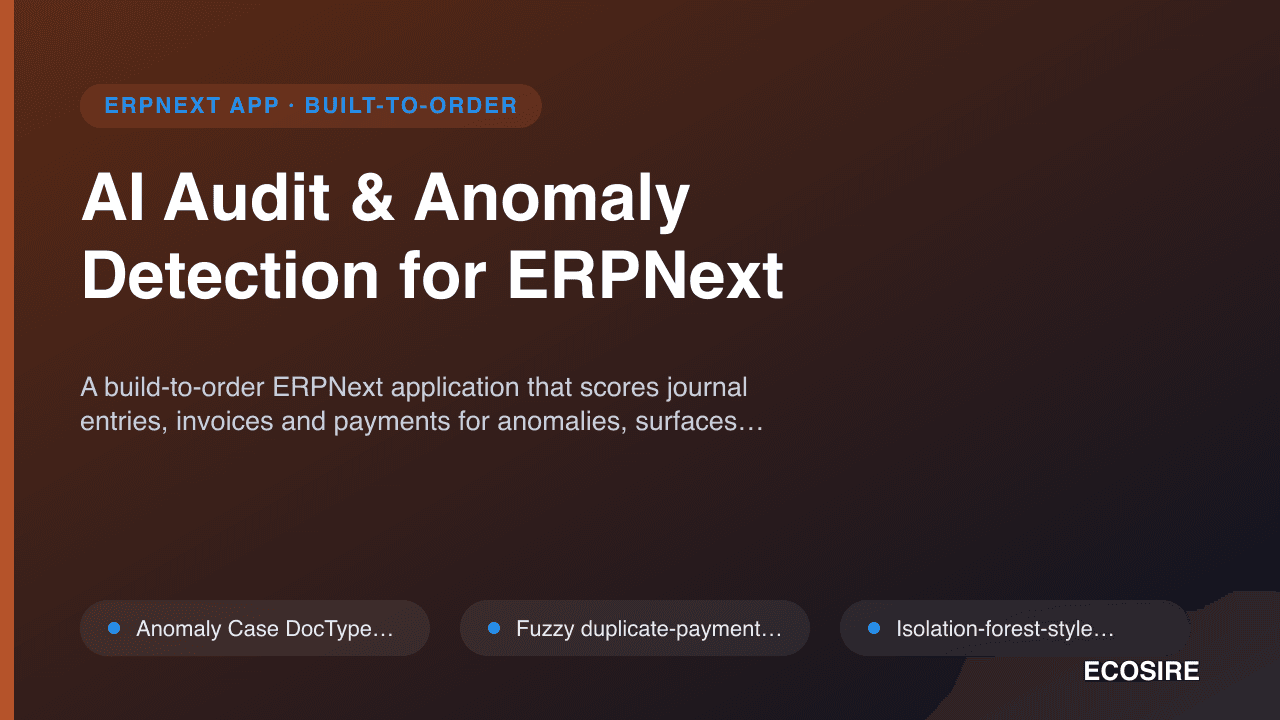
 Örnek önizleme
A build-to-order ERPNext application that scores journal entries,
invoices and payments for anomalies, surfaces duplicate payments and segregation-of-duties breaks, and gives your auditors a review workqueue inside ERPNext.
ECOSIRE scopes, builds, installs and supports it on your v15/v16 site.
AI Audit & Anomaly Detection for ERPNext nedir?
A build-to-order ERPNext application that scores journal entries, invoices and payments for anomalies, surfaces duplicate payments and segregation-of-duties breaks, and gives your auditors a review workqueue inside ERPNext. ECOSIRE scopes, builds, installs and supports it on your v15/v16 site. Built to order by ECOSIRE for ERPNext v15, v16 — indicative price from $999.00 USD; request a quote for a scoped proposal.
Temel Özellikler
Siparişe özel, sizin için baştan sona
Kendiniz kurmanıza gerek yok — ECOSIRE tarafından geliştirilen, kurulan ve desteklenen çalışır bir uygulama.
- 1
Sipariş verirsiniz
Tek seferlik geliştirme fiyatıyla başlayın. Kapsamı başlangıçta sizinle birlikte belirleriz.
- 2
Geliştirir ve kurarız
ECOSIRE, ERPNext ortamınızda geliştirir, yapılandırır ve kurar.
- 3
Yayına alma + destek
Yaklaşık bir iş haftasında yayına alırsınız; canlıya geçiş sonrası iki hafta destek dahildir. Teslim ettiğimiz koddaki hatalar ücretsiz düzeltilir.
Teknik Özellikler
- ERPNext Uyumluluğu
- —
- Lisans
- Lisansın doğrulanması gerekiyor
- Python Gereksinimi
- Python 3.10+
- Veritabanı
- MariaDB 10.6+
Bu Ürün Hakkında
Internal auditors and controllers running ERPNext usually discover control failures the same way everyone else does: after the money has left. A duplicate supplier payment surfaces on a bank reconciliation weeks later; a back-dated Journal Entry posted over a weekend never gets a second look; the same person who created a Purchase Invoice also submitted the Payment Entry because approval workflow was never enforced on that account. ERPNext gives you an immutable submitted-document trail and role-based permissions, but it does not proactively tell you which of last month's ten thousand transactions deserve a human's attention. Native reports are descriptive, not investigative — there is no built-in duplicate-payment sweep, no statistical outlier flag, no segregation-of-duties matrix, and no auditor workqueue. That gap is exactly where teams fall back to exporting to Excel and eyeballing, which does not scale.
ECOSIRE builds a proper Frappe application — its own module, DocTypes and permissions — that runs continuous, explainable checks over your ERPNext accounting data and turns the hits into a reviewable caseload. At the core is an Anomaly Case DocType: each flagged transaction becomes a case with a rule name, a risk score, the linked source document (Journal Entry, Purchase Invoice, Payment Entry, Sales Invoice), a plain-language reason, and a disposition workflow (Open → Under Review → Cleared / Confirmed Exception) driven by ERPNext's native Workflow engine. Detection runs two ways: near-real-time via hooks.py doc events (on_submit, on_update_after_submit) so a suspicious document is scored the moment it is submitted, and as a nightly sweep via a scheduler_events job that re-scans the period for patterns only visible across many documents.
The detection logic is deliberately transparent rather than a black box. Deterministic rules cover the high-value, well-understood risks: fuzzy duplicate detection on (supplier, amount, reference no, date-window) to catch near-duplicate bills and double payments; round-number and threshold-clustering heuristics (amounts landing just under an approval limit); weekend and after-hours posting flags derived from the document's creation and owner; and a segregation-of-duties matrix that compares the owner of the source document against the owner of its downstream Payment Entry and against your Role Profiles. On top of that, an unsupervised model (isolation-forest style scoring over amount, account, party, posting-hour and frequency features) ranks entries that break from each account's own historical pattern — so unusual is defined by your data, not a guessed threshold. Every score ships with the features that drove it, so an auditor can defend the flag. An audit-trail completeness check reconciles the Version/document history to catch gaps, and a set of whitelisted REST methods let your GRC tooling pull cases via the Frappe REST API.
Because this is build-to-order, nothing is a generic download. We start with a scoping call to map your chart of accounts, approval limits, Role Profiles and the specific fraud and error patterns that matter to your business, then tune the rules and model thresholds against a copy of your real data on a staging bench. You get the full source as an installable Frappe app, UAT sign-off on staging before anything touches production, a documented install and rollback plan, auditor training, and a post-go-live support window. Typical delivery is one working week from confirmed scope, depending on the number of detection rules and integrations. It targets Frappe/ERPNext v15 and v16 and installs alongside your existing apps without core patches.
Ne elde edeceksin
- Installable Frappe app (full source) for your version — a proper module with the `Anomaly Case`, rule-registry and supporting DocTypes, server scripts, client scripts and `hooks.py` events
- Installation and configuration on your bench, including scheduler and doc-event wiring, roles/Role Profiles and initial rule thresholds
- Technical documentation: DocType and data model, rule catalog with formulas, scoring/feature reference, REST endpoints and hook map
- Auditor user guide plus a live training session on triage, disposition workflow and reading the explainability panel
- UAT on a staging bench against a copy of your real data, with a documented rollback plan before production cutover
- Post-go-live support window for defect fixes and threshold tuning after real cases start flowing
- Git repository handover with commit history, README and upgrade notes for v15/v16
- Rule-tuning worksheet capturing your approval limits, chart-of-accounts mapping and segregation-of-duties matrix as configured
Bu kimin için
Internal auditor / controller
Owns financial controls and needs a defensible, continuously-updated caseload of suspicious transactions inside ERPNext — with the reasoning behind every flag — instead of monthly Excel exports and manual sampling.
CFO / finance director
Wants assurance that duplicate payments, threshold-gaming and maker-checker breaches are caught before period close, and a high-risk digest without having to log in and hunt.
ERPNext administrator / system manager
Needs the detection layer to install cleanly as a Frappe app on the existing v15/v16 bench, respect the current permission model, and run on the scheduler without core patches or performance surprises.
External auditor / compliance lead
Needs a complete, reconcilable audit trail and exportable exception cases via the REST API to support SOX-style or statutory review and evidence how each exception was dispositioned.
AI Audit & Anomaly Detection for ERPNext Nasıl Karşılaştırılır
| Kriter | ECOSIRE | Özel Yapı | Rakip | ERPNext Yerleşik |
|---|---|---|---|---|
| Duplicate-payment detection | Fuzzy match on supplier/amount/reference/date-window, tunable | Possible but you design and test the matching logic | Often exact-match only, misses near-duplicates | No native sweep; found manually on reconciliation |
| Anomaly scoring | Per-account unsupervised outlier model + explainable rules | Depends entirely on the developer's ML capability | Usually fixed-threshold rules, no learning | None |
| Segregation-of-duties checks | Maker-vs-checker matrix against Role Profiles, flags collisions | Buildable but rarely maintained | Rarely included | Permissions exist; no violation detection |
| Auditor workqueue | `Anomaly Case` DocType with disposition Workflow and assignment | You build the case model and states | Sometimes a flat report, no workflow | No case/disposition concept |
| Explainability | Each flag lists driving features and thresholds | Only if explicitly built | Often black-box or none | N/A |
| ERPNext v15/v16 fit | Native app via hooks/scheduler, no core patches | Varies with developer discipline | May lag on version compatibility | Core, but no audit features |
| Source code & lock-in | Full source + git repo handover | You own it, but bear full build cost | Usually closed-source subscription | Core code, not audit-specific |
| Time to value | one working week from confirmed scope, tuned to your data | Months of spec, build and QA | Fast install but generic, needs heavy tuning | Immediate but no detection capability |
AI Audit & Anomaly Detection hakkında Sıkça Sorulan Sorular
How long does delivery take?
This is a build-to-order engagement, not an instant download. Typical delivery is one working week from confirmed scope, depending on how many detection rules you need, whether we tune the unsupervised model against your data, and any REST/GRC integrations. The scoping call and a written statement of work come first, then build, then UAT on staging before go-live.
How is this different from ERPNext's built-in reports and permissions?
ERPNext gives you role-based permissions and an immutable submitted-document trail, but it is descriptive — it won't proactively tell you which transactions are anomalous. There is no native duplicate-payment sweep, statistical outlier flag, segregation-of-duties matrix or auditor workqueue. This app adds those as first-class DocTypes and scheduled/real-time checks on top of your existing data.
Will the AI produce false positives auditors can't explain?
Every flag ships with the rule name and the exact features and thresholds that produced its score, so an auditor can justify or clear it in an audit file. Deterministic rules (duplicates, SoD, round-number, weekend posting) are fully explainable; the unsupervised outlier model is calibrated against your own account history, and thresholds are tunable during UAT and the support window to drive noise down.
How do updates and support work after go-live?
You receive the full source and a git repository, so you are never locked in. The engagement includes a post-go-live support window for defect fixes and threshold tuning once real cases start flowing. Beyond that window we offer optional support and enhancement retainers, including compatibility updates when you upgrade your Frappe/ERPNext version.
Which ERPNext versions are supported and will it modify core?
It targets Frappe/ERPNext v15 and v16 and installs as a separate app alongside your existing apps — no core patches. It uses standard extension points: `hooks.py` doc events, `scheduler_events`, server and client scripts, custom DocTypes, and whitelisted methods for the REST API.
Does it need to read our production accounting data, and is that safe?
It runs inside your own ERPNext site and reads your accounting DocTypes there — data does not leave your environment. During the build we tune against a copy of your data on a staging bench, and access is scoped through dedicated audit roles/Role Profiles that grant read visibility without posting rights. UAT is signed off on staging with a rollback plan before anything touches production.
Can we start with a few checks and add more later?
Yes. The rules live in a configurable registry DocType, so we can go live with your highest-value checks (typically duplicate payments and segregation-of-duties) and enable or tune additional heuristics and the outlier model over time without redeploying code.
İlgili Modüller
Adyen Payments for ERPNext
A production-grade Adyen integration for ERPNext that unifies online, in-app, and in-person (POS) payments across 200+ countries on one processor. ECOSIRE builds, installs, and supports it for your environment on a build-to-order basis — no instant download.
Affiliate & Referral Program for ERPNext
A native ERPNext app that runs affiliate and referral programs end to end — tracking referral links, attributing sales, calculating tiered commissions, and generating payout statements. ECOSIRE builds it to your commission rules, installs it, and supports it.
AI Invoice Capture — OCR Bills to Purchase Invoice
A build-to-order ERPNext application that uses OCR and AI extraction to turn supplier PDFs, scans, and emailed bills into draft Purchase Invoices — with line items, taxes, supplier matching, and duplicate detection ready for AP review. ECOSIRE scopes, builds, installs, and supports it for your instance.
AI Lead Enrichment & Data Append for ERPNext
A build-to-order Frappe app that automatically appends company, job title, email, firmographic and social data to your ERPNext Leads and Contacts from the enrichment providers you already use. ECOSIRE scopes, builds, installs and supports it — not an instant Marketplace download.
AI Audit & Anomaly Detection
A build-to-order ERPNext application that scores journal entries, invoices and payments for anomalies, surfaces duplicate payments and segregation-of-duties breaks, and gives your auditors a review workqueue inside ERPNext. ECOSIRE scopes, builds, installs and supports it on your v15/v16 site.
- `Anomaly Case` DocType with rule name, risk score, linked source document, human-readable reason and a native ERPNext Workflow (Open → Under Review → Cleared / Confirmed Exception)
- Fuzzy duplicate-payment detection keyed on supplier, amount, bill/reference number and a configurable date window across `Purchase Invoice` and `Payment Entry`
- Isolation-forest-style unsupervised outlier scoring over amount, account, party, posting-hour and frequency, tuned per-account against your own history
- Segregation-of-duties matrix that compares source-document `owner` vs downstream Payment Entry `owner` vs assigned Role Profiles and flags maker-checker collisions