 イメージプレビュー
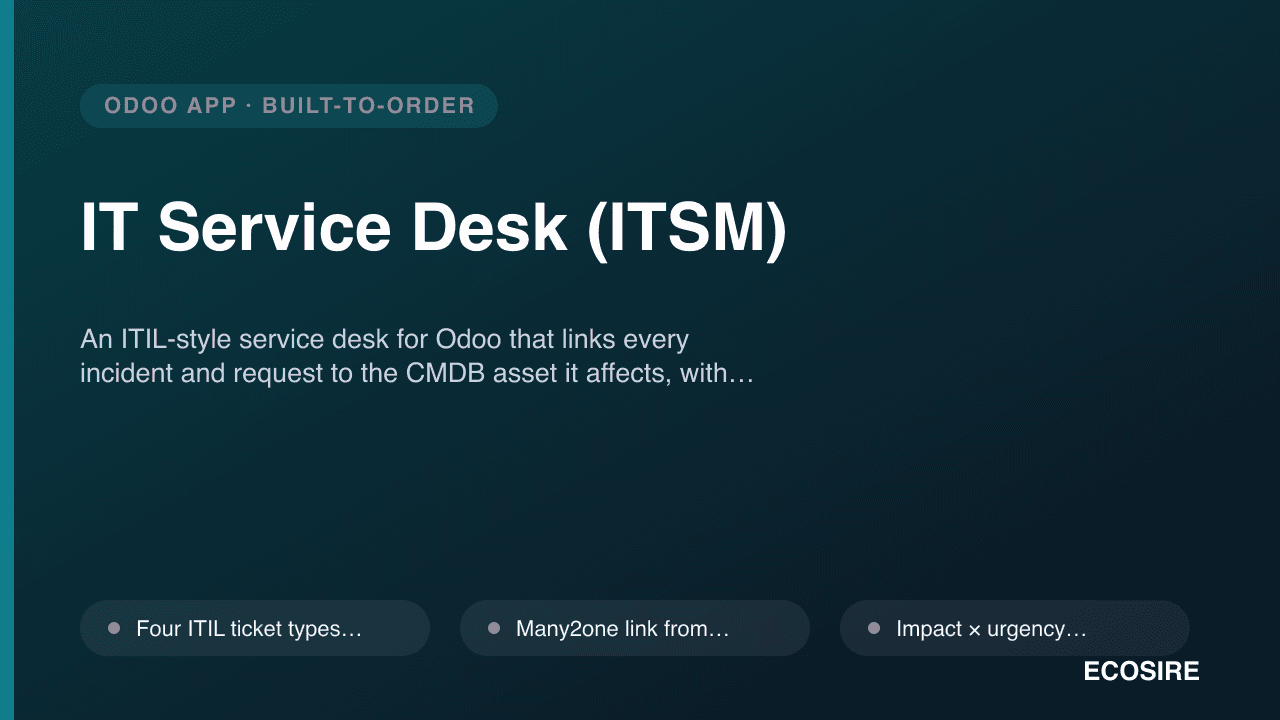
An ITIL-style service desk for Odoo that links every incident and request to the CMDB asset it affects,
with impact-based SLA timers and an employee self-service portal. Built, installed, and supported by
ECOSIRE after you request a quotation.
IT Service Desk (ITSM)とは?
An ITIL-style service desk for Odoo that links every incident and request to the CMDB asset it affects, with impact-based SLA timers and an employee self-service portal. Built, installed, and supported by ECOSIRE after you request a quotation. Built to order by ECOSIRE for Odoo 17, 18, 19 — indicative price from $999.00 USD; request a quote for a scoped proposal.
主な機能
受注生産、すべておまかせ
自分での設定は不要 — ECOSIRE が構築・インストール・サポートする実働アプリです。
- 1
ご注文
一回限りの構築料金から始めます。キックオフで一緒に範囲を決めます。
- 2
構築とインストール
ECOSIRE がお客様の Odoo 上で構築・設定・インストールします。
- 3
本番稼働 + サポート
約1週間(営業日ベース)で稼働し、本番稼働後2週間のサポートが付きます。納品したコードの不具合は無償で修正します。
技術仕様
- Odoo互換性
- Odoo 17, Odoo 18, Odoo 19
- エディション
- Enterprise&Community
- ライセンス
- ライセンスの確認が必要です
- Python要件
- Python 3.10+
- データベース
- PostgreSQL 12+
この製品について
Most IT teams running Odoo end up bolting incidents onto a generic ticketing tool that has no idea what a laptop, switch, or server actually is. A ticket lands and the technician has to go hunting: which machine is this, who owns it, what is its warranty status, was it touched last week for the same fault? Odoo core gives you mail, activities, and a discuss thread; the proprietary Enterprise helpdesk gives you a ticket object — but neither knows your hardware. There is no native link from a ticket to a configuration item, no impact-and-urgency matrix, no SLA clock that starts on submission and escalates on breach, and no self-service portal scoped to "raise a hardware issue." This is exactly where the native road runs out, and where a typical off-the-shelf apps.odoo.com module still treats your assets as free text.
We build an ITIL-aligned service desk as a proper Odoo application on top of base, mail, portal, hr, and your CMDB (it_asset_management_cmdb). At the core is a ticket model (models.Model) supporting four ITIL ticket types — incident, service request, problem, and change — each with its own state machine driven by server and automated actions. Every ticket carries a Many2one to the affected configuration item, so opening a ticket surfaces that asset's full history — prior tickets, owner, location, warranty, and maintenance schedule — pulled straight from the CMDB with no re-keying. Priority is not typed by hand: a compute method with @api.depends('impact_id', 'urgency_id') reads an impact × urgency matrix and derives ticket priority automatically, which in turn selects the applicable SLA policy.
SLA policies attach response and resolution targets to each priority tier, with timers that compute elapsed and remaining time against a working-calendar and fire tiered escalations on breach via ir.cron and automated actions (notify lead, reassign, bump priority). Technician teams support round-robin or load-balanced auto-assignment. An employee self-service portal built on portal and QWeb lets staff raise and track hardware issues, see status, and read suggested knowledge-base articles linked to the ticket category. Tickets can be auto-created from warranty and maintenance schedules or from monitoring webhooks over the JSON-RPC/XML-RPC API; loaner or replacement assets can be tracked against the CMDB while a device is in repair; and time and cost are logged per ticket for internal chargeback. Access is locked down with ir.model.access.csv plus record rules so technicians, team leads, and portal users each see only what they should. Reporting covers MTTR, SLA compliance, and tickets per asset, category, and technician, delivered as Odoo pivots, dashboards, and QWeb PDF reports.
Because this is build-to-order, nothing ships until we agree scope. After you request a quotation we run a short scoping call, confirm your ticket types, SLA matrix, escalation rules, and CMDB fields, then build against your target Odoo version (17.0, 18.0, or 19.0, Community or Enterprise). Typical delivery is one working week from confirmed scope, with UAT on a staging database before go-live. Pricing starts from $999 (indicative, single-company base scope); multi-company routing, deeper monitoring/webhook integrations, complex SLA calendars, or migrating a large volume of historical tickets increases the quoted scope.
得られるもの
- Installable Odoo module source code for your target version (17.0, 18.0, or 19.0), Community or Enterprise
- Installation and configuration on your server or Odoo.sh, including SLA matrix, teams, and CMDB field wiring
- Technical documentation — data model, security rules, automated actions, and API/webhook endpoints
- End-user and technician guide plus a live training session for your support staff
- UAT on a staging database with a documented rollback plan before production go-live
- Post-go-live support window for defect fixes and configuration adjustments
- Git repository handover with full commit history and tagged release
これは誰のためのものですか
IT support lead
Runs the internal help desk and wants incident management wired to real asset data — so techs see a device's full history and warranty the moment a ticket lands, instead of a generic free-text queue.
IT operations / infrastructure manager
Owns SLAs and uptime commitments and needs response/resolution timers, impact-based prioritisation, and breach escalation that hold across teams, plus MTTR and SLA-compliance reporting to prove it.
CIO or head of IT
Wants ITSM consolidated inside Odoo alongside the CMDB rather than a separate paid tool, with per-ticket time and cost logged for chargeback and clean reporting per asset, category, and technician.
Managed service provider
Delivers IT support to multiple client sites and needs portal-based ticket intake, team routing, and loaner-asset tracking that map onto a shared CMDB without a generic helpdesk's blind spots.
IT Service Desk (ITSM) の比較方法
| 基準 | エコシエール | カスタムビルド | 競合他社 | Odoo 標準機能 |
|---|---|---|---|---|
| Link between ticket and hardware asset | Direct CMDB link on every ticket with full asset history inline | Possible but you build and maintain the relation yourself | Usually free-text or a loose reference, not a real CMDB link | No concept of a configuration item on a ticket |
| Priority from impact × urgency | Computed automatically from a configurable matrix | Must be designed and coded from scratch | Often a flat priority field, no matrix | Manual priority field only |
| SLA timers and breach escalation | Response/resolution timers on a working calendar with tiered escalation | Build the cron, timers, and escalation logic yourself | Basic SLA on some, limited escalation | No SLA engine |
| Employee self-service portal | Portal scoped to raise and track hardware issues with suggested articles | Custom portal templates to design and secure | Generic portal, not asset-aware | No IT-specific portal flow |
| ITIL ticket types (incident/request/problem/change) | All four with distinct workflows | Whatever you scope and build | Often incident/request only | Generic activities, no ITIL types |
| Auto-created tickets from monitoring/warranty | Webhook and schedule-driven creation via JSON/XML-RPC | Integrations built per source | Rarely included | Not available |
| Chargeback (time & cost per ticket) | Time and cost logged per ticket with reporting | Add and report on it yourself | Partial time tracking at best | No per-ticket cost model |
| Ownership and lock-in | Full source and git handover, yours to extend | You own it but carry all build cost and risk | Vendor-controlled, proprietary | Core only, no ITSM capability |
IT Service Desk に関するよくある質問
How long does delivery take?
This is a build-to-order module, so nothing ships off a shelf. After a scoping call to confirm ticket types, your SLA matrix, escalation rules, and CMDB fields, typical delivery is one working week from confirmed scope, including UAT on a staging database before go-live. Larger scope — multi-company, heavy integrations, or historical-ticket migration — extends that timeline, which we state in the quote.
Does it require the CMDB / IT asset module?
Yes. The whole point is linking tickets to real configuration items, so it builds on the CMDB asset module along with `base`, `mail`, `portal`, and `hr`. If you do not yet run a CMDB in Odoo, we scope that setup into the engagement so tickets have real assets to reference from day one.
How does pricing and scoping work?
Pricing starts from $999 as an indicative figure for a single-company base scope. It is not a fixed price — after the scoping call we confirm exactly what you need and issue a firm fixed quote. Drivers like multi-company routing, monitoring/webhook integrations, complex SLA calendars, or large data migrations increase the quoted scope.
What about support and updates after go-live?
Every build includes a post-go-live support window for defect fixes and configuration tweaks, plus a git repository handover so the code is yours. Beyond that window we offer ongoing support and version-upgrade retainers; because you receive the full source, you are never locked in.
Which Odoo versions and editions does it support?
We build against Odoo 17.0, 18.0, or 19.0, on either Community or Enterprise. We confirm your exact version and edition during scoping and develop and test against that target, since model and view APIs differ between releases.
Can tickets be created automatically from monitoring or warranty schedules?
Yes. We wire auto-creation from warranty and maintenance schedules and from external monitoring tools via the JSON-RPC/XML-RPC API, so an alert or a due maintenance date opens a ticket with the correct asset, type, and priority already attached.
How is SLA breach handled?
Each priority tier maps to an SLA policy with response and resolution targets measured against a working-time calendar. Timers compute remaining time, and on breach a scheduled action fires tiered escalation — notifying the team lead, reassigning, or raising priority — so nothing silently ages out of target.
関連モジュール
Japan Payroll & Employee Profile
A Japan-localized payroll and employee-profile module for Odoo 17/18/19 that handles social insurance, income withholding tax, resident tax and JPY salary structures. ECOSIRE builds, installs and supports it after you request a quotation.
Japan Qualified Invoice Compliance
A build-to-order Odoo module that turns your existing billing flow into Japan Qualified Invoice System output — registration numbers, per-rate tax breakdowns, correction invoices and retained archives. ECOSIRE scopes, builds, installs and supports it on your Odoo 17, 18 or 19.
IT Service Desk
An ITIL-style service desk for Odoo that links every incident and request to the CMDB asset it affects, with impact-based SLA timers and an employee self-service portal. Built, installed, and supported by ECOSIRE after you request a quotation.
- Four ITIL ticket types — incident, service request, problem, and change — each with its own state machine driven by server and automated actions
- `Many2one` link from every ticket to the affected CMDB configuration item, surfacing that asset's owner, location, warranty, and full prior-ticket history inline
- Impact × urgency priority matrix computed via an `@api.depends` method so ticket priority (and the applicable SLA) is derived, never hand-typed
- SLA policies with separate response and resolution targets per priority tier, timers evaluated against a working-time calendar