Produktdetails werden auf Englisch angezeigt. Übersetzungen folgen in Kürze.
 Beispielhafte Vorschau
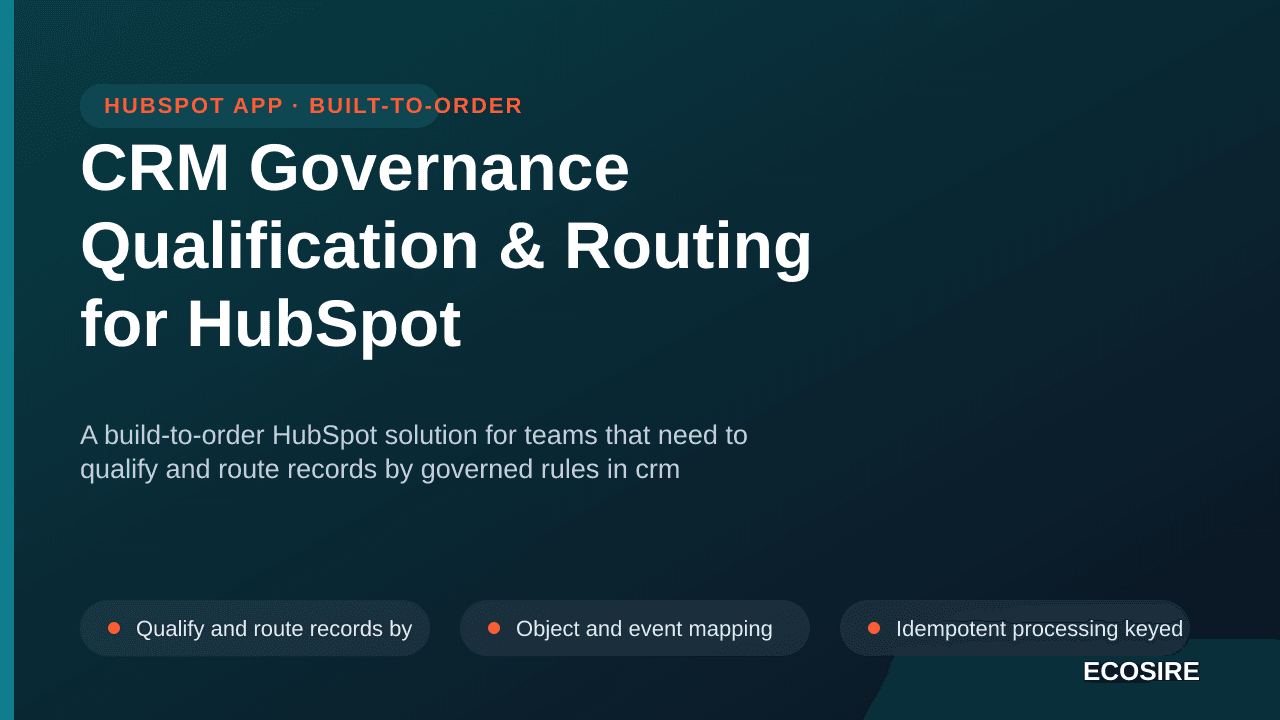
A build-to-order HubSpot solution for teams that need to qualify and route records by governed rules in crm
governance, with idempotent processing, visible exceptions, and reconciliation.
Hauptfunktionen
Qualify and route records by governed rules through a governed crm governance workflow with explicit intake, decision, write and closure states.
Object and event mapping from governance.qualify.requested across user, team and property definition to governance.qualify.recorded, documented against the approved business rules.
Idempotent processing keyed by hubspot-governance-qualify:source-id:revision, retaining the source revision and resulting target identifier.
Qualification & Routing exception handling that separates authentication, validation, mapping, throttling and downstream rule failures.
A crm governance reconciliation view with guarded replay, operator notes and correlated audit evidence.
Secret-safe diagnostics carrying correlation ID, decision, error code and processing state.
HubSpot OAuth requests only the granular CRM, webhook, workflow or settings scopes required for user, team and property definition.
CRM Objects and Associations APIs preserve object identifiers and association labels across the crm governance record graph.
Webhook subscriptions validate portal and app context, deduplicate subscription events and acknowledge delivery before asynchronous processing.
Custom workflow actions expose typed input fields and return a correlation reference for qualification & routing execution.
An app settings UI manages mappings and safe operational controls without displaying access tokens or private credentials.
CRM cards provide record-level status and exception context when operators need visibility inside HubSpot.
Auf Bestellung gebaut, komplett für Sie erledigt
Keine Selbsteinrichtung — eine funktionierende App, die von ECOSIRE erstellt, installiert und betreut wird.
- 1
Sie bestellen
Starten Sie mit einem einmaligen Entwicklungspreis. Den Umfang legen wir beim Kickoff gemeinsam fest.
- 2
Wir bauen & installieren
ECOSIRE erstellt, konfiguriert und installiert sie auf Ihrem HubSpot.
- 3
Go-live + Support
Sie gehen in etwa 2–4 Wochen live, mit einem Support-Zeitraum nach dem Launch.
Über dieses Produkt
A build-to-order HubSpot solution for teams that need to qualify and route records by governed rules in crm governance, with idempotent processing, visible exceptions, and reconciliation.
The buyer job
Revenue operations leads need to qualify and route records by governed rules without losing ownership when records cross system boundaries. This concept starts with the business decision and evidence required at each stage, then maps that intent to supported HubSpot surfaces.
Workflow and object design
Receive a crm governance signal, validate its source and required fields, resolve user, team and property definition, apply the qualification & routing decision rules, write the approved state, then record a correlated audit result. The source event is governance.qualify.requested; the resulting audit event is governance.qualify.recorded. The mapped business surface is user, team and property definition.
Technical approach
The scoped design may use OAuth 2.0 authorization, granular app scopes, CRM Objects APIs, associations APIs, webhook subscriptions, custom workflow actions, app settings UI. Authentication is based on HubSpot OAuth with only the CRM, webhook, workflow, or settings scopes confirmed in discovery. The implementation accounts for HubSpot per-app request limits, search limits and webhook retry behavior.
Failure and reconciliation design
Every request uses the idempotency key hubspot-governance-qualify:source-id:revision. Retryable transport and throttle responses enter bounded backoff; validation and mapping failures enter a visible exception queue. A reconciliation pass compares source revision, target identifier and recorded state, then permits controlled replay without duplicating the business action.
Build-to-order boundary
This page describes a solution concept, not a prebuilt or immediately available product. Exact fields, actions, interfaces, data retention and acceptance checks are confirmed before a build is authorized.
Was Sie bekommen
- HubSpot solution package or source bundle for the scoped extension
- Object, event and field mapping workbook for user, team and property definition
- Authentication, scope and connection configuration guide
- Exception taxonomy, retry policy and reconciliation runbook
- Automated checks for happy path, duplicates, invalid input, throttling and replay
- Administrator guide covering configuration, audit evidence and safe disablement
- Build-to-order acceptance checklist tied to the approved scope
Für wen das ist
Revenue operations lead
Owns the qualify and route records by governed rules process and needs its decisions, exceptions and audit state represented consistently in HubSpot.
HubSpot administrator
Controls authentication, permissions, configuration and safe promotion while keeping the extension supportable.
Integration support analyst
Investigates correlated failures, runs reconciliation, and replays only the records that are safe to process again.
Wie CRM Governance Qualification & Routing for HubSpot im Vergleich abschneidet
| Kriterium | ECOSIRE | Manuelle Alternative |
|---|---|---|
| CRM Governance scope | Build-to-order mapping for user, team and property definition | A generic procedure that does not encode the crm governance object model |
| Qualification & Routing decision | Versioned rules and evidence for “qualify and route records by governed rules” | Operator interpretation recorded outside the transaction |
| CRM Governance event | Correlated governance.qualify.requested to governance.qualify.recorded processing | Periodic manual review without a durable event key |
| Qualification & Routing duplicate control | Persistent key hubspot-governance-qualify:source-id:revision | Ad hoc checks against recently processed records |
| CRM Governance failure handling | Typed exception queue governed by HubSpot per-app request limits, search limits and webhook retry behavior | Unstructured notification followed by a manual restart |
| Qualification & Routing reconciliation | Source revision, target identifier and recorded-state comparison | Spot checks across the user, team and property definition involved |
| HubSpot change control | Versioned crm governance configuration and documented promotion | Direct configuration edits without a repeatable release record |
Häufig gestellte Fragen zu CRM Governance Qualification & Routing
Is CRM Governance Qualification & Routing for HubSpot a prebuilt product?
No. It is a build-to-order concept. ECOSIRE confirms the workflow, objects, permissions and acceptance criteria before implementation.
How are duplicate events prevented?
The design persists a source identifier and revision under a deterministic idempotency key, then checks the audit record before any repeat write.
What happens when a request is throttled?
Throttle responses are separated from permanent failures and retried with bounded backoff designed around the platform limits in your environment.
How are failed records reconciled?
A reconciliation view compares the source revision, target identifier and recorded state. Operators can correct mappings and use guarded replay.
Which permissions are required?
Only the OAuth scopes, permission sets, roles or connections required for the confirmed objects and actions are included in the design.
Can the operator interface match our process?
Yes. The scoped operator experience can use an app settings page, CRM card, or workflow-action configuration panel selected during scoping when the approved user journey requires it.
Verwandte Module
Auf Bestellung
HubSpot
App Integration Access & Policy Governance for HubSpot
A build-to-order HubSpot solution for teams that need to govern access, policy and change in app integration, with idempotent processing, visible exceptions, and reconciliation.
Ab $999.00Einstiegspreis – Angebot nach Ihrem Umfang
Auf Bestellung
HubSpot
App Integration Approval Control for HubSpot
A build-to-order HubSpot solution for teams that need to collect evidence and govern approvals in app integration, with idempotent processing, visible exceptions, and reconciliation.
Ab $999.00Einstiegspreis – Angebot nach Ihrem Umfang
Auf Bestellung
HubSpot
App Integration Financial Reconciliation for HubSpot
A build-to-order HubSpot solution for teams that need to reconcile transactions and exceptions in app integration, with idempotent processing, visible exceptions, and reconciliation.
Ab $999.00Einstiegspreis – Angebot nach Ihrem Umfang
Auf Bestellung
HubSpot
App Integration Fulfilment Orchestration for HubSpot
A build-to-order HubSpot solution for teams that need to orchestrate fulfilment handoffs in app integration, with idempotent processing, visible exceptions, and reconciliation.
Ab $999.00Einstiegspreis – Angebot nach Ihrem Umfang
Angebot anfordern
CRM Governance Qualification & Routing
A build-to-order HubSpot solution for teams that need to qualify and route records by governed rules in crm governance, with idempotent processing, visible exceptions, and reconciliation.
- Qualify and route records by governed rules through a governed crm governance workflow with explicit intake, decision, write and closure states.
- Object and event mapping from governance.qualify.requested across user, team and property definition to governance.qualify.recorded, documented against the approved business rules.
- Idempotent processing keyed by hubspot-governance-qualify:source-id:revision, retaining the source revision and resulting target identifier.
- Qualification & Routing exception handling that separates authentication, validation, mapping, throttling and downstream rule failures.