 Beispielhafte Vorschau
A build-to-order Frappe app that moves your NetSuite or SAP data into ERPNext in a controlled, reconciled way
— chart of accounts and master mapping, open-balance import, historical transaction load, and reconciliation reports.
ECOSIRE scopes, builds, installs, and supports it; it is not an instant download.
Was ist ERPNext NetSuite / SAP Data Migrator?
A build-to-order Frappe app that moves your NetSuite or SAP data into ERPNext in a controlled, reconciled way — chart of accounts and master mapping, open-balance import, historical transaction load, and reconciliation reports. ECOSIRE scopes, builds, installs, and supports it; it is not an instant download. Built to order by ECOSIRE for ERPNext v15, v16 — indicative price from $999.00 USD; request a quote for a scoped proposal.
Hauptfunktionen
Auf Bestellung gebaut, komplett für Sie erledigt
Keine Selbsteinrichtung — eine funktionierende App, die von ECOSIRE erstellt, installiert und betreut wird.
- 1
Sie bestellen
Starten Sie mit einem einmaligen Entwicklungspreis. Den Umfang legen wir beim Kickoff gemeinsam fest.
- 2
Wir bauen & installieren
ECOSIRE erstellt, konfiguriert und installiert sie auf Ihrem ERPNext.
- 3
Go-live + Support
Sie gehen in etwa einer Arbeitswoche live, mit zwei Wochen Go-live-Support. Fehler im von uns gelieferten Code beheben wir kostenlos.
Technische Spezifikationen
- ERPNext-Kompatibilität
- —
- Lizenz
- Lizenz muss bestätigt werden
- Python-Anforderung
- Python 3.10+
- Datenbank
- MariaDB 10.6+
Über dieses Produkt
Leaving NetSuite or SAP is rarely blocked by the new system — it is blocked by the data. Your source has years of accounts, dimensions, customers, suppliers, items, and posted transactions in a schema that does not line up with ERPNext's. ERPNext ships the Data Import tool and can consume CSV/Excel into most DocTypes, but out of the box it has no concept of your NetSuite internal IDs or SAP company-code/GL structure, no mapping layer, no dependency-aware sequencing, and no way to prove that what landed equals what you exported. Teams that try it by hand hit link-validation failures, duplicated parties, opening balances that never tie out, and Journal Entries that will not submit because the accounts they reference were imported in the wrong order.
ECOSIRE builds a dedicated Frappe app — a proper custom_app with its own module, DocTypes, and hooks.py — that turns a messy source extract into a repeatable ERPNext load. The core is a set of mapping DocTypes: you register each source entity (NetSuite account, SAP GL account, cost center, customer, item, tax code) against its ERPNext target, and the app persists the crosswalk so a re-run is deterministic. A staging DocType ingests the raw source rows (via the Frappe REST API or a bulk file drop), and whitelisted server-side methods (@frappe.whitelist()) run the transform in dependency order: Chart of Accounts and cost centers first, then master data (Customer, Supplier, Item, addresses/contacts), then open balances as opening Journal Entries and outstanding invoices, then historical transactions. hooks.py doc events and server scripts enforce validation and idempotency so a partial run can be safely resumed rather than double-posting.
On the finance side the app is careful about the things auditors care about. Open balances are loaded as period-close opening entries against a temporary opening account so the trial balance ties to the source cut-over date. Historical Sales/Purchase Invoices and Payments are recreated with their original posting dates and party links where you need drill-down history, or summarized where you only need balances — that choice is part of scoping. Every run emits reconciliation reports (built as Query/Script Reports) that compare source totals to ERPNext totals per account, per party, and per period, plus an exceptions list for any row that failed mapping — so you sign off on evidence, not hope. Role-based permissions and role profiles keep the migration tooling scoped to the implementation team, and scheduler events can drive long loads in the background job queue instead of timing out a web request.
Because every NetSuite and SAP tenant is different, this is build-to-order, not an app-store download. We start with a scoping call to inventory your source objects, decide summarized-vs-full history, and agree the cut-over plan. We then build and configure the app against your data, run it repeatedly on a staging bench until reconciliation is clean, and do a full UAT with you before go-live. Typical delivery is one working week from confirmed scope depending on data volume and how much transactional history you carry over. You receive the installable source, the reconciliation evidence, a git repo handover, and a post-go-live support window — targeting Frappe/ERPNext v15 and v16.
Was Sie bekommen
- Installable source code for your build, as a versioned Frappe app targeting ERPNext v15/v16
- Installation and configuration on your bench, including mapping-DocType setup and role-profile scoping
- Technical documentation: DocType/field reference, mapping schema, hooks and whitelisted-method contracts, and the load-sequence runbook
- User guide plus a live training session for your finance and implementation team covering the mapping, dry-run, and reconciliation workflow
- Post-go-live support window for defect fixes and mapping adjustments after cut-over
- UAT on a staging bench with a documented rollback plan before any production load
- Full git repository handover with commit history and tagged release
- Reconciliation report pack (source-vs-ERPNext by account, party, and period) as go-live sign-off evidence
Für wen das ist
Finance / Controllership lead
Owns the cut-over and the audit trail. Needs opening balances and history to tie exactly to the NetSuite/SAP source at the cut-over date, with reconciliation evidence to sign off on before go-live.
ERPNext implementation partner or in-house admin
Running the ERPNext rollout and tired of hand-built CSV imports failing on link validation. Wants a repeatable, dependency-aware load they can re-run on staging until it is clean.
IT / systems integration manager
Responsible for extracting from NetSuite (SuiteQL/saved searches) or SAP and getting it into ERPNext safely. Needs a defined staging-and-transform layer and a rollback plan, not ad-hoc scripts.
CFO / operations sponsor migrating off expensive licensing
Approving the move to ERPNext to cut NetSuite/SAP licensing cost. Needs confidence that history and balances survive the move so reporting continuity is not lost.
Wie ERPNext NetSuite / SAP Data Migrator im Vergleich abschneidet
| Kriterium | ECOSIRE | Benutzerdefinierter Build | Konkurrent | ERPNext nativ |
|---|---|---|---|---|
| Source-to-ERPNext mapping | Persistent mapping DocTypes for accounts, parties, items, and tax codes | Ad-hoc scripts, mapping lives in someone's spreadsheet | Generic field mapping, no NetSuite/SAP awareness | No mapping layer; raw CSV into Data Import |
| Load sequencing | Dependency-ordered pipeline that submits cleanly | Manual ordering, prone to link-validation failures | Import order left to the user | You order imports yourself, one DocType at a time |
| Open balances & history | Opening entries plus full or summarized history, your choice | Hand-built Journal Entries, easy to mis-post | Usually masters only, little finance logic | Manual Journal Entries and invoice re-keying |
| Reconciliation | Source-vs-ERPNext reports by account, party, and period | Whatever you build after the fact | Rarely included | None; you reconcile by hand |
| Re-runs & idempotency | Idempotent, dry-run mode, safe to resume | Re-runs risk duplicate postings | Varies; often re-import duplicates | Re-import duplicates unless you dedupe manually |
| Version support | Built and tested for Frappe/ERPNext v15/v16 | Whatever you target and maintain | May lag current versions | Core Data Import only |
| Delivery model | Scoped, built, installed, UAT'd, one working week | Open-ended internal effort | Instant download, then you do the work | Included but entirely DIY |
| Handover & ownership | Full source, git repo, docs, training, support window | You own it because you built it | Closed app, limited to vendor updates | N/A |
Häufig gestellte Fragen zu ERPNext NetSuite / SAP Data Migrator
How long does delivery take?
This is build-to-order, not an instant download. Typical delivery is one working week from confirmed scope, depending on your data volume and how much transactional history you carry over. We start with a scoping call, build and configure the app against your data, run it repeatedly on staging until reconciliation is clean, then do UAT with you before go-live.
Do you migrate full transaction history or just balances?
Both are supported and it is a scoping decision. Full history recreates Sales/Purchase Invoices and Payments with their original posting dates and party links so you keep drill-down; balance-only loads open items and opening entries so your trial balance ties out without the full transaction volume. We recommend the right cut based on your reporting and audit needs.
How do I know the migrated data is correct?
Every run emits reconciliation reports comparing source totals to ERPNext totals per account, per party, and per period, plus an exceptions list for any row that failed mapping. You sign off on that evidence during UAT before we ever load production. Nothing goes live on trust alone.
What about support and updates after go-live?
Every build includes a post-go-live support window for defect fixes and mapping adjustments after cut-over. The app targets Frappe/ERPNext v15 and v16; because you receive the full source and git repo, your team or ours can maintain and extend it. Longer support or a follow-on retainer can be arranged.
Will this touch or overwrite our existing ERPNext data?
No. All source data lands first in a dedicated staging DocType, and the transform runs idempotently with a dry-run mode that reconciles without submitting. We load into a staging bench first, validate, and only then run the agreed production cut-over — with a documented rollback plan in place.
Do you support both NetSuite and SAP, and multiple companies?
Yes. The mapping layer translates NetSuite internal IDs and SAP company-code/GL structures onto ERPNext account trees. Multi-company is handled by mapping SAP company codes or NetSuite subsidiaries onto separate ERPNext Company records, with per-company reconciliation.
How do you extract from our source system?
We ingest source extracts through a staging DocType via the Frappe REST API or a bulk file drop. You (or we) provide the extract from NetSuite saved searches / SuiteQL or SAP exports; the app handles the transform, mapping, and load. We do not need standing production access to your source system to run the migration.
Verwandte Module
ERPNext Microsoft 365 Suite (Outlook, Teams & OneDrive)
A build-to-order ERPNext integration that connects your instance to Microsoft 365 — two-way Outlook email and calendar sync, Teams notifications and a bot, and OneDrive/SharePoint file attachments, all secured with Entra ID single sign-on. ECOSIRE scopes, builds, installs, and supports it for your ERPNext v15/v16 deployment.
ERPNext Microsoft Dynamics 365 Migrator
A build-to-order Frappe app that moves your Microsoft Dynamics 365 Business Central or Finance & Operations data into ERPNext — masters, open transactions, and chart-of-accounts mapping — with validation reports and an optional incremental sync. ECOSIRE scopes, builds, installs, and supports it for your instance.
ERPNext Pakistan FBR Sales Tax & WHT Suite
A build-to-order Frappe app that turns your ERPNext sales, purchase, and payment data into FBR sales-tax returns, withholding statements, and provincial SRB/PRA filings with correctly formatted annexure exports. ECOSIRE scopes, builds, installs, and supports it — it is not an off-the-shelf download.
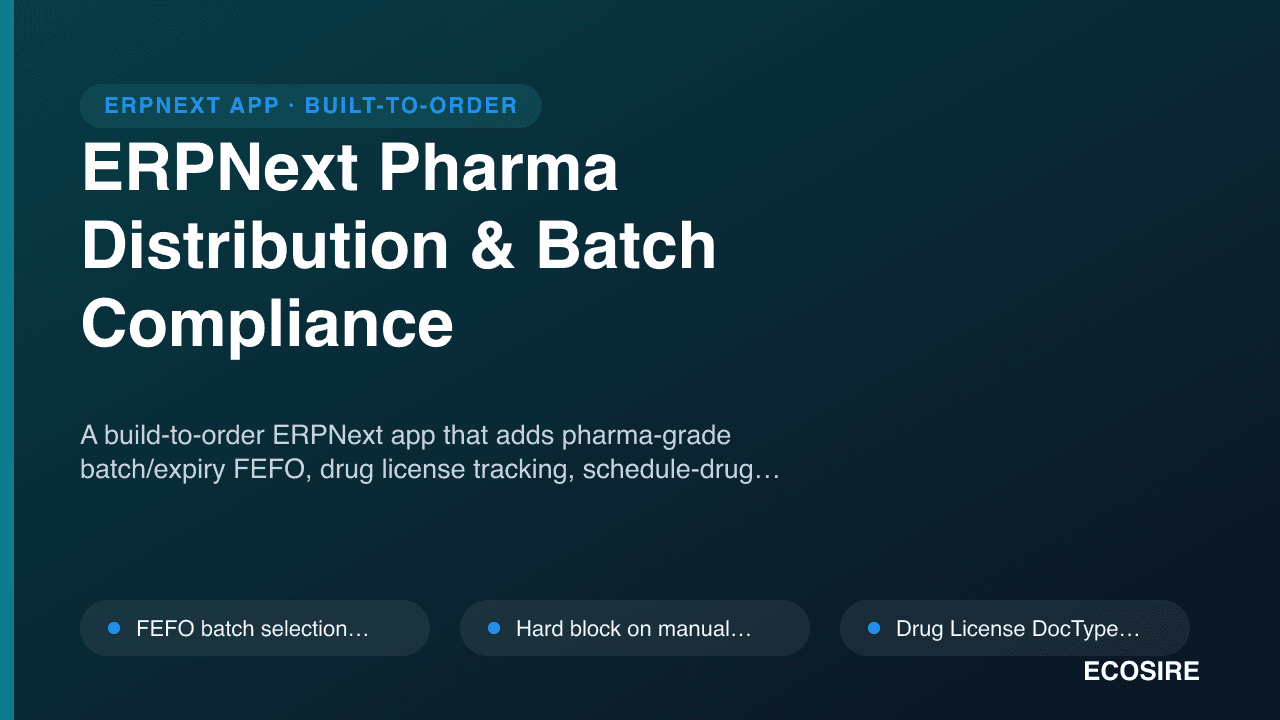
ERPNext Pharma Distribution & Batch Compliance
A build-to-order ERPNext app that adds pharma-grade batch/expiry FEFO, drug license tracking, schedule-drug compliance, and cold-chain handling on top of ERPNext Stock and Selling. ECOSIRE scopes, builds, installs, and supports it for your v15/v16 site.
ERPNext NetSuite / SAP Data Migrator
A build-to-order Frappe app that moves your NetSuite or SAP data into ERPNext in a controlled, reconciled way — chart of accounts and master mapping, open-balance import, historical transaction load, and reconciliation reports. ECOSIRE scopes, builds, installs, and supports it; it is not an instant download.
- Mapping DocTypes that persist a source-to-ERPNext crosswalk for accounts, cost centers, parties, items, and tax codes so every re-run is deterministic
- Dependency-ordered load pipeline (Chart of Accounts and cost centers, then masters, then open balances, then history) that prevents link-validation failures on submit
- Staging DocType that ingests raw NetSuite/SAP extracts via the Frappe REST API or bulk file drop before any transform touches live ledgers
- Whitelisted server-side methods (@frappe.whitelist()) that run each migration phase idempotently, so a partial run resumes instead of double-posting