跳至主要内容
NetSuiteSaaS Tools

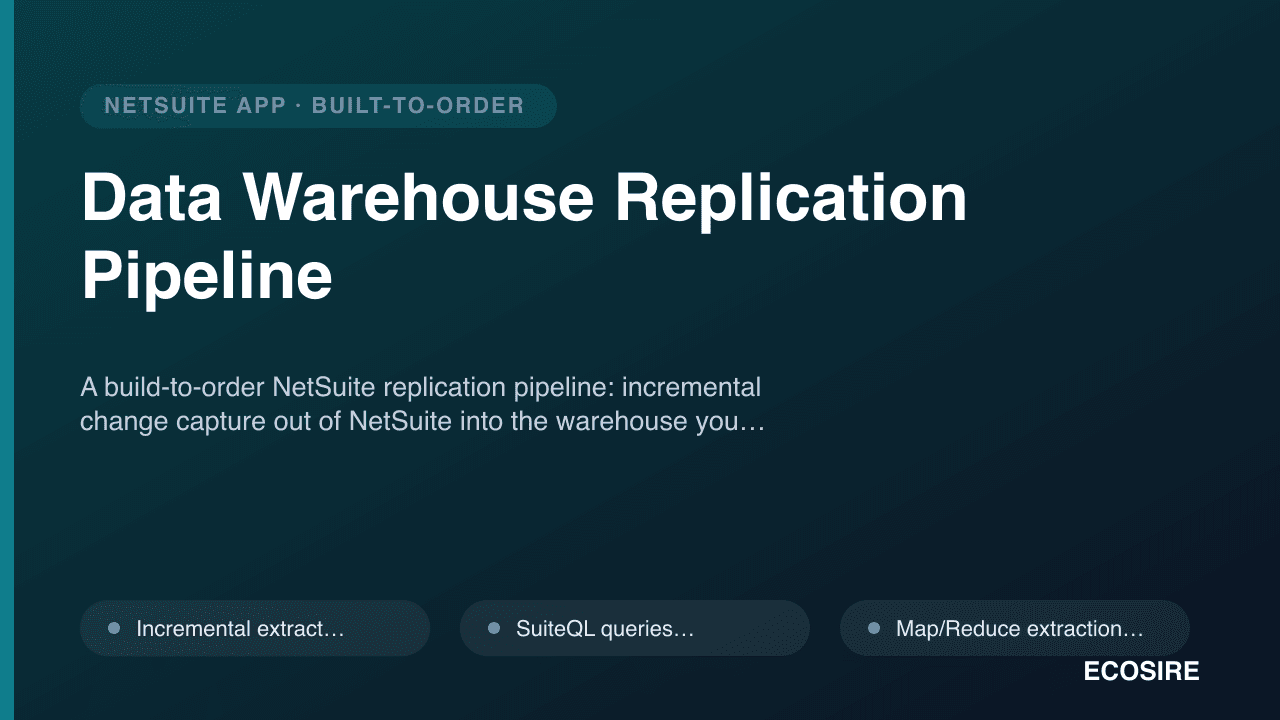
Data Warehouse Replication Pipeline

A build-to-order NetSuite replication pipeline:

incremental change capture out of NetSuite into the warehouse you already own, with delete handling, backfills and pre-joined analytics views.

按单定制

什么是 Data Warehouse Replication Pipeline?

A build-to-order NetSuite replication pipeline: incremental change capture out of NetSuite into the warehouse you already own, with delete handling, backfills and pre-joined analytics views. Built to order by ECOSIRE for Oracle NetSuite (build-to-order) — indicative price from $999.00 USD; request a quote for a scoped proposal.

Data Warehouse Replication Pipeline — A build-to-order NetSuite replication pipeline: incremental change capture out of NetSuite into the warehouse you already own, with delete handling, backfills and pre-joined analytics views

What we build

  • Incremental extract driven by a watermark custom record holding the last successful cursor per record type, using last modified date with an internal id tiebreaker
  • SuiteQL queries executed through N/query with paged result iteration so large tables stream rather than materialise in script memory
  • Map/Reduce extraction jobs chunked by record type and date window, with each map and reduce invocation working inside its own governance allowance
  • Deleted-record capture through the SuiteTalk deleted-records interface, propagated as tombstones so hard deletes do not leave orphan rows in the warehouse
  • Configurable record scope across transactions and transaction lines, entities, items, accounts, accounting periods, subsidiaries, departments, classes, locations and custom records
  • Custom segment and custom field inclusion driven by a mapping custom record, so new segments are added by configuration instead of a code change
  • Payload delivery over N/https to your own cloud storage or warehouse staging endpoint using signed requests, with retry and exponential backoff
  • Merge and upsert loads keyed on record type and internal id, making any rerun of the same window fully idempotent
  • Pre-joined analytics views in the warehouse covering transaction lines enriched with item, entity, subsidiary, accounting period, department, class, location and both transaction and base currency amounts
  • Backfill and replay mode that reprocesses an explicit date range for historical loads or after a mass update, without resetting the live watermark
  • Run-log custom record plus a saved search dashboard reporting rows extracted, rows loaded, duration, governance consumed and failure reason for every run
  • Schema-drift detection that compares the current field list against the last known layout and emails the owner before a load silently drops a column

关于此产品

Analytics against a live NetSuite account eventually stops working. It starts innocently — a saved search that feeds a dashboard, then a second one, then a scheduled export that someone pulls into a spreadsheet every Monday. Six months later the finance team is running a twelve-month transaction search at 9am on the first working day of the month, the same moment the close is happening, and everyone notices. Searches time out. Concurrency limits bite. Integration jobs queue behind reporting queries. Somebody asks why the dashboard shows a different revenue number than the income statement and nobody can answer, because the search that produced it has been edited three times since.

The deeper problem is structural. NetSuite is a transactional system tuned for transactional work. Analysts want to join transaction lines to items, entities, subsidiaries, accounting periods, departments, classes, locations and custom segments, then aggregate across years — the exact shape of query the account is least suited to serve. They also want history that NetSuite does not keep: what the pipeline looked like last quarter, what an order's status was before it was edited, what a customer's classification used to be. And they want to plug the result into whatever tooling the business already uses, without every new report becoming another live query against production.

What ECOSIRE builds

Nothing here ships pre-built. After scoping, ECOSIRE builds you a replication pipeline in SuiteScript 2.1 that extracts from your account on a schedule and loads into the warehouse you already own and pay for — a cloud warehouse such as Snowflake or BigQuery, or a managed Postgres if that is what your team runs. The NetSuite side is delivered as an SDF project (installable as an unmanaged bundle); the warehouse side is delivered as SQL you keep. There is no per-row fee and no black box in the middle.

Change capture, not full reloads

A watermark custom record holds the last successful cursor per record type — last modified date with an internal id tiebreaker, so records changed within the same second are never skipped. Each run pulls only what moved since the last cursor. Extraction runs as Map/Reduce jobs chunked by record type and date window, with each map and reduce invocation working inside its own governance allowance, so a large day and a quiet day both complete rather than one dying halfway through. Queries are written in SuiteQL and executed through N/query with paged iteration, so results stream instead of being materialised in script memory.

Deletes, restatements and backfills

Most home-grown extracts quietly break on deletion: a transaction removed in NetSuite lives forever in the warehouse and every revenue figure downstream is wrong by exactly that amount. The pipeline captures hard deletes through the SuiteTalk deleted-records interface and propagates them as tombstones, and it treats inactivation as a status change rather than a disappearance. Loads are merge/upsert operations keyed on record type and internal id, which makes reruns idempotent — the same window can be replayed after a failure without duplicating a single row. A separate backfill mode reprocesses an explicit date range on demand, for a historical load or after a mass update, without disturbing the live watermark.

Views your analysts can actually query

Raw replicas of NetSuite tables are faithful and almost unusable — the joins are the hard part, and every analyst re-derives them slightly differently. The build includes a modelled layer in the warehouse: transaction lines enriched with item, entity, subsidiary, accounting period, department, class, location and both transaction and base currency amounts; an accounting-period spine that respects your fiscal calendar; and dimension views for customers, vendors, items and employees. Custom segments and custom fields are pulled in through a mapping record, so adding a new segment to the warehouse is a configuration change rather than a code change and a redeploy.

Governance, scheduling and failure handling

Every run writes to a run-log custom record: rows extracted, rows loaded, duration, governance consumed, and the failure reason if there was one. A saved search turns that into a dashboard your administrator can watch, and a scheduled script raises an email when a run fails, when a run is late, or when no rows arrived for a record type that normally moves daily. Payloads leave the account over N/https as signed requests to your own staging location, with retry and exponential backoff so a transient network failure does not become a missing day. Schedules are set around your close and your integration windows, not against them.

Schema drift

The most expensive failure in this class is silent: a field is renamed, the extract stops returning it, the load succeeds with a null column, and three weeks of reports are quietly wrong. The pipeline compares the current field list against the last known layout on every run and emails the owner when it changes, before a report consumer notices.

Who this is for

Companies that have outgrown reporting directly against NetSuite and are now scheduling around it. Data teams that already run a warehouse for other sources and need NetSuite in it on the same footing, with proper change capture instead of a nightly full dump. Finance and operations leaders who want a single set of numbers that reconciles to the ledger, with history retained so quarter-over-quarter comparisons do not depend on somebody having saved a spreadsheet. It also suits teams whose auditors have started asking how a reported figure was derived.

How delivery works

Scoping first: which record types matter, which custom segments and fields you actually report on, what your warehouse is, how fresh the data has to be, what your concurrency and SuiteCloud licensing look like, and whether a historical backfill is needed. From that we issue a fixed quote. We build and test against realistic volumes, then install into your sandbox account and run the pipeline end to end into a warehouse schema you can query, so your analysts validate the model before it touches production. Sign-off moves the same SDF project into production, with the schedules, integration record and monitoring in place. A support window follows while the first full close cycle runs through the pipeline.

What this is not

It is not real-time streaming. Replication runs on a schedule you choose — commonly hourly for transactional records, daily for slow-moving dimensions — and we will tell you honestly during scoping if your latency requirement means the architecture should be different. It is not a warehouse, a BI tool or a hosting service: you own the destination account and pay its compute and storage directly, which is normally cheaper and always more transparent than paying someone else to hold your data. And it does not write back into NetSuite; extraction is deliberately one-way.
How delivery works

  1. 1

    Scoping call

    A short call to confirm the workflow, your platform version and where the integration boundaries sit.

  2. 2

    Fixed quote

    You receive a written scope and a fixed price. Nothing is built until you approve it.

  3. 3

    Build and test

    We develop against a copy of your configuration and test it there. Typically two to four weeks.

  4. 4

    Install and support

    我们在您的实例上完成安装并交付源代码,并包含两周上线支持。我们交付的代码中的缺陷免费修复。

你得到什么

  • Full SuiteScript 2.1 source delivered as an SDF project and an unmanaged bundle you own and may modify
  • Warehouse DDL and the modelled view layer delivered as SQL in your repository, not hidden inside a hosted service
  • Configured integration record, token-based authentication credentials, custom records, saved searches and script deployments in your account
  • Sandbox installation with a full end-to-end run into a warehouse schema your analysts validate before production
  • Production installation with schedules, monitoring saved searches and failure alerting configured
  • Historical backfill executed for the agreed date range, with row-count reconciliation against NetSuite as evidence
  • Runbook covering watermarks, replay, schema-drift handling and failure recovery, plus a working session with your data team and a post go-live support window

这是给谁的

Head of Data or Analytics Lead

Runs a warehouse that already holds every other source and has NetSuite sitting outside it as a set of manual exports. Wants NetSuite replicated on the same footing as everything else, with change capture, deletes and history rather than a nightly full dump.

Data Engineer

Has written the first version of this pipeline already and is now maintaining it — chasing timeouts, patching around governance limits and explaining duplicate rows. Wants a job that handles paging, deletes, replay and drift alerting properly so it stops consuming a day a week.

FP&A Director

Cannot get a consistent answer because every dashboard queries the live account through a different saved search. Wants one modelled dataset that reconciles to the ledger and retains history, so month-over-month comparisons do not depend on someone having archived a spreadsheet.

Data Warehouse Replication Pipeline 如何比较

标准伊科西尔定制建造竞争对手NetSuite 原生
Incremental change capture instead of repeated full reloads包含部分支持包含不包括在内
Hard deletes and inactivations propagated to the warehouse包含不包括在内部分支持不包括在内
Pre-joined analytics views including custom segments and custom fields包含部分支持不包括在内不包括在内
Governance-aware Map/Reduce extraction that survives high-volume days包含部分支持部分支持不包括在内
Backfill and replay of an explicit date range without duplicate rows包含部分支持部分支持不包括在内
Data lands only in a warehouse and cloud account you own包含包含不包括在内不包括在内
Schema-drift detection with alerting before reports go silently wrong包含不包括在内部分支持不包括在内
Source and warehouse SQL delivered, with no per-row or per-connector subscription包含包含不包括在内不包括在内

常见问题

How long is the build, and what does build-to-order mean for a pipeline?
Nothing is pre-built or downloadable. After scoping and a fixed quote, a typical build runs one working week depending on record scope, custom segment complexity and whether a large historical backfill is included. We write it against your record set, your warehouse and your schedule, prove it in your sandbox, then deploy to production.
Which NetSuite versions and editions does this need?
It targets accounts on SuiteScript 2.1 with SuiteCloud Development Framework enabled, and works on both standard and OneWorld accounts. OneWorld adds subsidiary-aware extraction and consolidation-friendly views. If your account has SuiteCloud Plus, we use the additional processors and concurrency to shorten run windows; without it the pipeline still works and we schedule more conservatively. We build against your current release and re-test in Release Preview ahead of upgrades.
Which warehouses can you load into?
We load into whichever warehouse you already own — commonly a cloud warehouse such as Snowflake or BigQuery, or a managed Postgres. The extract side is identical; only the staging and merge layer changes. We do not host your data or resell warehouse capacity: you keep the account, the credentials and the bill.
How fresh will the data be?
This is scheduled replication, not streaming. Transactional records are commonly refreshed hourly and slow-moving dimensions daily, and the schedule is set around your close and your existing integration windows. If you genuinely need sub-minute latency we will say so at scoping rather than pretend a batch pipeline delivers it.
What happens if a run fails halfway through?
The watermark only advances on a successful completion, and loads are merge operations keyed on record type and internal id, so the next run reprocesses the incomplete window without creating duplicates. The failure is written to the run-log record and emailed to the owner, and the same window can be replayed manually at any time.
Does it write anything back into NetSuite?
No. Extraction is deliberately one-way. The pipeline creates its own custom records for watermarks, mappings and run logs and reads everything else, which keeps the blast radius small and makes the security review straightforward. If you need write-back for a specific process, that is a separate integration we would scope on its own.

申请报价

告诉我们您对 Data Warehouse Replication Pipeline 的需求,我们将发送价格、许可选项和量身定制的方案,通常在一个工作日内。

现在无需付款。此操作会向我们的团队发送报价请求——我们会通过邮件跟进价格和后续步骤。

非常适合搭配

Configure, Price, Quote (CPQ) Engine
按单定制

Configure, Price, Quote (CPQ) Engine

A NetSuite-native CPQ engine: guided selling, rule-driven product configuration, margin-aware pricing and approval-gated discounts feeding straight into Estimates and Sales Orders. Built to order.

从$1499.00起起步价——最终按您的需求范围报价
View specification
CRM Two-Way Sync (Salesforce)
按单定制

CRM Two-Way Sync (Salesforce)

A bidirectional NetSuite and Salesforce sync covering accounts, contacts, opportunities, quotes, orders and invoice status, with explicit conflict rules. Built to order for your two orgs.

从$999.00起起步价——最终按您的需求范围报价
View specification
Egypt ETA E-Invoicing & E-Receipt Compliance — A NetSuite SuiteScript 2
按单定制

Egypt ETA E-Invoicing & E-Receipt Compliance

A NetSuite SuiteScript 2.1 application that builds, signs and submits e-invoices and e-receipts to the Egyptian Tax Authority with correct coding schemes and full status tracking. Built to order after a scoping call and fixed quote.

从$999.00起起步价——最终按您的需求范围报价
View specification
Employee Self-Service & Leave Portal
按单定制

Employee Self-Service & Leave Portal

A build-to-order NetSuite self-service portal for leave requests, balances, timesheets, payslips and profile changes on any device. Scoped, quoted and built for your account, then installed in sandbox first.

从$999.00起起步价——最终按您的需求范围报价
View specification