什么是 CRM Operations Approval Control for HubSpot?
A build-to-order HubSpot solution for teams that need to collect evidence and govern approvals in crm operations, with idempotent processing, visible exceptions, and reconciliation. Built to order by ECOSIRE for HubSpot (build-to-order) — indicative price from $999.00 USD; request a quote for a scoped proposal.
产品详细信息以英文显示。翻译即将推出。
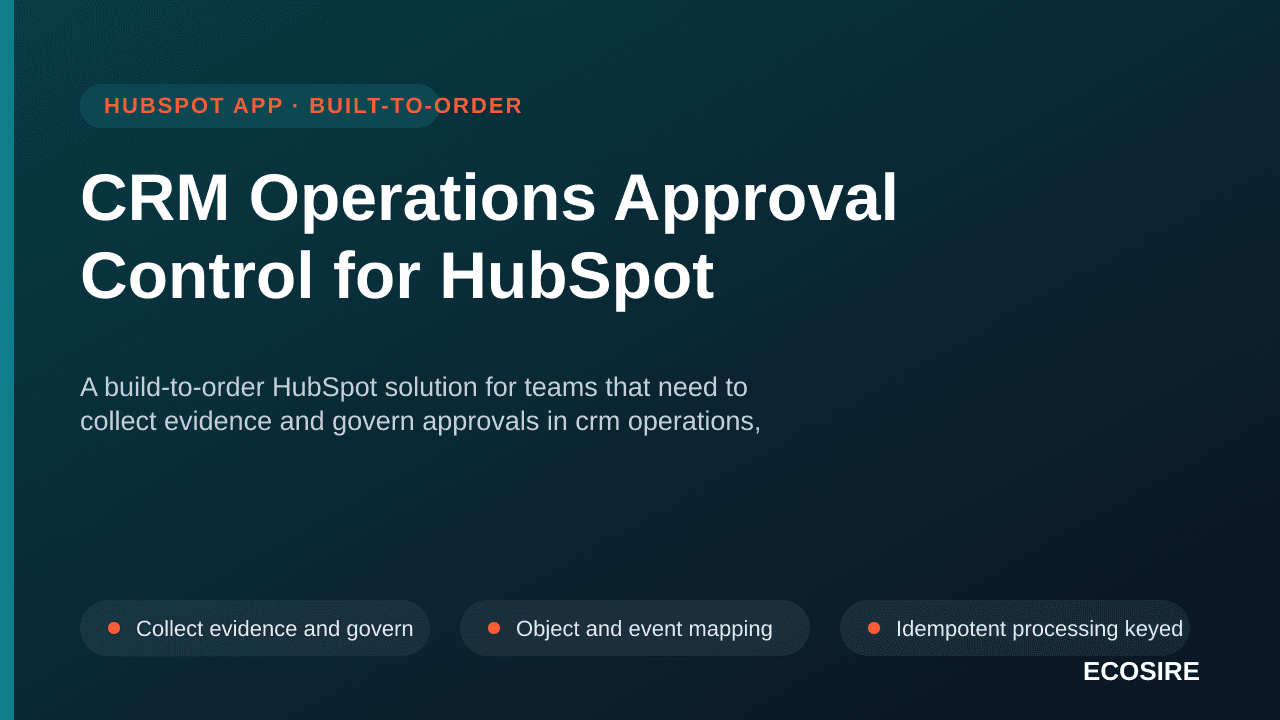 示意预览
示意预览A build-to-order HubSpot solution for teams that need to collect evidence and govern approvals in crm
operations, with idempotent processing, visible exceptions, and reconciliation.
核心功能
Collect evidence and govern approvals through a governed crm operations workflow with explicit intake, decision, write and closure states.
Object and event mapping from crm.approve.requested across contact, company and association to crm.approve.recorded, documented against the approved business rules.
Idempotent processing keyed by hubspot-crm-approve:source-id:revision, retaining the source revision and resulting target identifier.
Approval Control exception handling that separates authentication, validation, mapping, throttling and downstream rule failures.
A crm operations reconciliation view with guarded replay, operator notes and correlated audit evidence.
Secret-safe diagnostics carrying correlation ID, decision, error code and processing state.
HubSpot OAuth requests only the granular CRM, webhook, workflow or settings scopes required for contact, company and association.
CRM Objects and Associations APIs preserve object identifiers and association labels across the crm operations record graph.
Webhook subscriptions validate portal and app context, deduplicate subscription events and acknowledge delivery before asynchronous processing.
Custom workflow actions expose typed input fields and return a correlation reference for approval control execution.
An app settings UI manages mappings and safe operational controls without displaying access tokens or private credentials.
CRM cards provide record-level status and exception context when operators need visibility inside HubSpot.
按需定制,全程代劳
无需自行搭建——由 ECOSIRE 构建、安装并提供支持的可用应用。
- 1
您下单
以一次性构建价格开始。我们在启动时与您共同确定范围。
- 2
我们构建与安装
ECOSIRE 在您的 HubSpot 上构建、配置并安装。
- 3
上线 + 支持
约 2–4 周内上线,并提供上线后的支持期。
关于此产品
A build-to-order HubSpot solution for teams that need to collect evidence and govern approvals in crm operations, with idempotent processing, visible exceptions, and reconciliation.
The buyer job
Compliance operations leads need to collect evidence and govern approvals without losing ownership when records cross system boundaries. This concept starts with the business decision and evidence required at each stage, then maps that intent to supported HubSpot surfaces.
Workflow and object design
Receive a crm operations signal, validate its source and required fields, resolve contact, company and association, apply the approval control decision rules, write the approved state, then record a correlated audit result. The source event is crm.approve.requested; the resulting audit event is crm.approve.recorded. The mapped business surface is contact, company and association.
Technical approach
The scoped design may use OAuth 2.0 authorization, granular app scopes, CRM Objects APIs, associations APIs, webhook subscriptions, custom workflow actions, app settings UI. Authentication is based on HubSpot OAuth with only the CRM, webhook, workflow, or settings scopes confirmed in discovery. The implementation accounts for HubSpot per-app request limits, search limits and webhook retry behavior.
Failure and reconciliation design
Every request uses the idempotency key hubspot-crm-approve:source-id:revision. Retryable transport and throttle responses enter bounded backoff; validation and mapping failures enter a visible exception queue. A reconciliation pass compares source revision, target identifier and recorded state, then permits controlled replay without duplicating the business action.
Build-to-order boundary
This page describes a solution concept, not a prebuilt or immediately available product. Exact fields, actions, interfaces, data retention and acceptance checks are confirmed before a build is authorized.
你得到什么
- HubSpot solution package or source bundle for the scoped extension
- Object, event and field mapping workbook for contact, company and association
- Authentication, scope and connection configuration guide
- Exception taxonomy, retry policy and reconciliation runbook
- Automated checks for happy path, duplicates, invalid input, throttling and replay
- Administrator guide covering configuration, audit evidence and safe disablement
- Build-to-order acceptance checklist tied to the approved scope
这是给谁的
Compliance operations lead
Owns the collect evidence and govern approvals process and needs its decisions, exceptions and audit state represented consistently in HubSpot.
HubSpot administrator
Controls authentication, permissions, configuration and safe promotion while keeping the extension supportable.
Integration support analyst
Investigates correlated failures, runs reconciliation, and replays only the records that are safe to process again.
CRM Operations Approval Control for HubSpot 如何比较
| 标准 | 伊科西尔 | 手动替代方案 |
|---|---|---|
| CRM Operations scope | Build-to-order mapping for contact, company and association | A generic procedure that does not encode the crm operations object model |
| Approval Control decision | Versioned rules and evidence for “collect evidence and govern approvals” | Operator interpretation recorded outside the transaction |
| CRM Operations event | Correlated crm.approve.requested to crm.approve.recorded processing | Periodic manual review without a durable event key |
| Approval Control duplicate control | Persistent key hubspot-crm-approve:source-id:revision | Ad hoc checks against recently processed records |
| CRM Operations failure handling | Typed exception queue governed by HubSpot per-app request limits, search limits and webhook retry behavior | Unstructured notification followed by a manual restart |
| Approval Control reconciliation | Source revision, target identifier and recorded-state comparison | Spot checks across the contact, company and association involved |
| HubSpot change control | Versioned crm operations configuration and documented promotion | Direct configuration edits without a repeatable release record |
关于CRM Operations Approval Control的常见问题
Is CRM Operations Approval Control for HubSpot a prebuilt product?
No. It is a build-to-order concept. ECOSIRE confirms the workflow, objects, permissions and acceptance criteria before implementation.
How are duplicate events prevented?
The design persists a source identifier and revision under a deterministic idempotency key, then checks the audit record before any repeat write.
What happens when a request is throttled?
Throttle responses are separated from permanent failures and retried with bounded backoff designed around the platform limits in your environment.
How are failed records reconciled?
A reconciliation view compares the source revision, target identifier and recorded state. Operators can correct mappings and use guarded replay.
Which permissions are required?
Only the OAuth scopes, permission sets, roles or connections required for the confirmed objects and actions are included in the design.
Can the operator interface match our process?
Yes. The scoped operator experience can use an app settings page, CRM card, or workflow-action configuration panel selected during scoping when the approved user journey requires it.
相关模块
按单定制
按单定制
按单定制

申请报价
CRM Operations Approval Control
A build-to-order HubSpot solution for teams that need to collect evidence and govern approvals in crm operations, with idempotent processing, visible exceptions, and reconciliation.
- Collect evidence and govern approvals through a governed crm operations workflow with explicit intake, decision, write and closure states.
- Object and event mapping from crm.approve.requested across contact, company and association to crm.approve.recorded, documented against the approved business rules.
- Idempotent processing keyed by hubspot-crm-approve:source-id:revision, retaining the source revision and resulting target identifier.
- Approval Control exception handling that separates authentication, validation, mapping, throttling and downstream rule failures.