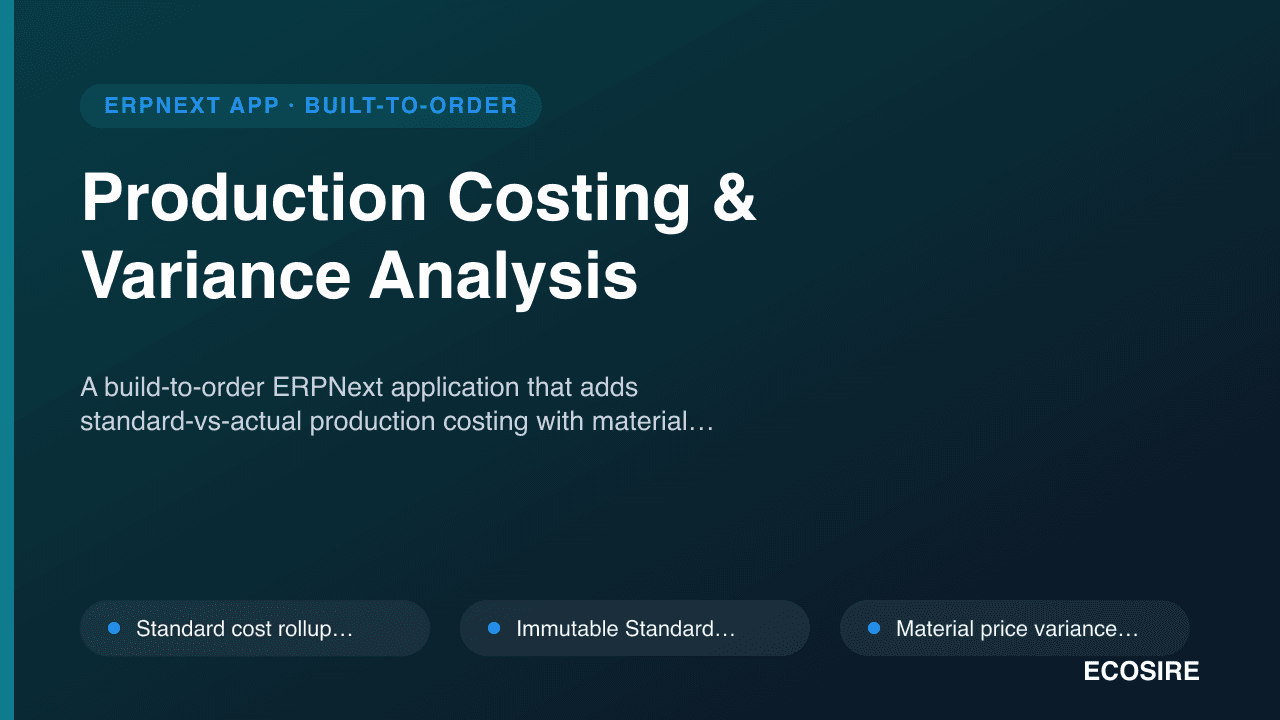
 示意预览
示意预览A build-to-order ERPNext application that adds standard-vs-actual production costing with material,
labor, overhead, and scrap variance analysis drilling down to the work order and job card. Scoped, built, installed, and supported by ECOSIRE.
什么是 Production Costing & Variance Analysis?
A build-to-order ERPNext application that adds standard-vs-actual production costing with material, labor, overhead, and scrap variance analysis drilling down to the work order and job card. Scoped, built, installed, and supported by ECOSIRE. Built to order by ECOSIRE for ERPNext v15, v16 — indicative price from $999.00 USD; request a quote for a scoped proposal.
核心功能
按需定制,全程代劳
无需自行搭建——由 ECOSIRE 构建、安装并提供支持的可用应用。
- 1
您下单
以一次性构建价格开始。我们在启动时与您共同确定范围。
- 2
我们构建与安装
ECOSIRE 在您的 ERPNext 上构建、配置并安装。
- 3
上线 + 支持
约一个工作周内上线,并包含两周上线支持。我们交付的代码中的缺陷免费修复。
技术规格
- ERPNext 兼容性
- —
- 许可证
- 许可证需要确认
- Python 要求
- Python 3.10+
- 数据库
- MariaDB 10.6+
关于此产品
Manufacturers running ERPNext get accurate landed costs on finished goods through the Stock Ledger and the Manufacture-type Stock Entry, but they hit a wall when the cost accountant asks the next question: why did this batch cost more than it should have? ERPNext core computes an actual cost per Work Order from consumed materials and applied operating costs, but it does not hold a governed standard cost, and it does not decompose the gap between standard and actual into material price, material usage (quantity), labor rate, labor efficiency, overhead absorption, and scrap. Controllers end up exporting Stock Ledger and Job Card rows into spreadsheets every month-end to reconstruct variances by hand — slow, error-prone, and impossible to drill from a P&L number back to the operation that caused it.
ECOSIRE builds a proper Frappe application (its own module, not a pile of customizations) that layers standard costing and variance analysis onto your existing ERPNext manufacturing data. We introduce DocTypes such as Standard Cost Version, Standard Cost Rollup, and Production Variance (with child tables for per-component and per-operation variance lines). A standard cost is rolled up from your multi-level BOM — exploding sub-assemblies, applying frozen material standards, and absorbing operation-level labor and machine-hour rates defined per Workstation and Operation. The rollup runs as a whitelisted server-side method so finance can recost on demand or on a scheduled scheduler_events job, and every version is immutable once approved so you always have an audit trail of what standard was in force.
The variance engine hooks into the manufacturing lifecycle via hooks.py doc events — on Work Order completion and on Stock Entry (Manufacture) submit, a server script captures actual consumed quantities, actual valuation rates, and actual operation time from the linked Job Cards, then computes and posts variance lines: material price variance (actual rate vs standard rate x actual qty), material usage variance (actual qty vs standard qty x standard rate), labor rate and efficiency variance from Job Card time logs against standard run rates, overhead absorption variance, and scrap/rework cost attributed back to the operation and cost center that produced it. Results surface as native ERPNext Query/Script Reports with drill-through from the finished-good SKU down to the Work Order, Job Card, and individual operation, plus role-scoped dashboards for the finance controller. Everything is reachable over the Frappe REST API and whitelisted methods so it can feed Power BI or a data warehouse.
Because this is build-to-order, nothing ships as an instant download. We start with a short scoping call to confirm your BOM structure, how you define standards (frozen annual, quarterly, or moving), your overhead absorption basis, and your v15 or v16 target. We then build against a staging bench that mirrors your data, run UAT with your cost accountant on real work orders, and only cut over to production once the numbers reconcile. Typical delivery is one working week from confirmed scope. You receive the full app source in a git repository, install and configuration on your environment, documentation, a training session, and a post-go-live support window — you own the code and can extend it yourself or have us maintain it.
你得到什么
- Installable source code for your version of the app, delivered as a self-contained Frappe app in its own module
- Installation and configuration on your ERPNext environment (staging first, then production cutover)
- Technical documentation: DocType schema, hooks/doc events, whitelisted methods, scheduler jobs, and variance formulas
- User guide plus a live training session for your cost accountant and finance team
- Post-go-live support window for defect fixes and questions after cutover
- UAT on a staging bench against your real work orders, with a documented rollback plan
- Full git repository handover so you own and can extend the code
- Configuration of standard cost basis, overhead absorption rules, and role/permission profiles to match your accounting policy
这是给谁的
Cost accountant in a discrete manufacturer
Owns the standard cost book and closes manufacturing variances at month-end. Needs standards frozen and auditable, and variances decomposed into price vs usage and rate vs efficiency so they can be explained to management rather than reconstructed in spreadsheets from Stock Ledger exports.
Finance controller / plant controller
Signs off the manufacturing P&L and needs to tie a variance number in the accounts back to the exact work order, operation, and cost center that caused it. Wants role-scoped dashboards and drill-through inside ERPNext instead of chasing the shop floor for explanations.
Manufacturing / operations manager
Accountable for efficiency and scrap on the floor. Uses operation-level labor efficiency and scrap-attribution reporting to see which workstations and job cards are burning cost against standard, and to target continuous-improvement effort where the variance actually is.
ERPNext administrator / systems owner
Maintains the ERPNext instance and cares about a clean, upgrade-safe app in its own module with documented hooks and whitelisted methods on v15/v16 — not tangled core patches. Wants the git repo, the schema docs, and the ability to extend or hand it to another team later.
Production Costing & Variance Analysis 如何比较
| 标准 | 伊科西尔 | 定制建造 | 竞争对手 | ERPNext 原生 |
|---|---|---|---|---|
| Standard vs actual variance | Full decomposition: material price/usage, labor rate/efficiency, overhead, scrap | Whatever you spec and can build in-house | Often actual-cost reporting only, limited variance breakdown | Actual cost per Work Order; no governed standard, no variance split |
| Standard cost governance | Immutable, versioned standards frozen on approval with audit trail | Depends on your build discipline | Rarely versioned; often a single editable field | No dedicated standard cost book |
| Drill-down granularity | SKU to Work Order to Job Card to individual operation | Buildable but costly to get right | Usually stops at work order or item level | Work Order and Stock Ledger level |
| Scrap and rework attribution | Traced to the causing operation and cost center | Possible with significant effort | Typically lumped, not operation-attributed | Scrap valued but not attributed as variance |
| Fit to your policy | Scoped to your BOM, standard basis, and overhead rules | Fully bespoke | Fixed template, configure within limits | Generic ERPNext costing only |
| Upgrade safety (v15/v16) | Own module via hooks/whitelisted methods, no core patch | Risk of core patches and drift if rushed | Varies by vendor quality | N/A — is core |
| Ownership & extensibility | Full git repo handover, you own the source | You own it, you build it all | Usually licensed, closed or restricted | N/A |
| Time to value | one working week build-to-order, UAT on staging first | Months, plus hiring/ramp risk | Instant install but generic fit, then customization | Immediate but the capability gap remains |
关于Production Costing & Variance Analysis的常见问题
How long does delivery take?
This is a build-to-order application, so there is no instant download. Typical delivery is one working week from confirmed scope. We start with a scoping call, build against a staging bench that mirrors your data, run UAT with your cost accountant, and cut over to production once the variance numbers reconcile. The exact timeline depends on your BOM complexity, how you define standards, and your overhead absorption rules.
How does the standard cost actually get calculated?
We roll the standard up from your multi-level ERPNext BOM. Sub-assemblies are exploded, frozen material standards are applied to each component, and operation-level labor and machine-hour rates (keyed to your Workstation and Operation masters) are absorbed to build a fully-loaded standard cost per finished good. The rollup runs as a whitelisted server-side method, so finance can recost on demand or on a scheduled job, and each approved standard is frozen as an immutable version for audit.
Which variances does it compute, and where do they come from?
Material price variance (actual valuation rate vs standard x actual qty), material usage variance (actual qty vs BOM standard x standard rate), labor rate and efficiency variance from Job Card time logs, overhead absorption variance, and scrap/rework cost attributed to the causing operation and cost center. Actuals are captured automatically via `hooks.py` doc events on Work Order completion and Manufacture Stock Entry submit, so there is no manual month-end export.
Does this work with our ERPNext version and does it patch core?
It targets Frappe/ERPNext v15 and v16 and ships as a self-contained Frappe app in its own module. It does not fork or patch ERPNext core — it integrates through documented `hooks.py` doc events, whitelisted server methods, scheduler events, and client scripts, which keeps your instance upgrade-safe. Confirm your exact version on the scoping call and we build against it.
How does support and updates work after go-live?
Every build includes a post-go-live support window for defect fixes and questions. Because you receive the full git repository and own the source, your own team can extend or maintain it. Beyond the included window we offer ongoing support and enhancement retainers, including compatibility work when you upgrade ERPNext to a new major version.
Can we get the variance data into Power BI or another BI tool?
Yes. Standard costs and variances are exposed over the Frappe REST API and whitelisted methods, and surface as native Script/Query Reports inside ERPNext. That lets you feed Power BI, a data warehouse, or scheduled extracts without scraping the desk UI. We can configure the endpoints and role permissions for your BI service account as part of delivery.
What if our costing policy is unusual (moving standards, non-standard overhead basis)?
The scoping call exists for exactly this. We support frozen annual/quarterly standards or moving standards, and configurable overhead absorption bases (labor hours, machine hours, or a custom driver). We tailor the rollup and variance formulas to your accounting policy rather than forcing you into a fixed template, and document the chosen logic in the technical handover.
相关模块
Production Costing & Variance Analysis
A build-to-order ERPNext application that adds standard-vs-actual production costing with material, labor, overhead, and scrap variance analysis drilling down to the work order and job card. Scoped, built, installed, and supported by ECOSIRE.
- Standard cost rollup that explodes a multi-level BOM, applying frozen material standards plus operation labor and machine-hour rates to produce a fully-loaded standard cost per finished good and sub-assembly
- Immutable `Standard Cost Version` DocType so an approved standard is frozen and auditable; recosting mints a new version rather than overwriting history
- Material price variance (actual valuation rate vs standard rate x actual quantity) posted per component from the Manufacture Stock Entry
- Material usage/quantity variance (actual consumed qty vs BOM standard qty x standard rate) attributed to the Work Order and BOM line