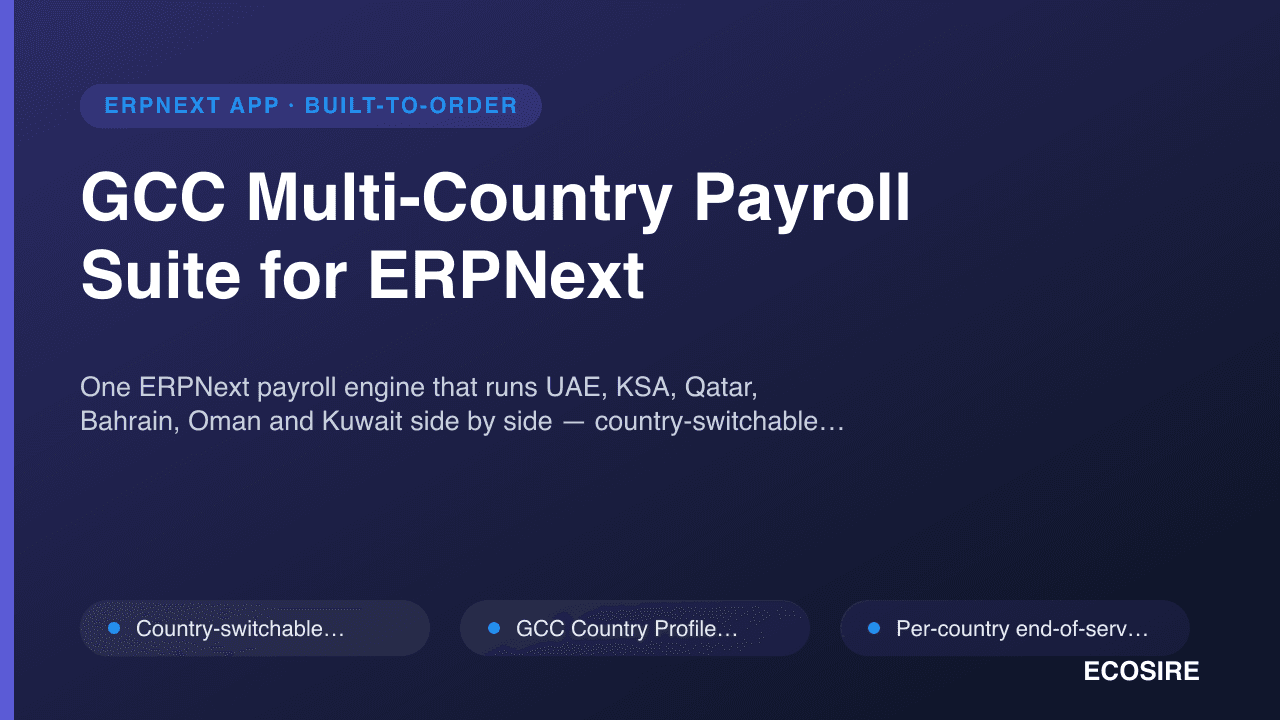
 示意预览
示意预览One ERPNext payroll engine that runs UAE, KSA, Qatar, Bahrain, Oman and Kuwait side by side
— country-switchable WPS/SIF generation, per-jurisdiction gratuity and social-insurance rules, and unified multi-entity reporting. Build-to-order:
ECOSIRE scopes, builds, installs and supports it.
什么是 GCC Multi-Country Payroll Suite for ERPNext?
One ERPNext payroll engine that runs UAE, KSA, Qatar, Bahrain, Oman and Kuwait side by side — country-switchable WPS/SIF generation, per-jurisdiction gratuity and social-insurance rules, and unified multi-entity reporting. Build-to-order: ECOSIRE scopes, builds, installs and supports it. Built to order by ECOSIRE for ERPNext v15, v16 — indicative price from $999.00 USD; request a quote for a scoped proposal.
核心功能
按需定制,全程代劳
无需自行搭建——由 ECOSIRE 构建、安装并提供支持的可用应用。
- 1
您下单
以一次性构建价格开始。我们在启动时与您共同确定范围。
- 2
我们构建与安装
ECOSIRE 在您的 ERPNext 上构建、配置并安装。
- 3
上线 + 支持
约一个工作周内上线,并包含两周上线支持。我们交付的代码中的缺陷免费修复。
技术规格
- ERPNext 兼容性
- —
- 许可证
- 许可证需要确认
- Python 要求
- Python 3.10+
- 数据库
- MariaDB 10.6+
关于此产品
Groups running staff across two or more GCC countries hit the same wall in ERPNext: standard HR & Payroll handles Salary Structures, Salary Slips and Payroll Entry well, but it has no concept of a country's Wage Protection System file, a KSA GOSI contribution split, or the divergent end-of-service gratuity math that UAE, Qatar, Oman, Bahrain and Kuwait each define differently. Teams end up running one ERPNext company per country with copy-pasted Salary Components, exporting to spreadsheets to build WPS/SIF banking files by hand, and reconciling six sets of statutory rules every month. A single wrong field in a fixed-width WPS file gets the whole batch rejected by the bank, and a miscalculated gratuity accrual becomes a real liability at settlement.
The GCC Multi-Country Payroll Suite is a proper Frappe app — its own module, DocTypes, hooks.py, fixtures and role profiles — that layers a jurisdiction engine on top of ERPNext's native payroll rather than replacing it. A GCC Country Profile DocType holds each state's rule set: the WPS/SIF file format and field map, employer/employee social-insurance rates (GOSI in KSA, GPSSA/pension in the UAE, PIFSS in Kuwait, PASI in Oman, and so on), gratuity accrual bands, and rounding. Adding or amending a country becomes configuration, not a code change. Each legal entity is tagged with its country profile, so the same instance can process a KSA company and a UAE company from one Payroll Entry run without cross-contamination of rules.
Technically, the suite hooks ERPNext's payroll lifecycle with doc_events on Salary Slip and Payroll Entry: server-side controllers compute the correct social-insurance and gratuity lines against the entity's profile and write them back as Salary Components, so the native Salary Slip stays the source of truth and existing reports keep working. A WPS File Generation DocType produces the country-specific bank file (fixed-width SIF for the UAE, the KSA WPS layout, Qatar/Bahrain/Oman/Kuwait variants) with validation that catches malformed IBANs, establishment IDs and totals before you ever hand the file to a bank. Whitelisted methods exposed over the Frappe REST API let an outsourced provider trigger generation and pull status programmatically; scheduler events (scheduler_events in hooks.py) post monthly gratuity accruals and flag employees approaching a statutory threshold. Client Scripts add country-aware UI on the Salary Structure and Employee forms, and everything is gated behind dedicated roles and permission profiles so a payroll clerk for one country cannot see another's data. It targets Frappe/ERPNext v15 and v16.
Because this is build-to-order, we do not hand you a generic download. ECOSIRE starts with a scoping call to confirm exactly which of the six countries you run, your bank/WPS agent formats, your entity structure and any local variations, then builds and configures the suite against your ERPNext instance. Typical delivery is one working week from confirmed scope. You get the version we built for you as installable source in a git repository, UAT on a staging site with a documented rollback plan, and a post-go-live support window — no fabricated benchmarks, just a working payroll engine tuned to your actual jurisdictions.
你得到什么
- Installable source code for the version we build for you, delivered as a Frappe app (module, DocTypes, hooks.py, fixtures, role profiles)
- Installation and configuration on your ERPNext instance, including country profiles for the GCC states you actually run
- Technical documentation: DocType reference, hook/event map, WPS field mappings per country and REST API method list
- End-user guide plus a live training session for your payroll and HR team
- UAT on a staging site with sample runs, plus a documented rollback plan before production go-live
- Post-go-live support window for defect fixes and configuration adjustments
- Git repository handover with full commit history and versioned tags
- Sample WPS/SIF output files validated against your bank/WPS agent format for sign-off
这是给谁的
Group Payroll Manager, multi-country GCC holding
Runs staff across two or more GCC states from one ERPNext instance and is tired of separate spreadsheets, separate WPS uploads and separate gratuity rules per country. Needs one payroll run, one consolidated report and correct statutory files every month.
Outsourced payroll / BPO provider on ERPNext
Processes payroll for many client entities across the GCC and needs a repeatable, API-drivable engine that switches WPS format and social-insurance rules by client jurisdiction, with hard data isolation between clients.
HR & Finance Director scaling into new GCC markets
Expanding from one country into KSA or the UAE and needs end-of-service liability, GOSI/pension contributions and WPS compliance handled inside the existing ERPNext, without standing up a second system per market.
ERPNext implementation partner / systems integrator
Delivering ERPNext to a regional client and needs a proven GCC payroll layer to slot in, with source, docs and a migration path for v15/v16 rather than rebuilding jurisdiction logic from scratch.
GCC Multi-Country Payroll Suite for ERPNext 如何比较
| 标准 | 伊科西尔 | 定制建造 | 竞争对手 | ERPNext 原生 |
|---|---|---|---|---|
| Multi-country coverage | All six GCC states in one app, switchable per entity | Whatever you scope and build in-house | Usually single-country (UAE or KSA only) | No GCC-specific payroll concepts at all |
| WPS/SIF file generation | Per-country generators with pre-submission validation | Hand-built per country, you own the edge cases | Often one country's format, limited validation | None — manual export and spreadsheet assembly |
| End-of-service gratuity | Distinct accrual/settlement math per jurisdiction | Coded once per rule set you commission | Single-country logic, if included | No built-in GCC gratuity rules |
| Social insurance (GOSI/GPSSA/PIFSS/PASI) | Per-country engines split into employer/employee lines | Built to your spec, maintained by you | Typically one scheme covered | Not modeled |
| Delivery model | Build-to-order, one working week from confirmed scope | Months of internal dev and testing | Instant download, generic fit | Already installed, but gaps remain |
| Source & ownership | Full source in a git repo handed over | You own it outright | Often closed or license-locked | Open source but no GCC layer |
| Support & rule updates | Post-go-live window plus scoped rule updates | Entirely your team's burden | Vendor SLA varies, roadmap not yours | Community support only |
| Multi-entity reporting | Consolidated GCC report with per-country drill-down | Reports you build yourself | Per-company, rarely consolidated | Per-company standard reports only |
关于GCC Multi-Country Payroll Suite的常见问题
How long does delivery take?
This is a build-to-order product, not an instant download. Typical delivery is one working week from confirmed scope. The timeline depends on how many of the six GCC countries you run, your bank/WPS agent file formats and your entity structure — all confirmed on the initial scoping call before any build work starts.
Which GCC countries are covered?
UAE, KSA, Qatar, Bahrain, Oman and Kuwait. Each is a `GCC Country Profile` carrying that state's WPS/SIF format, social-insurance rules (GOSI, GPSSA, PIFSS, PASI and the Bahrain/Qatar equivalents) and end-of-service gratuity math. We build and configure the countries you actually operate; more can be added later as configuration.
How does this handle support and updates after go-live?
Every engagement includes a post-go-live support window for defect fixes and configuration adjustments. You receive the full source in a git repository, so your own team can maintain it too. Because statutory rates and WPS formats change, rule updates for a new period or a changed bank format are handled as a scoped configuration or support task.
Does it replace ERPNext's native payroll?
No. It layers on top of ERPNext's standard HR & Payroll using `doc_events` hooks. Native Salary Structures, Salary Slips and Payroll Entry stay the source of truth; the suite computes the statutory social-insurance and gratuity lines and writes them back as Salary Components, so your existing payroll reports and workflows keep working.
Which ERPNext versions are supported?
Frappe/ERPNext v15 and v16. We confirm your exact version on the scoping call and build against it, with clean bench install and migration hooks. If you are on an older version, we will advise on the upgrade path as part of scoping.
Can our outsourced payroll team trigger it programmatically?
Yes. The suite exposes whitelisted methods over the Frappe REST API to trigger WPS/SIF generation and pull run status, and role/permission profiles isolate each entity's data. That makes it workable for BPO providers processing many client companies from one instance.
Will the WPS files be accepted by our bank?
The generator produces the country-specific format and validates IBANs, establishment/employer IDs and control totals before output. During UAT we validate sample files against your specific bank or WPS agent format and get your sign-off before go-live, so rejections are caught on staging rather than in production.
相关模块
GCC Multi-Country Payroll Suite
One ERPNext payroll engine that runs UAE, KSA, Qatar, Bahrain, Oman and Kuwait side by side — country-switchable WPS/SIF generation, per-jurisdiction gratuity and social-insurance rules, and unified multi-entity reporting. Build-to-order: ECOSIRE scopes, builds, installs and supports it.
- Country-switchable WPS/SIF file generators — fixed-width UAE SIF plus KSA, Qatar, Bahrain, Oman and Kuwait bank layouts driven by a per-country field map
- `GCC Country Profile` DocType storing each jurisdiction's WPS format, contribution rates, gratuity bands and rounding as configuration, not code
- Per-country end-of-service gratuity engine — separate accrual and settlement math for each GCC state, with limited vs. unlimited contract handling where applicable
- Social-insurance engines per jurisdiction: GOSI (KSA), GPSSA/pension (UAE), PIFSS (Kuwait), PASI (Oman) and Bahrain/Qatar equivalents, split into employer and employee lines