 Beispielhafte Vorschau
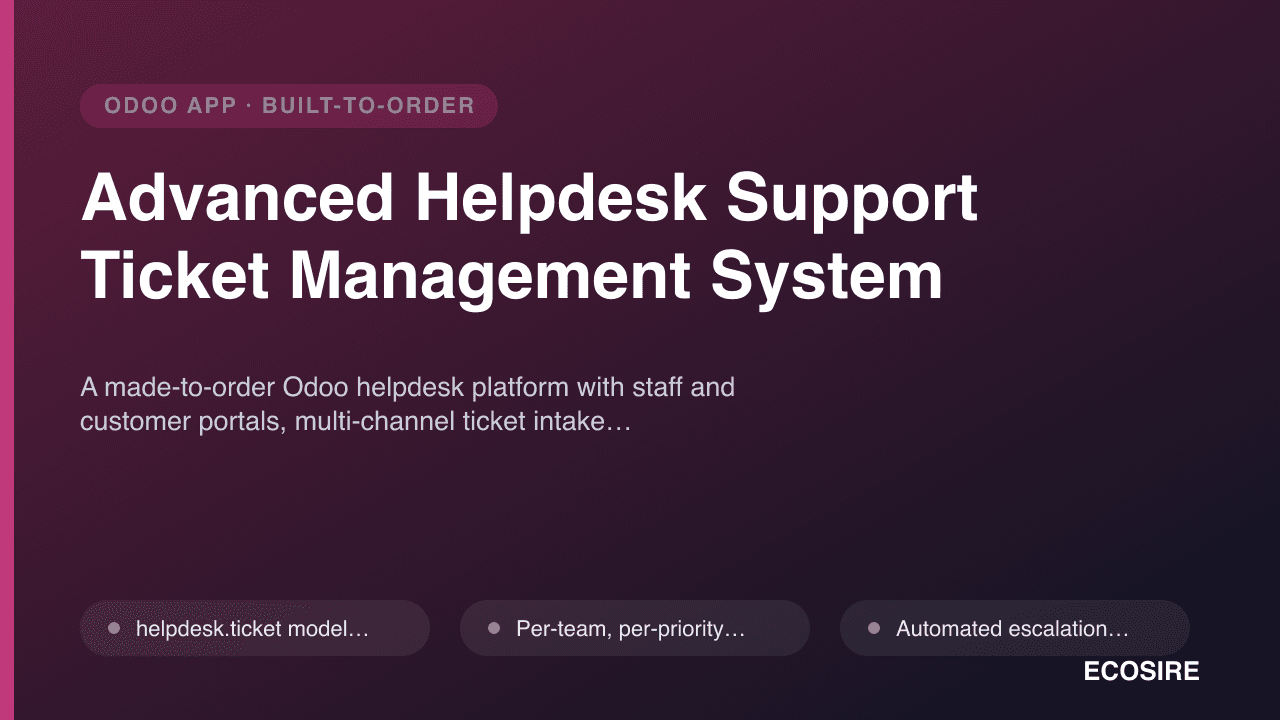
A made-to-order Odoo helpdesk platform with staff and customer portals,
multi-channel ticket intake, policy-driven SLA tracking, and automated escalation workflows.
ECOSIRE builds, installs, and supports it against your exact support process.
Was ist Advanced Helpdesk Support Ticket Management System?
A made-to-order Odoo helpdesk platform with staff and customer portals, multi-channel ticket intake, policy-driven SLA tracking, and automated escalation workflows. ECOSIRE builds, installs, and supports it against your exact support process. Built to order by ECOSIRE for Odoo 17, 18, 19 — indicative price from $999.00 USD; request a quote for a scoped proposal.
Hauptfunktionen
Auf Bestellung gebaut, komplett für Sie erledigt
Keine Selbsteinrichtung — eine funktionierende App, die von ECOSIRE erstellt, installiert und betreut wird.
- 1
Sie bestellen
Starten Sie mit einem einmaligen Entwicklungspreis. Den Umfang legen wir beim Kickoff gemeinsam fest.
- 2
Wir bauen & installieren
ECOSIRE erstellt, konfiguriert und installiert sie auf Ihrem Odoo.
- 3
Go-live + Support
Sie gehen in etwa einer Arbeitswoche live, mit zwei Wochen Go-live-Support. Fehler im von uns gelieferten Code beheben wir kostenlos.
Technische Spezifikationen
- Odoo-Kompatibilität
- Odoo 17, Odoo 18, Odoo 19
- Editionen
- Enterprise und Community
- Lizenz
- Lizenz muss bestätigt werden
- Python-Anforderung
- Python 3.10+
- Datenbank
- PostgreSQL 12+
Über dieses Produkt
Support teams running Odoo usually start with email, a shared inbox, and a spreadsheet — then hit a wall. Tickets get lost between agents, response-time promises made in contracts go untracked, and customers have no self-service window into their own requests. Odoo Community ships no helpdesk at all, and while the Enterprise Helpdesk app covers the basics, teams quickly outgrow its fixed SLA model, its single-portal assumptions, and its limited automation once real support operations — tiered teams, contractual response windows, multi-channel intake, and customer-visible progress — enter the picture. Bending native views and stage flows to fit a mature process tends to produce brittle Studio customizations that break on the next upgrade.
We build a dedicated helpdesk module tailored to how your team actually works. At its core is a helpdesk.ticket model (with supporting helpdesk.team, helpdesk.sla, and helpdesk.stage models) carrying compute/@api.depends fields for live SLA deadlines, first-response and resolution timers, and breach flags. Tickets are scoped and secured through ir.model.access.csv plus record rules, so agents see their team's queue, customers see only their own tickets through the portal, and managers get the full picture. The staff side is delivered as kanban, list, and form views (XML, with OWL components where an interactive widget earns its place); the customer side is a QWeb-rendered portal where authenticated contacts open, track, comment on, and reopen tickets. Multi-channel intake — inbound email aliases, a website form, and the XML-RPC/JSON-RPC API for integrations — funnels every request into one normalized queue, with deduplication against existing threads.
Automation is where the platform pays off. SLA policies are defined per team and priority, with business-hours-aware deadline computation driven by resource.calendar, automatic escalation via server actions and ir.cron jobs when a timer approaches breach, and templated auto-responses on creation and stage change. Automated actions handle round-robin or load-balanced assignment, priority re-rating, and stage transitions, while every SLA outcome is logged for reporting. QWeb PDF reports and dashboards surface volume, backlog aging, breach rates, and per-agent throughput so support becomes measurable rather than anecdotal. Everything targets Odoo 17.0, 18.0, and 19.0, and we build cleanly against Community or Enterprise depending on your edition.
Because this is build-to-order, delivery follows a defined path: a scoping call to pin down your teams, SLA rules, channels, and portal requirements; a written scope and fixed quote; development on a staging instance; UAT with your team; then go-live with a rollback plan and a support window. Typical delivery is one working week from confirmed scope. Pricing starts from $999 (indicative, single-company base scope); multi-company routing, additional intake channels or third-party integrations, localization depth, and historical ticket data migration increase the quoted scope.
Was Sie bekommen
- Installable source code for your Odoo version (17.0, 18.0, or 19.0), edition-matched to Community or Enterprise
- Installation and configuration on your instance, including SLA policies, teams, stages, and portal setup
- Technical documentation covering models, fields, security rules, automated actions, and integration endpoints
- End-user guide plus a live training session for agents and managers
- UAT on a staging instance with a documented sign-off and a rollback plan before go-live
- Post-go-live support window for defect fixes and configuration adjustments
- Git repository handover with full commit history and tagged release
- Configuration workbook capturing your SLA rules, escalation matrix, and channel mappings
Für wen das ist
Support Operations Manager
Runs a growing service desk on Odoo and needs contractual SLA response/resolution windows tracked and reported automatically, instead of manually policing a shared inbox and hoping nothing slips.
IT / Systems Lead
Owns the Odoo instance and wants a clean, upgrade-safe module with proper access controls and API endpoints, not a stack of fragile Studio tweaks that break on the next version bump.
Customer Success / Account Lead
Wants clients to have a branded self-service portal to raise and follow their own tickets, reducing status-chasing emails and giving customers visibility into progress and resolution.
Managed Service Provider
Supports multiple client accounts and needs team-based routing, per-client SLA tiers, and multi-channel intake unified into one measurable queue with per-agent throughput reporting.
Wie Advanced Helpdesk Support Ticket Management System im Vergleich abschneidet
| Kriterium | ECOSIRE | Benutzerdefinierter Build | Konkurrent | Odoo nativ |
|---|---|---|---|---|
| Fit to your support process | Built to your exact teams, SLA rules, and channels | Fully bespoke but you own all design decisions | Fixed feature set, bend your process to fit it | Basic ticketing only, no support process modeling |
| SLA & escalation | Business-hours-aware policies, cron escalation, breach logging | Whatever you build and test yourself | Simple SLA timers, limited escalation rules | Minimal SLA on Enterprise, none on Community |
| Customer portal | Branded QWeb self-service portal, record-rule isolated | Possible, but a large build effort on your side | Generic portal if included at all | Limited or no customer-facing portal |
| Multi-channel intake | Email, website form, and API unified with dedup | Each channel wired up by hand | Often email-only or one extra channel | Email alias only |
| Upgrade safety | Clean module, version-targeted, git handover | Depends entirely on your engineering discipline | Tied to the vendor's own upgrade cadence | Studio tweaks break on version bumps |
| Cost model | From $999 indicative, fixed quote after scoping | Open-ended dev time and internal cost | Low upfront, but limited and rigid | Included, but capability-limited |
| Support & ownership | Post-go-live support window plus repo handover | You maintain it entirely | Vendor support, no source ownership | Standard Odoo support only |
| Reporting | QWeb reports and dashboards for backlog, breach, throughput | Build every report yourself | Basic canned reports | Generic list/pivot views only |
Häufig gestellte Fragen zu Advanced Helpdesk Support Ticket Management System
How long does delivery take?
This is a build-to-order module, not an instant download. Typical delivery is one working week from confirmed scope. The timeline starts once we've completed the scoping call, agreed the SLA rules, channels, and portal requirements in writing, and you've approved the fixed quote. Larger scopes — multi-company, heavy data migration, or several integrations — sit at the longer end.
How does pricing and scoping work?
Pricing starts from $999, which is indicative for a single-company base scope. We run a short scoping call to understand your teams, SLA policies, intake channels, and portal needs, then issue a fixed written quote before any development begins. Drivers like multi-company routing, extra integrations, localization depth, and historical ticket data migration increase the quoted scope — you approve the final number up front.
What do I get for support and updates after go-live?
Every build includes a post-go-live support window for defect fixes and configuration adjustments, plus a git repository handover so you own the code. Because we build against a specific Odoo version, version upgrades (for example moving from 17.0 to 18.0) and new feature work are scoped separately — we're happy to quote ongoing maintenance or an upgrade path when you need it.
Does this work on Odoo Community or only Enterprise?
Both. Odoo Community ships no helpdesk, so on Community we build the full ticketing platform from the ground up. On Enterprise we can extend or replace the native Helpdesk app depending on how far your requirements exceed it. We confirm your edition during scoping and build the module to match, targeting Odoo 17.0, 18.0, or 19.0.
Can it integrate with our email, website, and other systems?
Yes. Multi-channel intake covers inbound email aliases and a website form out of the base scope, and the module exposes ticket operations over Odoo's `XML-RPC`/`JSON-RPC` API so external systems can create and update tickets. Specific third-party integrations (chat tools, monitoring systems, other CRMs) are scoped and quoted as part of your build.
How are SLAs actually tracked and enforced?
SLA policies are defined per team and priority, with deadlines computed against your business hours using `resource.calendar` so weekends and off-hours don't count against you. Compute fields track first-response and resolution timers live, `ir.cron` jobs and server actions escalate before a breach, and every outcome is logged so you can report met-versus-breached rates for contractual reviews.
Will customers be able to see and manage their own tickets?
Yes. Authenticated portal contacts get a QWeb-rendered self-service portal where they open new tickets, track status, add comments, reopen resolved items, and rate the resolution. Record rules ensure each customer sees only their own tickets, while your agents work the internal kanban and managers see the full queue.
Verwandte Module
Advanced Cash on Delivery (COD) Suite for Odoo
Smart COD for Odoo eCommerce: cart limits, geo-rules, COD fees, OTP verification and prepaid nudges to slash fake orders and RTO losses.
Advanced DMS for Odoo
A build-to-order Odoo document management module with in-browser PDF annotation, full version history, and record-rule-driven access control. ECOSIRE scopes, builds, installs, and supports it — this is not an off-the-shelf download.
Advanced List View Manager
A build-to-order Odoo module that turns standard list views into a power-user workspace: reorderable per-user columns, inline editing, conditional row coloring, saved presets and one-click Excel/CSV export. ECOSIRE builds, installs and supports it on your Odoo 17, 18 or 19.
Advanced MCP Server for Odoo
A build-to-order integration that exposes your live Odoo data and actions to AI assistants through the Model Context Protocol, so teams can query records, generate reports, and trigger workflows in natural language — with Odoo's own access rights and record rules enforced on every call.
Advanced Helpdesk Support Ticket Management System
A made-to-order Odoo helpdesk platform with staff and customer portals, multi-channel ticket intake, policy-driven SLA tracking, and automated escalation workflows. ECOSIRE builds, installs, and supports it against your exact support process.
- `helpdesk.ticket` model with compute/`@api.depends` fields for live first-response and resolution timers, SLA deadlines, and breach flags
- Per-team, per-priority `helpdesk.sla` policies with business-hours-aware deadlines driven by `resource.calendar`
- Automated escalation via `ir.cron` jobs and server actions that fire before an SLA timer breaches
- Customer self-service portal (QWeb) where authenticated contacts open, track, comment on, reopen, and rate their own tickets